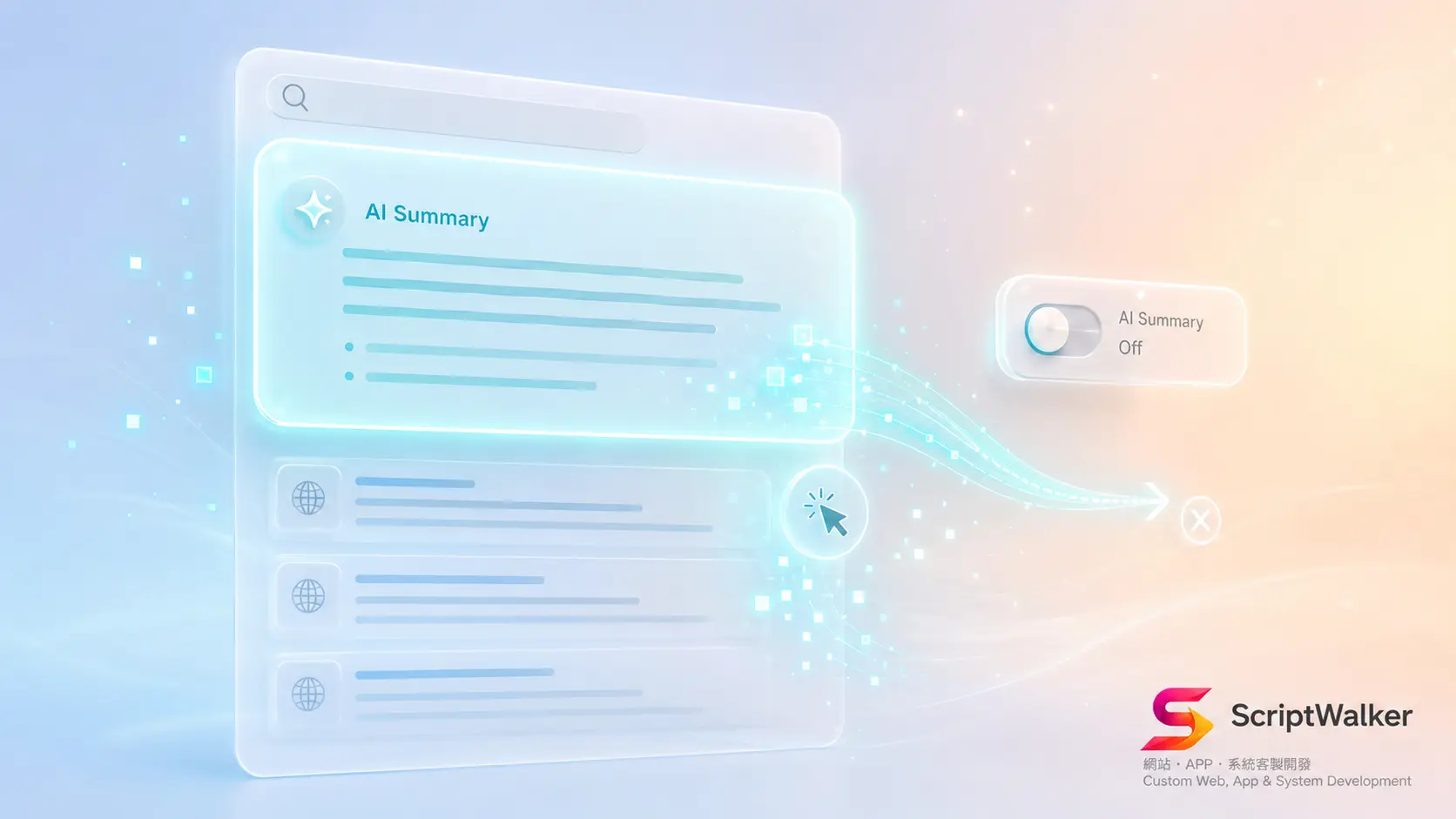
For the past year, how much traffic is the AI summary eating has been a question everyone guessed at and nobody measured cleanly. This summer of 2026, a widely cited field study finally turned it into one clean number: when Google's AI Overviews appear, organic clicks on those queries drop by about 38% — turning the AI Overview off pushes outbound clicks on the same queries from 0.38 per search up to 0.61. Put differently, organic CTR is about 0.61% with an AI Overview present versus 1.62% without — nearly a threefold gap.
Why revisit this now? Because AI Overviews are no longer an experiment; they are the default. Multiple 2026 datasets show AI Overviews now appear on roughly 48% of queries, up about 58% year over year. That means for every two searches your target customer runs, one already opens with an AI-written summary — an answer that often needs no click into any site. The market structure is shifting: the organic-click pie is shrinking while the paid-ads pie grows. Analysis suggests that between 2025 and 2026, organic click share fell 11 to 23 percentage points across verticals, while text ads gained 7 to 13 points in every category.
This is not one isolated study. Line the data up — AIO coverage heading toward 48%, clicks cut 38%, organic share dropping double digits a year — and the direction is consistent: search is shifting from a click economy to zero-click and a citation economy. The old game was who ranks first; the new one is who gets cited into the AI summary and who captures the high-intent traffic among the queries people still click. That is exactly why GEO/AEO tools and AI-visibility monitors have sprung up over the last year or two.
For Taiwanese SMBs, this is very concrete: you may see site traffic fall while sales hold — because a lot of what AI intercepted was research-type clicks that would never have bought. This article unpacks how to read that 38%, which traffic is a real loss, and what SMBs can do today without paying for expensive SaaS.
Event Details and Full Numbers
- Core finding: on queries with AI Overviews, removing the AIO raised outbound organic clicks from 0.38 to 0.61 per search — a roughly 38% cut on triggered queries.
- CTR comparison: organic CTR about 0.61% with AIO present versus 1.62% without (field study reported by Search Engine Journal).
- Coverage: AI Overviews now on about 48% of queries, up about 58% YoY.
- Structural shift: 2025 to 2026, organic click share down 11 to 23 points across verticals; text ads up 7 to 13 points.
- Winners and losers: content sites monetizing informational long-tail traffic get hit; brand terms, local businesses, and transactional-intent queries are relatively resilient.
A caveat: this is the drop on AIO-triggered queries, not a 38% cut to your whole site. The real move is to split clicks and the sales quality of those clicks into two separate KPIs — a consensus among practitioners heading into the second half of 2026.
Immediate Actions for Three Reader Types
- Brand owners / SMBs: do not stare at total traffic. In Google Search Console, split queries into brand vs generic and informational vs transactional to see where the drop is — if it is mostly informational long-tail, your sales are less hurt, so pivot to getting cited by AI and holding transactional-term rankings.
- Marketing / SEO operators: restructure content answer-first — 40 to 60 words of conclusion up top, more lists, tables, and FAQ blocks so AI can lift it. Also build citation tracking: weekly, manually ask ChatGPT, Perplexity, and Google AIO your core keywords and log whether you were cited.
- Developers / agencies: fill in structured data (Article, FAQPage, Product), keep Core Web Vitals healthy (LCP is a key metric), and identify AI crawlers in server logs (GPTBot, PerplexityBot, Google-Extended). Package all of it as a deliverable AI-visibility health check.
SaaS Tool Comparison Table
| Tool | Focus | Pricing idea | Best for |
|---|---|---|---|
| Profound | Enterprise AI-visibility / citation tracking | High monthly | Mid-large brands with budget monitoring across AI platforms |
| Bluefish | AEO / brand presence in AI answers | Mid-high monthly | Companies focused on owning AI-answer real estate |
| Evertune | Model-level brand-mention analysis | Mid-high monthly | Brands wanting to know how each model mentions them |
| Scrunch | AI search visibility monitoring | Mid monthly | Growth-stage teams doing GEO tracking |
What They Will Not Tell You
1. Down 38% is not you earn 38% less. Much of what AI intercepts is pure research clicks that were never going to buy. Watching traffic alone scares you; conversion and revenue often look far less grim.
2. GEO tools contradict each other. Different tools use different query sets, model versions, and sampling, so their citation rates rarely reconcile. Treating one tool's number as gospel leads to bad decisions.
The No-SaaS-Subscription SMB Alternative
You do not need to pay for a GEO tool first. An SMB can self-build a good-enough AI-visibility health check: use free Google Search Console to split query intent and drops; each week, in a single Google Sheet, manually ask ChatGPT, Perplexity, and Google AI Overviews 10 to 20 core keywords and log whether and who was cited; add FAQPage/Article structured data to the site; then pull GPTBot, PerplexityBot, and Google-Extended crawl counts from server logs to see if AI is even reading you. Near-zero cost, yet it answers the one question that matters: can AI see me and cite me right now.
My site traffic dropped — should I panic?
Split by intent first. If the drop is informational long-tail while brand and transactional terms hold, usually no panic; if brand and transactional terms are also falling, that is the alarm to act on immediately.
Should I pull content off Google to stop AI free-riding?
Usually not. Pulling it also loses the brand exposure and downstream clicks citations bring. Better to make content easy to cite correctly (sources, data, clear conclusions) and turn being cited into a brand asset.
Are GEO tools worth buying?
Track manually for 4 to 8 weeks first, confirm you truly need scaled cross-platform, cross-keyword monitoring, then pay. At small scale, free tools are enough.
My Take
The mainstream story is AI summaries are killing organic traffic and SEO is done. My read is cooler: what is actually dying is commercially worthless informational clicks, not traffic that converts; over the next 12 months, the winners are not those chasing raw traffic but those shifting budget from buying generic traffic to being cited correctly by AI plus defending transactional-intent terms. For an agency like ScriptWalker, the concrete lesson: stop selling we will boost your rankings — a service AI is diluting — and package AI-visibility health check + structured data + Core Web Vitals + answer-first content rework as a recurring retainer. It is the best wedge to grow a one-off SEO project into a long-term partnership.
Sources
- Search Engine Journal — Study Confirms Google AI Overviews Cut Organic Clicks 38%
- QuickSEO — Google AI Overviews Statistics 2026
- theStacc — Google AI Overviews in 2026: 48% of Searches Have Them
- The Digital Bloom — Organic Traffic Crisis Report, 2026 Update
- Omnibound — Zero-Click Search Statistics 2026