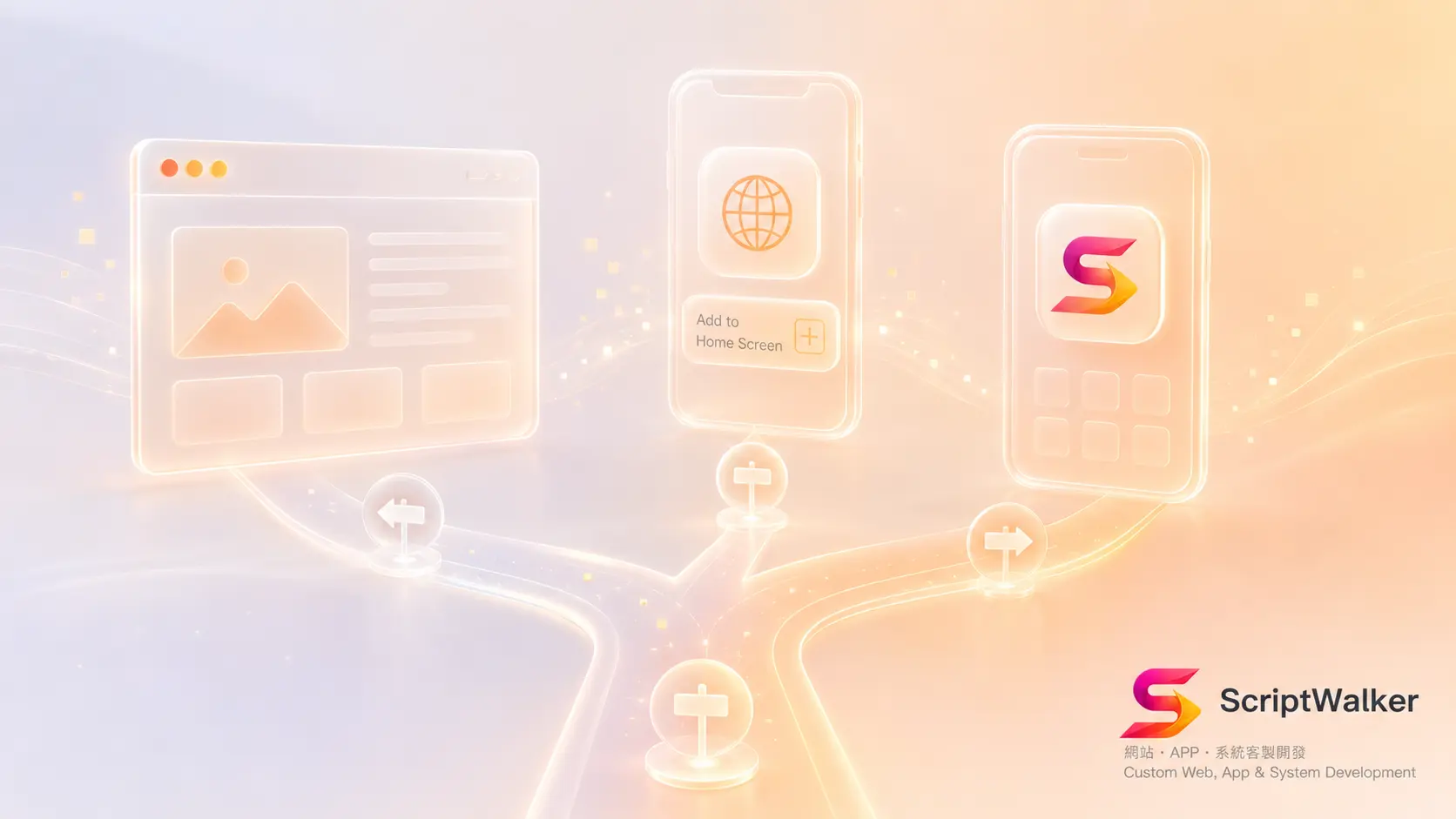
Do I need a website or an app? — one of the most common questions SMB owners ask us, and they often spec it wrong from the first sentence: they budget NT$600K for a native app when all they want is online booking; or the reverse, they cram an offline-scanning, push-notifying floor tool into a plain website and fight it daily after launch. This piece lays out all three paths — responsive website (RWD), Progressive Web App (PWA), and native app — with real costs, fit, and a decision tree, so you choose right before spending.
Fit vs Poor Fit
- Good for responsive website (RWD): businesses centered on being found, being cited by AI, content marketing; catalog, booking, simple payments; limited budget wanting a fast launch.
- Good for PWA: want add-to-home-screen, push, works on weak networks, but do not want App Store cuts and review; e-commerce, content subscriptions, internal tools.
- Good for native app: heavy camera/Bluetooth/NFC/geofencing, silky animation or large offline data, or needing iOS/Android native payment mechanics.
- Poor fit for native app: a catalog updated twice a year, content that lives on SEO, or a sub-NT$300K budget that still wants both platforms — building an app is nearly burning money.
- Poor fit for pure RWD: scenarios needing reliable push, offline operation, or deep hardware integration.
Alternatives Matrix
| Option | Pros | Cons | Cost band (Taiwan) |
|---|---|---|---|
| Responsive website (RWD) | Best SEO/GEO, fastest build, single codebase, no store cut | Weak push, limited hardware | NT$80K-400K |
| PWA | Add-to-home + push + offline, no store cut/review, one code cross-platform | Some iOS capabilities limited, no store discovery | NT$150K-600K |
| Cross-platform native (Flutter) | Near-native feel, one code to both stores, full hardware integration | Higher cost, needs store ops | NT$400K-1.2M |
| Dual native (Swift + Kotlin) | Peak performance and platform features | Priciest, two codebases, double maintenance | NT$1M+ |
For most SMBs, our default: RWD as the base, PWA when you need an app-like experience, and only when you truly hit hardware or store needs, Flutter for one codebase across both platforms — reserving dual-native for the rare few.
Full Process Breakdown (With Tools and Deliverables)
- Phase 1 - needs and selection (3-5 days): clarify the core task and whether you need hardware/push/offline; deliver a three-option trade-off table and decision. Tools: Notion, Figma whiteboard.
- Phase 2 - design (1-2 weeks): information architecture, wireframes, visuals. Deliverable: clickable Figma prototype.
- Phase 3 - build (3-8 weeks by option): front-end framework for RWD/PWA; Flutter for cross-platform app. Deliverable: staging link.
- Phase 4 - integration and testing (1-2 weeks): payments (ECPay/TapPay), push (FCM), analytics (GA4), and UAT. Deliverable: UAT checklist.
- Phase 5 - launch and store submission (3-10 days): deploy site or submit to App Store/Google Play. Deliverable: live/store links and ops docs.
Full Real-Cost Breakdown
- Development: see table (NT$80K-1.2M by option).
- Payment fees: ECPay credit card about 2.75%-3.5%, Stripe about 3.4% + fixed — an ongoing per-transaction cost, do not omit it.
- Store fees: Apple developer US$99/yr, Google Play one-time US$25; in-app purchases also carry a 15%-30% cut.
- Infrastructure: hosting/cloud NT$500-5,000/mo, SSL (mostly free), domain about NT$500/yr.
- Hidden fees: push service, SMS OTP (about NT$1-2 each), third-party APIs, and compatibility maintenance for every OS update after the app ships.
- Ongoing maintenance: budget 15%-20% of dev cost per year for ops and security updates.
Reality vs Client Imagination
- Imagined: build an app and customers will download it. Reality: the bar to install an app is very high; most small-business users would rather use the web, and without a retention plan a downloaded app just sits there.
- Imagined: build the app once and forget it. Reality: iOS/Android update yearly; an unmaintained app gets delisted or crashes.
- Imagined: PWA equals native. Reality: PWA push and some hardware capabilities are still limited on iOS; confirm support for the features you need before choosing.
Common Pitfalls and How to Avoid Them
- Pitfall: demanding dual-native from the start. Fix: ask is there a must-have hardware need; if not, Flutter or PWA halves the cost.
- Pitfall: burying SEO-critical content in an app. Fix: keep content on the website (searchable and AI-citable); only transaction/tool features go in the app.
- Pitfall: ignoring payment cuts. Fix: build the 2.75%-3.5% per transaction into your model, especially for high-frequency small tickets.
- Pitfall: no push or retention plan. Fix: decide why users come back before launch, or the app is a liability.
- Pitfall: underestimating store review time. Fix: App Store review can take several days of back-and-forth; leave buffer around campaigns.
Success Metrics and 90-Day Roadmap
- Day 30: watch core-task completion (booking/order/signup), Core Web Vitals like LCP, crash rate; fix the three biggest friction points.
- Day 60: watch retention (7/30-day return), push open rate, payment success; A/B test key flows.
- Day 90: compute cost per user and payback, then decide which path to double down on (e.g., if PWA performs, hold off on native).
Decision Checklist (RWD / PWA / Native App)
- ☐ Does my core need require camera/Bluetooth/NFC/geofencing?
- ☐ Do I need reliable push notifications?
- ☐ Do I need it to work offline?
- ☐ Does being found by Google/AI matter a lot to me?
- ☐ Can I accept the App Store's 15%-30% cut?
- ☐ Is my budget, including first-year maintenance, over NT$400K?
- ☐ Can I fund yearly OS-compatibility updates for the app?
- ☐ Will my users bother to install an app?
- ☐ Do I need both platforms (iOS + Android) at once?
- ☐ Do I have a clear why-they-come-back retention plan?
More boxes on hardware/push/offline/dual-platform -> lean Flutter native; mainly content/SEO/fast launch -> RWD; want app feel but fear the cut and review -> PWA.
FAQ
Website first or app first?
Nine times out of ten, website first. It is the foundation for being searched, AI-cited, and building trust; decide on an app after you validate demand and have repeat customers — lowest risk.
Can PWA really replace native?
For e-commerce, content, and internal tools, mostly yes; for heavy hardware integration or products needing iOS native payments or game-grade animation, go native.
Does Flutter one-codebase compromise quality?
For most business apps, no — near-native feel at half the cost; only peak-performance or deep platform-feature products need dual-native.
How much maintenance after the app ships?
Budget 15%-20% of dev cost per year, covering OS compatibility, security updates, and small feature iterations.
Call to Action
Still unsure between website, PWA, or app? Tell us your core needs, budget, and timeline, and ScriptWalker will run the decision tree on your actual situation in a free 30-minute technical consult and give you the most cost-effective answer. Website planning from NT$80K; Flutter cross-platform apps from NT$400K.
- Email: [email protected]
- Phone: 0916-224-047
- LINE: @ufv9089p