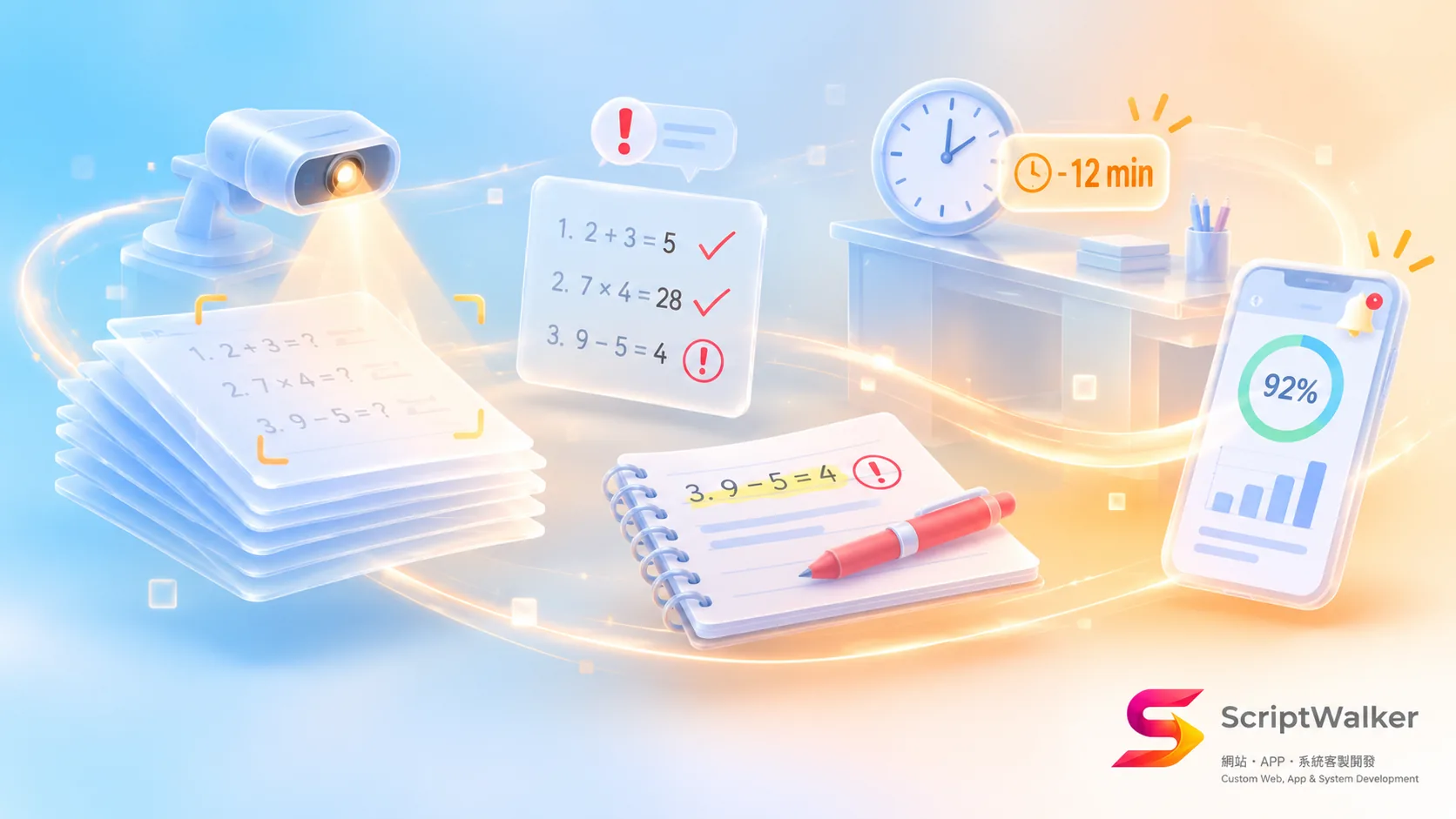
Short answer: Start with homework pre-grading and mistake notebooks. In a 200-student math and science school, letting AI grade multiple-choice and calculation questions while teachers review only flagged items saves 12–16 hours a week; a custom build costs about NT$250K–450K and pays back in roughly 8–18 months.
Where the industry stands
AI is becoming routine in classrooms, but cram schools mostly use it only for enrollment. A 2025 Gallup and Walton Family Foundation survey found about 3 in 10 US teachers use AI weekly, saving 5.9 hours a week, or about six weeks a school year. Homework loads in Taiwanese cram schools are often heavier than in schools; a math teacher grading 150–200 assignments a week is common, which is exactly where AI helps most.
Three typical AI use cases
Grading comes first because it converts directly into teacher hours.
- Homework pre-grading: students upload photos, AI reads answers, grades multiple choice and calculations, and flags items for teachers.
- Automatic mistake notebooks: each student's errors are tagged by unit and concept, and review sheets are generated before exams.
- Parent progress reports: weekly completion, weak units and teacher comments, pushed via LINE.
Real cases
Public education systems have shown that "AI grades first, teachers decide" works; cram schools just run it at smaller scale.
- Taiwan Ministry of Education, Write AI: launched in October 2025 for high-school essays, it scores and comments on an essay in about 15 seconds versus 5–7 minutes by hand. It started with 1,000 Chinese teachers and aims for 10,000+. The ministry stresses it reduces workload rather than replacing teachers.
- Seoul Metropolitan Office of Education, Chaeum AI: an AI system for essay and short-answer grading expanding from 66 to 120 schools in the 2026 school year, adding handwriting recognition with teacher training and on-site support. Year one focused on building the platform and models, a reminder that rollout takes time.
Both share the same pattern: AI gives a first pass, teachers keep the final decision, and both started small.
Recommended tool stack
Off-the-shelf models plus your own workflow are more flexible than an all-in-one "AI tutoring platform."
- Handwriting: OpenAI vision models or the Claude API, which can read working in photos.
- OCR fallback: Google Cloud Vision for printed questions and answer sheets.
- Orchestration: n8n for scheduled grading, notifications and reports.
- Parent messages: LINE Messaging API for weekly reports.
- Back office: Laravel for question banks, classes and mistake data.
ROI model
Teacher hours alone pay for it; retention is a bonus.
| Item | Figure |
|---|---|
| Students / teachers | 200 / 4 |
| Weekly grading hours (before) | About 28 |
| Weekly hours saved | 12–16 |
| Monthly labor saved (NT$500/hour) | About NT$26,000–35,000 |
| Build cost / monthly running cost | NT$250K–450K / NT$3,000–8,000 |
| Payback | About 8–18 months |
If parent reports keep 3 more students per term (NT$5,000 a month each), that adds about NT$180K in revenue a year.
Rollout timeline
About 14 weeks from assessment to full launch.
- Phase 1 (weeks 1–2): collect samples and measure grading hours.
- Phase 2 (weeks 3–6): test accuracy on 100 assignments.
- Phase 3 (weeks 7–10): pilot with one grade and two teachers.
- Phase 4 (weeks 11–14): full launch with mistake notebooks and parent reports.
Common failures and fixes
Failures usually come from process and expectations, not weak models.
- Poor photos: set a photo template and lighting rules; blurry uploads trigger a retake.
- Grading everything at once: start with multiple choice and calculations, then essays once time savings are proven.
- Teacher distrust: during the pilot, teachers compare AI grading with their own to build confidence.
- Mishandled personal data: strip names before model calls and get parental consent under Taiwan's Personal Data Protection Act.
- Messy question banks: without answer and unit tags, mistake notebooks can't classify errors.
Where AI doesn't belong
- Final grades on essays and open-ended answers.
- Counseling on students' emotions and motivation.
- Discussing school choices with parents.
- Small schools under 60 students with light homework.
ScriptWalker's offer
ScriptWalker (a Taiwanese Laravel/Flutter custom development studio) offers a "Cram School AI Homework Grading" package from NT$250K, covering a photo upload app, AI pre-grading, mistake notebooks and LINE parent reports, starting with a 100-assignment accuracy test before full rollout.
FAQ
Is AI grading accurate?
Very accurate for multiple choice and final answers; handwritten working and essays still need teacher review. Let AI pre-grade and flag doubts, then teachers confirm.
How much does AI grading cost for a cram school?
A custom build is about NT$250K–450K and 10–14 weeks, with model and hosting fees of about NT$3,000–8,000 a month depending on volume.
Is student data safe?
It can be. Keep data on your own server, strip names before sending to a model, and confirm in the contract that it isn't used for training.
Does it suit small schools?
Usually not below 60 students. Start with off-the-shelf tools for multiple choice and build a custom system once volume grows.
Checklist and next step
- ☐ More than 100 students?
- ☐ Teachers grade more than 5 hours a week?
- ☐ Half or more of homework is multiple choice or calculation?
- ☐ A digital question bank, or willingness to build one?
- ☐ Students can upload photos by phone?
- ☐ Teachers willing to pilot?
- ☐ Willing to spend 4 weeks testing accuracy?
- ☐ An existing parent channel (LINE)?
Five or more ticks? Bring 20 sample assignments for a free trial grading:
- Email: [email protected]
- Phone: 0916-224-047
- LINE: @ufv9089p