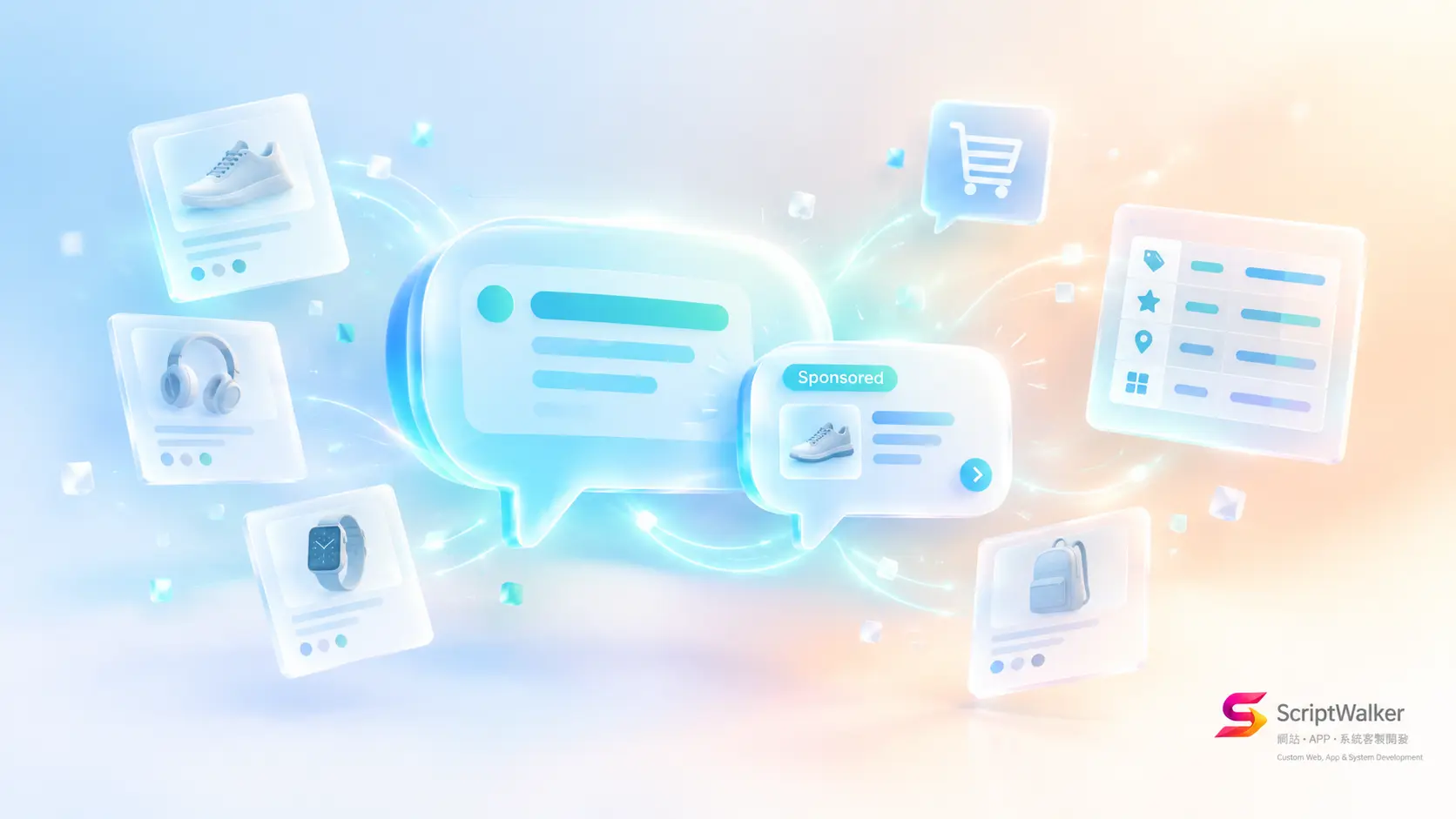
On September 16, 2026, OpenAI published Reimagining advertising with AI and named the next phase of ChatGPT Ads: Sponsored Agents. Click an ad and you are no longer bounced to a landing page — you open a clearly labelled, brand-sponsored conversation, ask whether the table fits your room, and leave for the merchant's site only when you are ready. The same drop added HubSpot (first CRM partner) and Shopify (first ecommerce partner), and the ChatGPT Ads app on the Shopify App Store goes live internationally on September 23 in every market where ChatGPT Ads already runs. The number behind it stings: ChatGPT's ad business crossed a $1 billion annualized run rate in late August, up from $100 million in March.
None of this came out of nowhere. OpenAI only started testing ads in ChatGPT on February 9, 2026, limited to logged-in adults on the Free and Go tiers, with Plus and above ad-free. Canada, Australia and New Zealand followed on March 26; the UK, Mexico, Brazil, Japan and South Korea on August 11. Zero to a $1B run rate in seven months has no precedent in digital advertising. The volume explains it: OpenAI CMO Colin Fleming told AdWeek that ChatGPT now sees more than a billion weekly active users, roughly 20% of them showing commercial intent — about 200 million purchase-adjacent conversations a week. The pressure explains the rest: OpenAI booked close to $10 billion in 2025 revenue against operating losses near $21 billion. Ads are not an option; they are a tourniquet.
Line the category up and it has split four ways. Perplexity went the opposite direction: the first company to test sponsored answers back in 2024 walked away from advertising entirely in February 2026, arguing that even a clearly labelled ad erodes the trust an answer engine runs on. It is betting on $20–$200 monthly subscriptions, roughly $200 million annualized revenue and 780 million monthly queries. Google weaves ads through AI Overviews and AI Mode using existing Ads accounts; Microsoft auto-generates Copilot ads from creative already in Microsoft Advertising; Anthropic has committed to never running ads at all.
For small businesses and freelancers outside the US, the question is not whether to buy. Sponsored Agents are US-only and invite-only. The line that actually matters is buried in the announcement: Shopify merchants' "products are already integrated through Shopify Catalog, so merchants can start running these ads right away." The entry ticket to the answer layer is not prose. It is structured product and service data. Here is how to build it, verify it, and price it.
What actually shipped
OpenAI pushed ten ChatGPT Ads updates in a single week. These are the ones that change how you operate:
- Sponsored Agents (US test): the ad becomes a conversation, kept separate from ChatGPT's own independent answers and from the user's original thread. Wayfair and Angi are among the first named brands.
- Ads Manager plugin and AI text customization: turn a URL or a brief into a campaign with plain-language prompts; opt in and ChatGPT rewrites your existing headlines and descriptions to fit the conversation, then translates them. Cross-border sellers gain the most — one English asset set, localized across Japan, Korea and Brazil.
- Impression-billed conversion optimization: conversion-optimized campaigns are generally available, optimizing for both click-through and view-through conversions. The Event Quality Score shipped the same week for a reason — with sloppy tracking, this billing model bleeds.
- Per-platform targeting and reporting: Android app/web, desktop web and iOS app/web can be split. Practitioners report Android traffic quality is noticeably weaker than iOS and desktop.
- HubSpot and Shopify integrations: build campaigns, track performance and work leads inside HubSpot; US Shopify merchants install an app and run on catalog data they already maintain.
What each reader should do this week
Business owners
- Check market availability and register at ads.openai.com. Do not prepay an agency that claims access your market does not have.
- In most non-US markets this is not yet a scalable channel. Spending a few hundred dollars fixing your citation foundation beats chasing placements.
- Inventory the facts an agent could be asked to retrieve: price ranges, service area, lead times, return terms, and where your product is a poor fit. That is what a Sponsored Agent talks about — not your brand story.
Marketers and SEOs
- Build the GA4 AI-referral segment today (regex below) and see what each assistant is actually sending you.
- Break long articles into one question, one self-contained answer. The answer layer cites passages, not posts.
- If you already run ChatGPT Ads, check the Event Quality Score before switching billing models; view-through sits in its own column, so month-over-month comparisons need a reset baseline.
Developers and agencies
- Template
Product,ServiceandOfferschema.org markup once and roll it sitewide. - Establish a single source of truth for product feeds — Shopify Catalog, Merchant Center or a self-hosted JSON endpoint — generate everything else from it, then wrap it as a queryable endpoint. That is the most billable and least replaceable work of the next three years.
Paid entry points in the answer layer
| Platform | Paid format | Who can buy | Best fit |
|---|---|---|---|
| ChatGPT Ads | Labelled in-conversation ads plus Sponsored Agents (US test); CPC and impression-billed conversion optimization | Self-serve, 40+ markets; connects to HubSpot and Shopify | Ecommerce, home goods, home services, cross-border sellers |
| Google AI Mode / AI Overviews | Ads inside and around AI answers, using existing accounts and assets | Any existing Google Ads advertiser | Brands with a mature Google Ads account |
| Microsoft Copilot | In-answer ads auto-generated from existing Microsoft Advertising creative | Existing Microsoft Advertising advertisers | B2B and Windows/Edge-heavy audiences |
| Perplexity | None — abandoned advertising in February 2026, subscriptions only | Nobody | Organic citation only; data quality is the sole lever |
What the announcement leaves out
- $1 billion is a run rate, not booked revenue. It extrapolates current revenue across twelve months. OpenAI's own 2026 target is $2.3 billion — so this is roughly 43% of plan.
- Buyers are complaining. Four ad buyers interviewed by AdWeek on September 8 asked for basics: which prompts trigger an ad, what conversation surrounds it, whether exposure drove incremental sales. Standard on Google and Meta; absent here. Europe only opened on August 24 and reporting definitions shifted within three weeks.
- Perplexity is betting the other way. It gave up ad revenue rather than risk the premise that its answer is the best available one. If that bet is right, an over-monetized answer layer leaks users — usually to whoever is not running ads.
The zero-subscription version
AI visibility tools run $99–$499 a month. These four steps cost nothing and take an afternoon.
1. Let retrieval crawlers in, decide on training crawlers separately:
User-agent: OAI-SearchBot
Allow: /

User-agent: ChatGPT-User
Allow: /

User-agent: PerplexityBot
Allow: /

User-agent: GPTBot
Disallow: /
2. Quantify crawling from your logs — one line tells you how often you are fetched:
grep -Ei "OAI-SearchBot|ChatGPT-User|PerplexityBot|Claude-SearchBot" access.log \
  | awk '{print $1, $7}' | sort | uniq -c | sort -rn | head -30
3. Segment AI referrals in GA4 with a regex match on session source:
chatgpt\.com|openai\.com|perplexity\.ai|copilot\.microsoft\.com|gemini\.google\.com|claude\.ai4. Structure your commercial facts. Fewer accurate fields beat many vague ones:
{
  "@context": "https://schema.org",
  "@type": "Service",
  "name": "WordPress maintenance plan",
  "provider": { "@type": "Organization", "name": "Your company" },
  "areaServed": "TW",
  "offers": {
    "@type": "Offer",
    "price": "6000",
    "priceCurrency": "TWD"
  }
}- ☐ robots.txt treats retrieval and training crawlers separately
- ☐ Last 30 days of logs show real requests from at least one answer-layer crawler
- ☐ GA4 reports AI-sourced sessions and conversions on their own
- ☐ Core product and service pages carry price, provider and service-area markup
- ☐ Every core question has one self-contained 80–150 word answer
FAQ
Can I buy ChatGPT Ads in my market?
ChatGPT Ads now runs in 40-plus markets, but the ones OpenAI has named explicitly are the US, Canada, Australia, New Zealand, the UK, Mexico, Brazil, Japan and South Korea. Check the current list at ads.openai.com and register there rather than taking an agency's word for it.
Do Sponsored Agents change ChatGPT's organic answers?
OpenAI states in both the announcement and its ads principles that ads do not influence answers, and that the sponsored conversation is separate from both the independent answer and the user's original thread. The open risk is perception — exactly why Perplexity walked away from ads.
Should I buy placements or fix structured data first?
Fix the data. Paid slots are not yet scalable in most non-US markets, and structured data serves organic citation and future sponsored conversations alike — a Sponsored Agent can only say what you fed it. Structured data is necessary, not sufficient: citation still depends on whether your claims are verifiable and corroborated. Agencies should sell in the same order: audit, remediation, monitoring.
My take
The consensus read is that OpenAI is selling conversation slots and the free GEO window is closing. I read it the other way: Sponsored Agents are a 12-to-18-month transitional format, and what actually gets priced is structured data, never the slot. The proof is in the same post — Shopify merchants write nothing and run anyway, because the catalog is already wired in. OpenAI is simultaneously pushing the Apps SDK. Once merchants can plug their own apps and data endpoints straight into ChatGPT, the premium on paying the platform to speak for you compresses. Brands overspending on placements today will find the residual value sits in the product data they tidied up along the way.
Second non-consensus call: for small businesses in non-English markets, the biggest opening is not fighting for English impressions — it is the thinness of citable sources in their own language. Structuring prices, specs and eligibility conditions costs a fraction of what the same visibility costs in English.
For an agency like ScriptWalker, the productizable move is fixed-price answer-layer readiness instead of vague consulting hours:
- Answer-layer audit (robots, crawler logs, structured data, content granularity): NT$ 18,000–35,000
- Product and service data remediation (schema templating, single-source feed, 30–50 citable answer passages): NT$ 40,000–90,000
- Measurement build (pixel, event quality, GA4 AI segments, dashboard): NT$ 25,000–45,000 build, NT$ 8,000–15,000/month
- Queryable data endpoint (product, inventory or service API / MCP endpoint): NT$ 60,000–150,000
To review your own answer-layer readiness:
- Email: [email protected]
- Phone: 0916-224-047
- LINE: @ufv9089p
Sources
- Primary: OpenAI — Reimagining advertising with AI (Sept 16, 2026)
- Primary: OpenAI — Testing ads in ChatGPT (Feb 9, 2026, with Mar/May/Aug updates)
- Primary: OpenAI — Our approach to advertising and expanding access
- Primary: OpenAI Help Center — Conversion-optimized campaigns
- Primary: Shopify App Store — ChatGPT Ads
- Third party: AdWeek — ChatGPT Surpasses $1 Billion in Annualized Ads Revenue (Aug 31, 2026)
- Third party: AdWeek — Advertisers Want More Brand Safety, Prompt-Matching, Incrementality Tracking (Sept 8, 2026)
- Third party: Search Engine Land — Perplexity stops testing advertising
- Third party: Search Engine Land — OpenAI is turning ChatGPT ads into conversations (Sept 16, 2026)
- Third party: Parvi.ai — 10 ChatGPT Ads updates from 9/2026 (Sept 17, 2026)