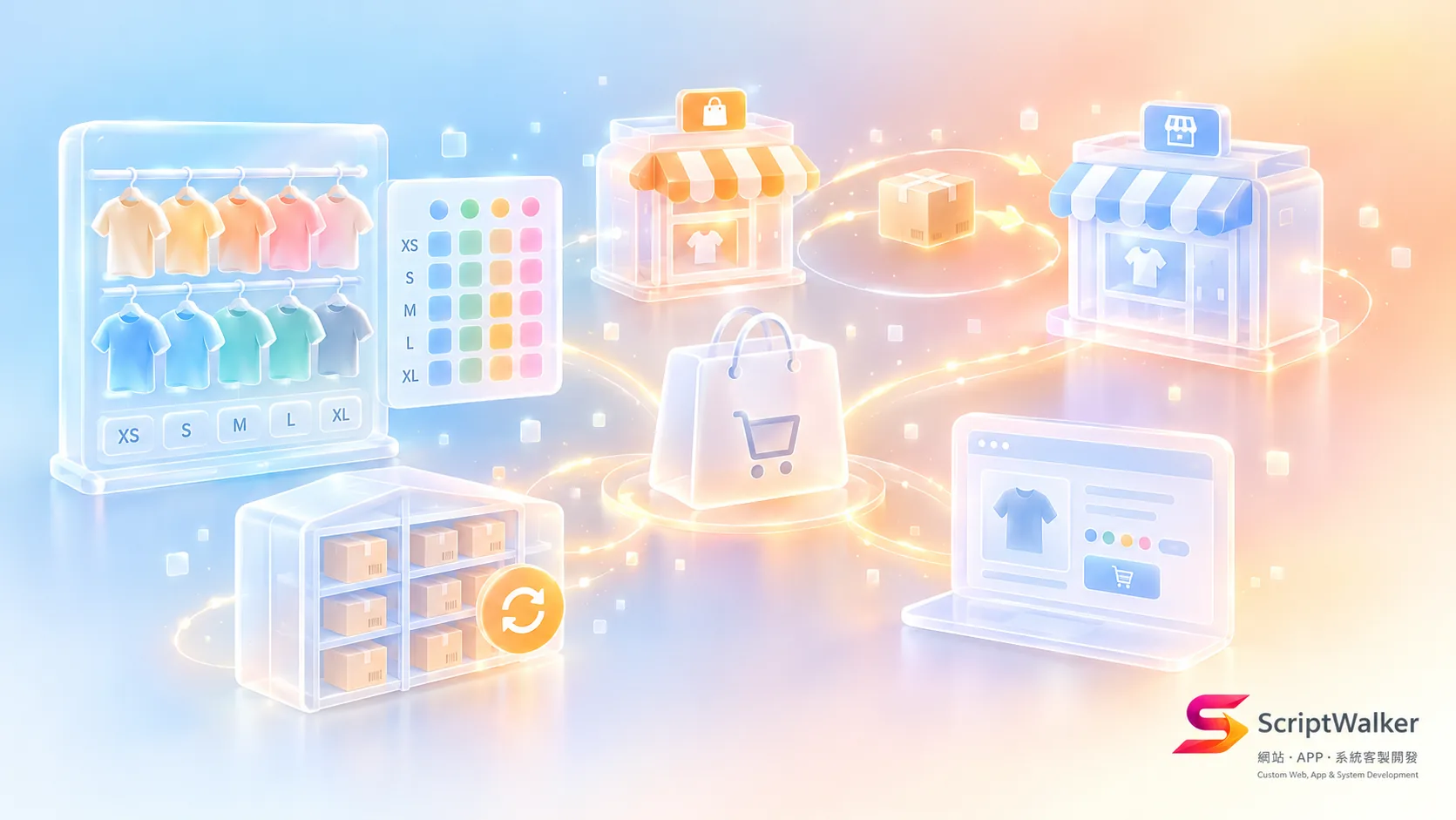
Short answer: For an apparel brand with a website and 5 stores, phase one of an ERP should cover the size-color matrix, replenishment suggestions, store transfers and multichannel inventory, in about 16–20 weeks for NT$550K–950K. Keep the existing accounting software and integrate it rather than replacing everything at once.
Company background and pain points
This is a scenario case (based on common project needs, not a specific client). A 30-person Taiwanese womenswear brand launches about 120 styles a season, averaging 4 colors × 5 sizes, which means 2,400 SKUs per season. It sells through its website, one marketplace and 5 stores.
- Inventory is tracked separately in Excel and the POS; stores report nightly and HQ consolidates the next day.
- Best-selling styles run out of size M by week 2, while 40% of size XL remains at season end.
- About 60 store-to-store transfers a week are arranged over LINE, and some "shipped but never received."
- The website oversells about 15 orders a month, each requiring an apology call and refund.
Requirements: which modules
Phase one includes only the 4 modules needed to see where every size and color is; the rest waits for phase two.
| Module | Owner | Phase |
|---|---|---|
| Size-color matrix product master | Merchandising | Phase 1 |
| Multichannel inventory (website, marketplace, stores, warehouse) | E-commerce, warehouse | Phase 1 |
| Replenishment suggestions by size sell-through | Merchandising, stores | Phase 1 |
| Store transfers and in-transit stock | Stores, warehouse | Phase 1 |
| Purchasing and factory lead times | Purchasing | Phase 2 |
| Membership and promotions | Marketing | Phase 2 |
Why hybrid instead of packaged ERP
The deciding factor: matrix products and transfers are core, accounting isn't, so we customize the core and keep accounting.
- Packaged ERP: feature-rich, but most are built around single item codes; size-color matrices and store transfers often need extra modules or customization, stretching cost and time.
- Open-source ERP: no license fee, but apparel matrices and Taiwan e-invoicing need custom work and ongoing engineers.
- Hybrid (this case): custom matrix products, inventory, replenishment and transfers; existing accounting software connected by export or API.
Packaged is the better choice in some cases: if you sell through one channel, launch fewer than 30 styles a season, or already use a POS with built-in multi-store inventory, buying a package or POS add-on is cheaper and faster.
Architecture and integrations
ScriptWalker (a Taiwan Laravel/Flutter custom development studio) builds the HQ back office in Laravel and the store app in Flutter, with every inventory movement written to one database.
- HQ back office: matrix product master, inventory overview, replenishment, transfer approvals and reports.
- Store app: scan barcodes to check stock across stores, request transfers, confirm receipt and run stock counts.
- Website and marketplace: inventory syncs every 5–15 minutes with safety stock to prevent overselling.
- POS and e-invoicing: keep the existing POS and write sales back to inventory; invoices follow the Ministry of Finance e-invoice platform rules.
- Accounting: daily export of purchase and sales data to the accounting software.
Implementation timeline
16–20 weeks in 5 stages, each with acceptable deliverables.
- Weeks 1–3 | Requirements and codes: standardize style, color and size codes; deliver flowcharts and coding rules.
- Weeks 4–6 | Design: clickable prototypes for the back office and store app.
- Weeks 7–14 | Build: demos every 2 weeks; deliver a test environment.
- Weeks 15–17 | Pilot: 2 stores and the website run in parallel; deliver an issue list and fixes.
- Weeks 18–20 | Launch: switch all 5 stores; deliver training and manuals.
Cost breakdown
Total budget NT$550K–950K, plus 10–15% for hidden costs.
| Item | Cost |
|---|---|
| HQ back office (matrix products, inventory, replenishment, transfers) | NT$350K–550K |
| Store app (Flutter, iOS/Android) | NT$120K–250K |
| Website, marketplace and POS integration | NT$80K–150K |
| Hosting and backups | About NT$1,500–4,000 a month |
| Maintenance | From NT$2,000 a month; NT$6,000–12,000 recommended here |
| Hidden costs | Legacy data cleanup, relabeling, scanners, app store developer fees |
ScriptWalker's pricing: custom systems from NT$80,000; ERP roughly NT$150K–1.5M depending on scope, 16–24+ weeks.
Post-launch targets
These are targets and typical improvement ranges, not a specific client's results.
- Day 30: all channel inventory consistent within 15 minutes; website overselling under 5 orders a month.
- Day 60: every store transfer in the system with trackable in-transit stock; zero "shipped but not received."
- Day 90: replenishment live; target 30% fewer stockout days for best-selling sizes and 10–20% less end-of-season stock in slow sizes.
Pitfalls and fixes
Apparel ERP projects stall on codes and store habits more than on code.
- Inconsistent codes: the same color named differently each season → define a color code table before building and convert legacy data once.
- Stores resist scanning: it feels slower than LINE → one-tap transfer requests in the app, and retire the LINE transfer group.
- Replenishment ignored: managers go by feel → show suggestions next to actual orders for the first month.
- Sync too infrequent: daily sync still oversells → sync every 5–15 minutes with safety stock.
- All stores at once: problems pile up → pilot 2 stores first.
FAQ
How much does ERP cost for an apparel brand?
Phase one for a website plus 5 stores is about NT$550K–950K over 16–20 weeks, including back office, app and integrations.
We already have a POS. Do we still need ERP?
Yes, with multiple stores plus a website. POS handles checkout; ERP handles cross-channel stock, replenishment and transfers.
What is a size-color matrix?
It expands one style into a color × size grid where each cell is a SKU, so gaps are visible at a glance.
Can we start with inventory and add purchasing later?
Yes, and we recommend it. Get inventory accurate in phase one, then add purchasing and factory lead times.
Next step
Does your brand also run out of popular sizes while slow sizes pile up? Tell us your style count, store count and current POS, and we'll plan phase-one modules and budget for free.
- Email: [email protected]
- Phone: 0916-224-047
- LINE: @ufv9089p