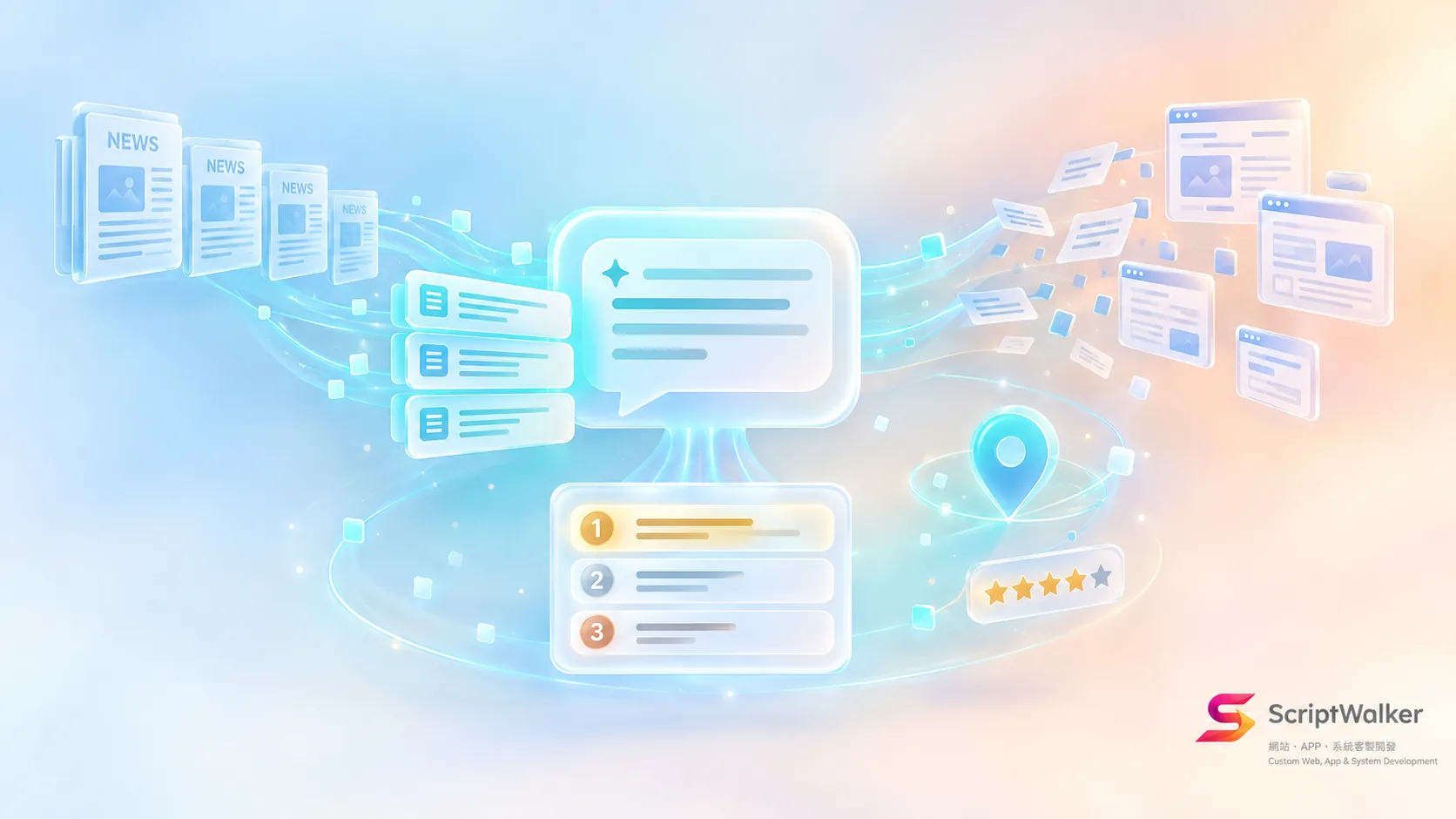
Short answer: The research says yes. An analysis published by Peec AI on October 27 found ChatGPT turns content from 12 licensed publishers into pre-written summaries placed ahead of ordinary web pages, filling 70% of top-3 positions across 1,000 ranked-list samples. SMBs cannot buy a license, but they can earn mentions in trade media and directories and complete their Google Business Profile.
On October 27, David Konitzny, a GEO researcher at Berlin startup Peec AI, published a breakdown of ChatGPT's internal configuration, reported the same day by The Decoder. Comparing the 3 news engines ChatGPT uses, he found only the one codenamed "labrador" carries a "provider" field, which led him to 12 publishers across 43 domains, including Condé Nast, Hearst, Axel Springer, News Corp, Reuters and AP, plus recipe and review sites such as Allrecipes and Tom's Guide. The striking number: across 1,000 ranked-list samples, partner summaries filled 70% of positions 1–3 but only 23% of positions 7–10.
Why is this surfacing now? ChatGPT is relying less on outside search engines. Peec AI's September research post describes labrador as a family of vertical indexes covering general web, news, Wikipedia, local, shopping, medical and legal content, while ChatGPT also pulls from at least 8 outside providers, with local business data coming from Yelp, TripAdvisor and Google Maps. In other words, the raw material behind AI answers is being redistributed, and which content reaches the model in which format decides who gets mentioned. OpenAI promised partners more prominent display back in 2024; this is the first look at how that might be implemented.
Other AI search platforms are moving the same way. Google's AI Overviews lean on its own index and Knowledge Graph, Perplexity runs a revenue-share program with publishers, and an earlier Hamburg study found Axel Springer titles appeared far more often in ChatGPT's web interface than via the API. The GEO industry is shifting from "how to write content" to "which pipe carries content into the AI," which is why visibility trackers like Peec AI and Profound are racing to reverse-engineer platform internals.
For Taiwan SMBs the meaning is direct: nearly all 12 licensed partners are Western media, and you will not sign one of these deals. But the same research shows where ordinary sites and local businesses get in. Below: the details, actions for three readers, a tool comparison, the study's limits and a no-subscription alternative.
The details: 12 publishers, 43 domains, 1,000 ranked samples
Partner content and ordinary pages reach ChatGPT in different formats, which drives the ranking gap.
- Researcher and method: Peec AI's David Konitzny analyzed the configuration of ChatGPT's 3 news engines and traced partners through labrador's provider field.
- Partners: 12 publishers and 43 domains, including Condé Nast, Hearst, Axel Springer, News Corp, Reuters, AP, Allrecipes, Tom's Guide and Welt.
- Different handling: ChatGPT does not fetch partner pages live; it receives pre-generated summaries placed ahead of all web results in the prompt, while ordinary sites arrive as raw text snippets.
- Ranking numbers: across 1,000 ranked-list samples, partner summaries took 70% of positions 1–3 and 23% of positions 7–10.
- Still imperfect: even partner content is not always cited correctly.
- OpenAI's response: none published at the time of reporting.
What three readers should do now: check whether AI mentions you or skips you
You cannot change platform ranking, so first confirm which pipe you appear in.
- Brand owners: list 10 questions customers ask, such as "recommended mold makers in Taichung," ask each in ChatGPT 3 times and record whether you appear and which site is cited.
- Marketers: sort cited sources into media coverage, directories (Google Maps, trade associations, comparison sites) and your own site, then invest first in the category that shows up most.
- Developers: make sure core pages do not depend on JavaScript to render, and output service pages, prices and FAQs as plain HTML with structured data so even raw snippets carry the key facts.
AI visibility tools compared: track who gets cited before you spend
These tools are valuable for repeated prompting and citation statistics, not for changing rankings.
| Tool | Main function | Best for | Limits |
|---|---|---|---|
| Peec AI | Tracks brand presence and cited sources in ChatGPT, Perplexity and others | Marketing teams watching competitors and source domains | Subscription; Chinese prompts must be designed yourself |
| Profound | Large-scale AI answer monitoring and platform research | Mid-to-large brands with bigger budgets | Expensive for SMBs |
| Semrush AI visibility features | Combines existing SEO data with AI mentions | Teams already on Semrush | Thinner data for Chinese-language markets |
| DIY spreadsheet | Manual monthly prompts logging mentions and sources | Budget-limited Taiwan SMBs | Small samples, needs a fixed owner |
What they won't tell you: two limits of this study
The direction is credible, but the numbers should not be treated as law.
- One researcher, one moment: the analysis is one researcher's observation of system configuration, unconfirmed by OpenAI, and the system may change weekly. The 70% applies to ranked-list samples, not every answer.
- News queries are not buying queries: labrador is a news engine. The "which vendor should I hire" questions Taiwan owners care about mostly run through local and general web indexes, where Google Maps and directory data may matter more.
A no-subscription alternative: a 2-hour monthly AI mention check
A single spreadsheet gets most SMBs 80% of the insight.
- Fix 10 questions: 5 brand-name queries and 5 service-plus-city queries, asked monthly on the same day in ChatGPT and Google AI Overviews.
- Log 4 columns: mentioned or not, cited URL, source type, and whether the description is accurate.
- Fill the gaps: complete Google Business Profile services, hours and photos; update trade association and directory listings; earn one trade media or partner write-up.
FAQ
The questions readers ask most often. The first sentence of each answer is the answer.
Does ChatGPT really favor licensed publishers?
The research suggests priority ordering. Partner summaries took 70% of top-3 list positions, though OpenAI has not confirmed it.
Can a Taiwan SMB become a ChatGPT licensing partner?
Practically no. The 12 known partners are mostly large Western media, so SMBs should pursue directories, reviews and media mentions.
How do local businesses show up in ChatGPT recommendations?
Complete your Google Business Profile first. The research says ChatGPT's local data comes from Google Maps, Yelp and TripAdvisor.
Do we need an AI visibility tool subscription?
Not on a tight budget. Ask 10 fixed questions monthly and log mentions and sources in a spreadsheet, about 2 hours.
My take: stop chasing "being indexed by AI" and start chasing "being mentioned by others"
The easy reading of this research is "AI search has been bought by big media, small companies have no chance." I think the opposite: it makes the rules clearer. AI does not just judge how well your own site is written; it looks at whether your name appears in channels it trusts. Licensed media is one channel; Google Maps, trade directories, review platforms and partner sites are others.
Many Taiwan SMBs spend their entire GEO budget rewriting their website, which leaves the website as the only place that mentions them. Instead of 20 more articles, get 3 third-party sites to state your company name, services and location correctly. Your site still matters, but its job is to give AI accurate details, not to carry visibility alone.
For ScriptWalker (a Taiwan-based Laravel/Flutter custom development studio), a service opportunity is an "AI mention audit plus structured website rebuild": monthly prompt logs and source mapping, then service pages, FAQs and Schema reshaped into formats AI can read, which shows results more clearly than selling SEO articles.
Sources
- The Decoder: OpenAI's partner content arrives in ChatGPT pre-summarized (2026-10-27) (third party, citing the original analysis)
- David Konitzny (Peec AI): original LinkedIn analysis (primary)
- Peec AI: ChatGPT built its own search index (2026-09-04) (primary)
- OpenAI: Oracle apps in ChatGPT (primary, recent ChatGPT platform move)
- Tomorrow's Publisher: OpenAI appears to give licensed publishers a hidden head start in ChatGPT (2026-10-27) (third party)
- Search Engine Roundtable: Daily Search Forum Recap, October 28, 2026 (third party)