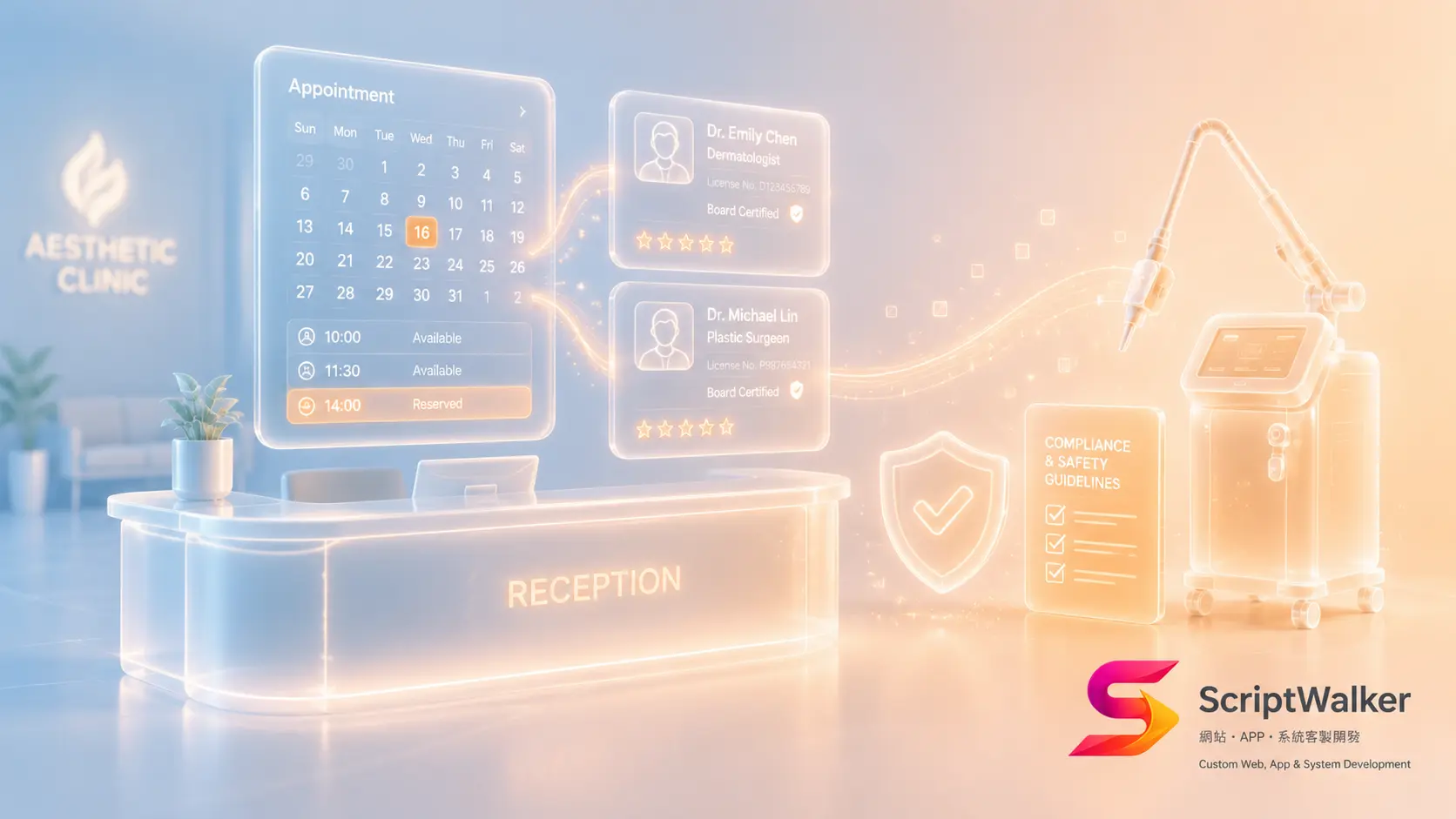
Industry snapshot: 277 new competitors in five years
As of December 2024, Taiwan had 445 medical institutions licensed under the Ministry of Health and Welfare's special-management regulations to perform specified aesthetic medicine procedures — up from 168 in May 2019, growth of nearly 165% in five and a half years. Demand is expanding too: consumer research puts 23.2% of the public as having had an aesthetic procedure, with a further 64.0% interested but not yet treated. Taiwan's medical aesthetics market passed NT$60 billion back in 2022. The combination is clear enough: the market is growing, competitors are growing faster, and everyone is chasing the same keywords.
Websites in this sector carry a constraint most industries do not: the site is simultaneously a marketing asset and a compliance exposure. The same paragraph is fine as "reduces fine lines" and potentially a fine as "the most effective wrinkle solution — this month only." Below: features, budgets, stack and landmines.
What customers in this industry search for
Search behaviour splits into three stages: what is this and will it hurt, how much does it cost, and finally who should do it. Most clinic websites only address the third.
- picosecond laser recovery time / laser toning side effects — informational, longest lead time, but the easiest first-page wins through content
- hyaluronic acid price / botox wrinkle cost / ultherapy price / rhinoplasty cost — pre-transaction price comparison, highest volume, highest regulatory sensitivity
- aesthetic clinic recommendations / pigment laser recommendations / clinic reviews — commercial investigation, largely occupied by forums and content sites
- Taipei aesthetic clinic / laser hair removal Taichung / free aesthetic consultation — local transactional, highest close rate, driven by Google Business Profile and location pages
- ultherapy PTT / aesthetic treatment installments / post-treatment care — word of mouth and payment terms, the final decision mile
Practical advice: put 60% of the budget into long-form patient education around "procedure + recovery / side effects." Those pages carry the lowest regulatory risk, face the least competition, and are the only content that reliably accumulates domain trust.
Essential website features
- Physician team pages: name, gender, education, experience and license number. These are explicitly permitted content under Article 85 of the Medical Care Act and the primary trust signal — use them fully.
- Procedure pages: written as patient education — mechanism, who it suits, who it does not suit, aftercare, possible risks. The more honest the "not suitable for" section, the better the consultation quality.
- Online booking / consultation: selectable branch, physician, procedure type and time slot, with form fields that map to the actual first-visit workflow.
- LINE Official Account integration: the primary communication channel in Taiwan, but designed to book time rather than to consult remotely.
- FAQ and aftercare education: serves users and search engines simultaneously, and reduces post-treatment support volume.
- Directions and parking: high-value local search content and a real friction point for walk-ins.
- Privacy policy and data notice: once a consultation form asks about medical history, medication or allergies, it collects special-category data under Article 6 of Taiwan's Personal Data Protection Act, and the notice and consent flow needs to be designed separately.
- Mobile performance: over 80% of traffic here is mobile; keep LCP under 2.5 seconds.
Worth adding vs not worth building
| Worth adding | Why | Skip | Why |
|---|---|---|---|
| Aftercare follow-up and recall reminders | Directly drives completion and repeat purchase | 3D face simulation | Expensive, sets unrealistic expectations, invites disputes |
| Installment calculator | High-intent keyword, cuts consultation back-and-forth | AI diagnostic chatbot | Risks constituting diagnosis without in-person examination |
| Member treatment history | Improves recall rate and raises switching friction | Direct card checkout for procedures | High promotional-solicitation risk; take deposits instead |
| Multi-branch scheduling and physician rosters | The main conversion bottleneck for chains | Full-screen intro animation | Damages LCP, worst possible trade on mobile-heavy traffic |
| Multilingual (EN / JP / HK-MO) | Medical tourism carries higher ticket sizes | Live queue numbers | Not urgent care; low demand, high maintenance |
Three budget tiers
- Entry NT$120,000–250,000: brand site, 8–12 procedure pages, form-based booking, LINE funnel, basic SEO architecture. For single-location, newly opened clinics that need to be findable. No membership system.
- Standard NT$300,000–600,000: adds a booking engine (branch / physician / slot / procedure), membership and treatment history, an education content library with categories and site search, Google Business Profile integration, and performance tracking. For 1–3 locations with 200+ consultations a month.
- Advanced NT$800,000–1,500,000: adds clinic management system / HIS integration, multi-branch permissions and reporting, automated recall reminders, multilingual versions, and field-level encryption plus audit trails for special-category data. For chains or clinics with medical tourism business.
Annual costs on top: hosting and CDN NT$18,000–60,000/year, SSL usually bundled with the CDN plan, and content maintenance (2–4 education articles a month) at NT$8,000–20,000/month.
Stack recommendation, with reasons
- Laravel on the back end: the real technical difficulty here is not traffic, it is permissions and auditing — who viewed which patient's treatment history, and when. Laravel's Policy/Gate layer plus mature audit packages turn that into a specification you can accept against, rather than a verbal assurance.
- Blade or Next.js on the front end: prefer server rendering for content pages, because long-form education is this sector's most important organic traffic source and SSR/SSG helps both indexing and LCP.
- Cloudflare: CDN, WAF and bot management. Aesthetic clinic sites are heavily targeted by form spam.
- Payments limited to deposits: ECPay or TapPay, scoped to booking deposits only. Turning procedures into cart items walks straight into the solicitation prohibition.
- Data protection: medical history, medication and allergies are special-category data. Use field-level encryption, second-factor verification for access, complete access logging, and a defined retention and deletion policy.
Competitor sketches: a northern chain (A) built each procedure into its own long-form education hub, with organic now over 60% of traffic. A single-location clinic in central Taiwan (B) runs a one-page site funded entirely by ads — traffic goes to zero when spend stops. A Japanese-styled clinic (C) has striking visuals but an intro animation pushing LCP past 4 seconds, with visibly high mobile bounce. The difference is not budget. It is whether the money went into content or animation.
Common landmines and how to avoid them
- Landmine 1: the site was never filed. Under the Regulations Governing Internet Information Management of Medical Institutions, clinics must file their domain name, URL and main webpage items with the local competent authority. → Fix: complete the filing before launch and update it when main items change.
- Landmine 2: discounts, gifts, limited-time pricing, free trials. Soliciting patients by improper means is a bright line in medical advertising. → Fix: keep pages to procedure content and education, route all pricing to "assessed at consultation," and run no countdown timers or promotional blocks.
- Landmine 3: before-and-after photos and patient testimonials. Extremely high risk, and easily construed as exaggerating efficacy. → Fix: use educational diagrams and procedure walkthroughs instead; where genuinely needed, confirm the specific case with your local health bureau first.
- Landmine 4: superlatives. Safest, most effective, number one, zero risk — the classic exaggeration finding. → Fix: maintain a banned-terms list wired into a pre-publish check, so marketing staff are blocked at the point of posting.
- Landmine 5: treatment advice over LINE. Diagnosing without an in-person examination carries legal risk. → Fix: converge all LINE scripts on "let's book time for the physician to assess," and write it into the support SOP and auto-replies.
- Landmine 6: consultation forms collecting medical history with no separate notice. Special-category data collection has stricter requirements. → Fix: give the form its own notice-and-consent block covering purpose, period, scope and use, and retain the consent record.
- Landmine 7: influencer content presented as independent reviews. Promoting under another's name is explicitly prohibited by Article 86 of the Medical Care Act. → Fix: disclose every partnership clearly, and never conceal the clinic as the source.
The penalties are not symbolic: violations of the medical advertising provisions carry fines of NT$50,000 to NT$250,000 under Article 103 of the Medical Care Act, with suspension or revocation of the practice license available for serious cases.
The first 30 / 60 / 90 days
- Day 30: filing complete, Google Business Profile claimed and synced, banned-terms check live. Watch two numbers — form completion rate (target ≥25%) and mobile LCP (target under 2.5 seconds).
- Day 60: 8–12 long-form "procedure + recovery / side effects" pages published, with a repeatable content cadence. Check the keyword composition of organic traffic and confirm informational terms are appearing.
- Day 90: recall reminders and aftercare follow-up live. Watch three numbers — consultation-to-visit conversion, cost per consultation, and organic share of total traffic (healthy is ≥30%, meaning you are no longer entirely ad-funded).
What ScriptWalker offers in this sector
We split aesthetic clinic websites into three separately purchasable modules: compliant content architecture (procedure page templates, banned-terms checking, filing document support) from NT$120,000; booking and membership (branch / physician / slot, treatment history, recall reminders) from NT$280,000; and data protection hardening (field-level encryption for special-category data, access auditing, retention and deletion) from NT$150,000. The stack is Laravel plus Cloudflare, with Flutter available to extend into a member app.
To be clear: what we provide is technical and process support for compliance, not legal advice. Formal review of advertising copy should still come from the clinic's counsel or a lawyer familiar with medical regulation.
FAQ
Can a clinic website list procedure prices?
Stating fees and soliciting patients through discounts, gifts or limited-time offers are two different things, and local health bureaus interpret the boundary with varying strictness. The safest approach is no promotional pricing blocks, no countdown timers, no "was / now" pricing, and pricing discussed at consultation instead. Confirm with your local health bureau before launch.
Are before-and-after photos genuinely off limits?
The risk is high and enforcement is inconsistent across jurisdictions. Such content is readily construed as exaggerating efficacy or implying guaranteed results. Most chains have moved to educational diagrams and procedure walkthroughs. If you have a genuine need, obtain case-specific consent and confirm with the competent authority first.
How thorough does the filing need to be? Does changing one page require refiling?
The regulations require filing the domain name, URL and the main items of the site. Publishing another education article normally is not a change to main items; adding an entire service section, changing domains, or a major redesign should trigger an update.
How long should consultation form data be retained?
No single retention period is prescribed for consultation forms, but the Personal Data Protection Act requires deletion once the specified purpose ends or the period expires. In practice, state a retention period in the privacy policy (for example, one year for consultations that did not convert) and automate expiry cleanup in the system rather than relying on memory.
Can we just run a LINE Official Account and skip the website?
You can operate that way, but you will earn no organic traffic. LINE is a relationship channel; it does not appear in results for "picosecond laser recovery time." In a market with 445 competitors, having no searchable content asset means permanently loading all customer acquisition onto paid media.
Decision checklist and next step
- ☐ The domain and main site items are filed with the competent authority.
- ☐ No discount, gift or limited-time pricing language or blocks appear on the site.
- ☐ No before-and-after photos or patient testimonials.
- ☐ A banned-terms list exists and is wired into a pre-publish check.
- ☐ Physician pages show name, credentials and license number.
- ☐ Consultation forms carry a separate special-category data notice with a consent record.
- ☐ LINE support scripts contain no treatment advice.
- ☐ Mobile LCP is under 2.5 seconds.
- ☐ At least 8 "procedure + recovery / side effects" education pages are live.
- ☐ Organic traffic is at least 30% of the total.
Fewer than 7 checks and your website carries both a compliance exposure and a customer acquisition cost problem. We offer a free clinic website review: a walkthrough of the ten items above with an issue list and a prioritized remediation order.
- Email: [email protected]
- Phone: 0916-224-047
- LINE: @ufv9089p
Sources
- Laws & Regulations Database of Taiwan: Medical Care Act, Article 86 and related provisions
- Laws & Regulations Database of Taiwan: Personal Data Protection Act (Article 6, special-category data)
- Dr.BEAUTY: 2026 Q1 Taiwan medical aesthetics market signals (licensed institution counts)
- Taiwan Trend Research: Medical Aesthetics Consumer Trends Report (consumer penetration)
- Carat Weekly: Taiwan medical aesthetics market paradigm shift (market size)
- web.dev: Largest Contentful Paint (LCP)