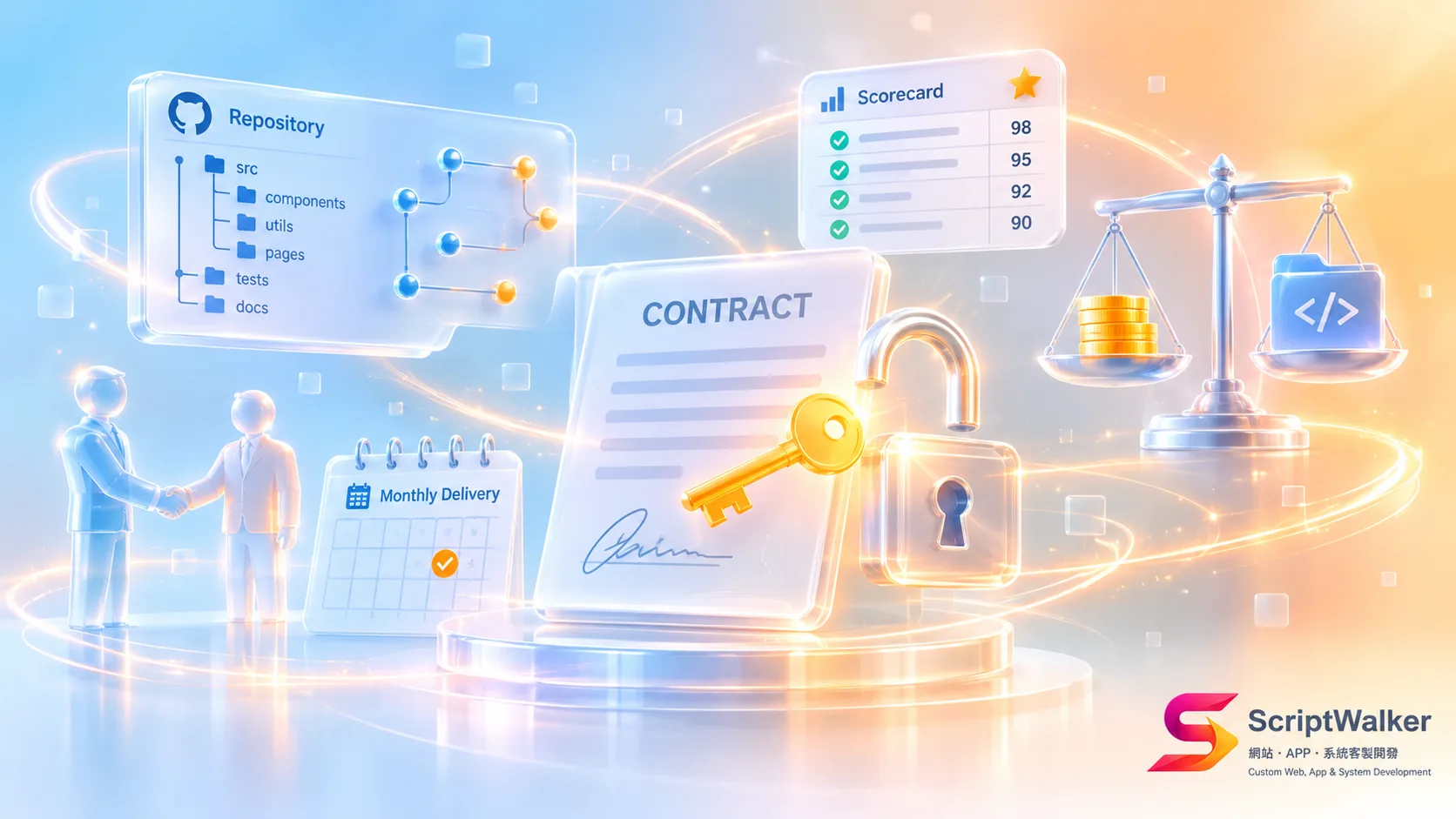
Short answer: If the contract is silent, the copyright in outsourced code belongs to the contractor by default. Score the project on 8 items (16 points max); at 9 or above, the contract should spell out transfer of economic rights, monthly Git delivery and deployment docs. Full ownership often costs 10–30% more than a usage license, but saves hundreds of thousands in rewrites if you ever switch vendors.
The real question: NT$800K spent, no code in hand
A 40-person trading company paid NT$800K for an order system. Three years later it wanted new features, found the original vendor too expensive and planned to switch. The new vendor asked for the code and discovered the contract only said "deliver the system," with nothing on source code or copyright. The original vendor said the code included its own framework and offered to sell it for NT$250K. The owner assumed paying meant owning; the law says otherwise.
Myths to drop: three common misunderstandings
Most disputes come from assuming payment equals ownership, not from vendors being difficult.
- Myth: paying for development means I own the copyright. Truth: under Article 12 of Taiwan's Copyright Act, commissioned works belong to the contractor unless agreed otherwise; the commissioning party may only use them.
- Myth: having the code lets me switch vendors. Truth: without deployment docs, environment variables and third-party accounts, the code won't run.
- Myth: full buyout is the only safe option. Truth: many cases only need a perpetual, modifiable, sublicensable license, which is cheaper and sufficient.
The framework: a source-code delivery score (8 items, 0–2 each)
The total tells you which rights to require: 9+ means full transfer, 5–8 means a perpetual license plus code, 4 or less means a standard license.
| Item | 0 points | 1 point | 2 points |
|---|---|---|---|
| Core operations (can't ship or collect payment without it) | No | Partly | Yes |
| Expected lifespan | Under 2 years | 2–5 years | 5+ years |
| Likely to switch maintenance vendor | No | Unsure | Likely |
| Unique business logic (pricing, scheduling algorithms) | None | Some | A lot |
| Plans to sublicense or sell as a product | No | Considering | Yes |
| Share of annual IT budget | Under 20% | 20–50% | Over 50% |
| In-house engineers or IT staff | None | Part-time | Dedicated |
| Investor due diligence or IPO plans | No | Possible in 2–3 years | Yes |
- 9–16: transfer economic rights in the custom work, perpetual license for shared components, monthly Git access and deployment docs.
- 5–8: perpetual, modifiable, sublicensable license plus code at each milestone.
- 0–4: standard license plus code escrow or delivery at closing.
Three typical cases: same framework, different answers
Company size and system importance change the level of rights you need.
- A 12-person studio's booking site (3 points): 2–3 years of use, non-core. A license and code at closing saves 10–15%.
- A 40-person trading company's order system (10 points): core, 5+ years, likely vendor switch. Require transfer of the custom work and monthly Git delivery.
- A startup's SaaS product (15 points): resale and investor diligence ahead. Full transfer, with shared components and their license scope listed.
Hidden costs: four in the contract, four at handover
The more complete your rights, the higher the upfront cost and the lower the cost of switching.
- Buyout premium: transferring economic rights often adds 10–30%, since the vendor can't reuse that code.
- Contract review: a lawyer reviewing IP terms costs about NT$10K–30K.
- Account transfers: domains, hosting, payment gateways and Apple/Google developer accounts in the vendor's name take 1–4 weeks to move.
- The cost of not having it: rewriting a mid-size system without the code often runs NT$500K–1.5M.
Vendor scorecard: eight dimensions
Vendors who discuss IP and delivery openly tend to be clear about everything else too.
- Does the contract proactively state copyright ownership and list shared components?
- Is there a private Git repository with client admin rights?
- Is a deployable version delivered at each milestone?
- Are there templates for deployment docs and environment variables?
- Are domains, hosting and payment accounts registered to the client?
- Are open-source licenses listed?
- Is there a code and data handover checklist at closing?
- Will they accept a third-party code review?
Score each 0–2; be careful with vendors under 10.
ScriptWalker's options and who we're not right for
ScriptWalker (a Taiwan-based Laravel/Flutter custom development studio) defaults to clients owning their Git repository and all service accounts, with code delivered at each milestone.
- Project-based: transfer of economic rights in the custom work can be agreed; shared modules get a perpetual, modifiable license.
- Monthly maintenance: the repository and deployment docs are updated monthly, so a handover package is always ready.
- Advisory review: we review IP clauses and delivery lists in other vendors' contracts.
- Takeover audit: we assess how complete and maintainable your existing code is.
We're not a fit if you want a full buyout at SaaS rental prices, want zero documentation and the fastest launch, or expect resale rights on a budget under NT$80K.
Launch playbook: the 90 days after signing
The first 90 days turn rights on paper into rights you can actually exercise.
- Month 1: confirm IP clauses; create the Git repository, domain and hosting accounts under the company.
- Months 2–3: accept code and deployment docs at each milestone, and have another engineer deploy from the docs once.
- Day 90: check all third-party accounts are company-owned and the open-source license list is complete.
Decision checklist: confirm before signing
- ☐ You've calculated the source-code delivery score
- ☐ The contract states copyright ownership of the custom work
- ☐ Shared components carry a perpetual, modifiable, sublicensable license
- ☐ The Git repository sits under a company account
- ☐ Code is delivered at every milestone
- ☐ Deployment docs and environment variable lists are deliverables
- ☐ Domain, hosting and payment accounts are company-owned
- ☐ Open-source licenses are listed
- ☐ There's a handover checklist at closing
- ☐ A lawyer or professional has reviewed the IP clauses
FAQ
If the contract is silent, is the code mine?
No. Under Article 12 of Taiwan's Copyright Act, the contractor is the author by default and the commissioning party only gets a right to use it.
Does having the source code let me switch vendors?
Not always. You also need deployment docs, the database schema and third-party accounts; missing one adds 2–4 weeks for a new vendor.
Is it fair for a vendor to keep rights to shared components?
Yes. Shared login or permission modules can stay theirs, but the contract should give you a perpetual, modifiable, sublicensable right to use them.
When should I receive the source code?
Monthly or at each milestone. Waiting for a single handover at the end is when incomplete versions happen.
Next step: a free 30-minute contract IP check
Send us your outsourcing contract or quote, and within 30 minutes we'll tell you whether source code and copyright are clearly covered and which deliverables are missing. This article shares practical experience; consult a lawyer on specific legal questions.
- Email: [email protected]
- Phone: 0916-224-047
- LINE: @ufv9089p