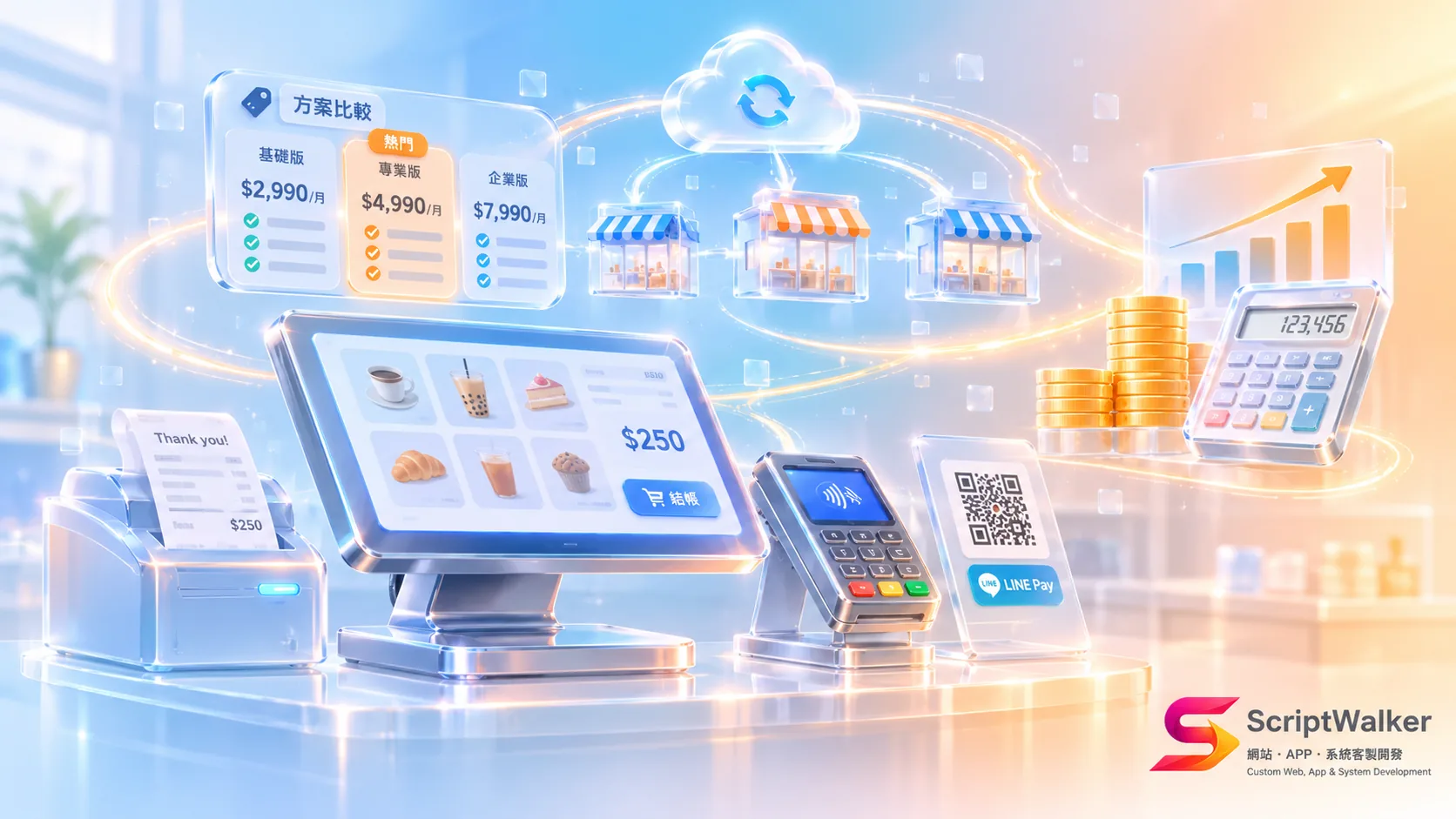
Short answer: POS system costs vary widely by type: cloud POS runs about NT$0–3,950 per month, traditional buy-once systems about NT$30K–60K per set, and custom POS about NT$150K–600K. Shops with three or fewer stores and standard workflows are fine with cloud POS; custom only pays off at five-plus stores or when POS must sync with your own e-commerce and membership systems.
The pain: three quotes, from NT$900 a month to NT$500K up front
An owner of two bubble-tea shops asked three POS vendors. A quoted NT$900 a month, B NT$45K to buy outright, C NT$500K for a custom build. All three were called a "POS system," yet they differed by a factor of hundreds. Nobody was cheating; they simply included different things. Software, hardware, payments, e-invoicing, inventory, loyalty and integrations can each be priced separately.
The direct answer: POS price ranges
Pick the type first, then factor in store count, and you'll know a reasonable POS cost. The table draws on Taiwan quotes collected by PRO360 and common brands' public plans:
| Type | Cost | Best for |
|---|---|---|
| Cloud POS (subscription) | NT$0–3,950/month (e.g. iCHEF from free to NT$3,950; DuDu about NT$1,500) | 1–3 stores, F&B and retail |
| Traditional POS (buy once) | About NT$30K–60K per set, plus about NT$2,000/month maintenance | No subscription, stable workflows |
| Tablet hardware | Tablet about NT$10K, receipt printer NT$6K–10K | Paired with cloud POS |
| Custom POS / checkout system | About NT$150K–600K once + maintenance | 5+ stores, integration with e-commerce/ERP/loyalty |
Full cost breakdown: six components
Break every quote into these items, or the cheap subscription may be the most expensive option after three years.
- Software: cloud subscription or perpetual license. HQ and multi-store features are often add-ons; one vendor charges an extra NT$1,500/month for HQ.
- Hardware: tablet, receipt printer, cash drawer, barcode scanner, about NT$15K–30K per store.
- Payments: card and mobile payment fees depend on the acquirer, about 1.5–3%, not included in POS fees.
- E-invoicing: value-added center fees or per-invoice charges, sometimes billed separately.
- Integrations: delivery platforms, e-commerce, loyalty and accounting are often paid modules on cloud plans; for custom builds, each interface costs about NT$20K–80K.
- Maintenance: about NT$2,000/month for traditional systems; about 1.5–2% of the build cost per month for custom.
ScriptWalker (a Taiwan-based Laravel/Flutter custom development studio) publishes its starting prices: websites from NT$15,000, systems from NT$80,000, apps from NT$150,000. A custom POS counts as a system; with in-store checkout, inventory and HQ reporting it usually starts above NT$150K.
Common traps: a cheap subscription isn't always cheap
POS budgets most often overrun on items the quote doesn't mention.
- Feature-tier locks: entry plans exclude inventory or reports, forcing an upgrade to NT$2,000–4,000/month plans.
- Data lock-in: sales and member data can't be exported when you switch, so you start over.
- Hardware contracts: cheap hardware tied to 2–3 year subscriptions with early-termination fees.
- Integrations billed separately: "supports" delivery and e-commerce sync often means a setup fee per platform.
- Cheap "custom" builds: custom POS under NT$50K is usually a modified template, often without offline checkout or invoice error handling.
Decision checklist: 10 questions to test your POS budget
- ☐ Three or fewer stores
- ☐ Under 300 SKUs
- ☐ No real-time inventory sync with your own website or ERP
- ☐ Loyalty only needs points, not tiered benefits
- ☐ Brief manual notes are acceptable during outages
- ☐ The quote lists payment and e-invoicing fees
- ☐ Data export to CSV is confirmed
- ☐ You've calculated three-year total cost of ownership
- ☐ Hardware isn't tied to a long contract
- ☐ No plan to reach five-plus stores in two years
Seven or more checks: cloud POS is enough. Four or fewer: evaluate a custom checkout system.
FAQ
Is a free POS fine for a small shop?
Yes for a single store with few items and no inventory or tiered loyalty, but check whether e-invoicing and payments cost extra.
Do I need to buy new POS hardware?
Not necessarily. Most cloud POS run on an iPad or Android tablet; add a receipt printer and cash drawer for about NT$15K–25K.
When does a custom POS make sense?
With five or more stores, or when POS must sync in real time with your own e-commerce, ERP or membership system.
Can POS costs be subsidized?
Sometimes. Taiwan's SME digital transformation programs often cover cloud solutions; terms change yearly, so check the current announcement.
Next step: a free POS quote breakdown
Send us your POS quotes and we'll split out software, hardware, payments and integrations, calculate three-year total cost, and tell you whether to rent, buy or build.
- Email: [email protected]
- Phone: 0916-224-047
- LINE: @ufv9089p