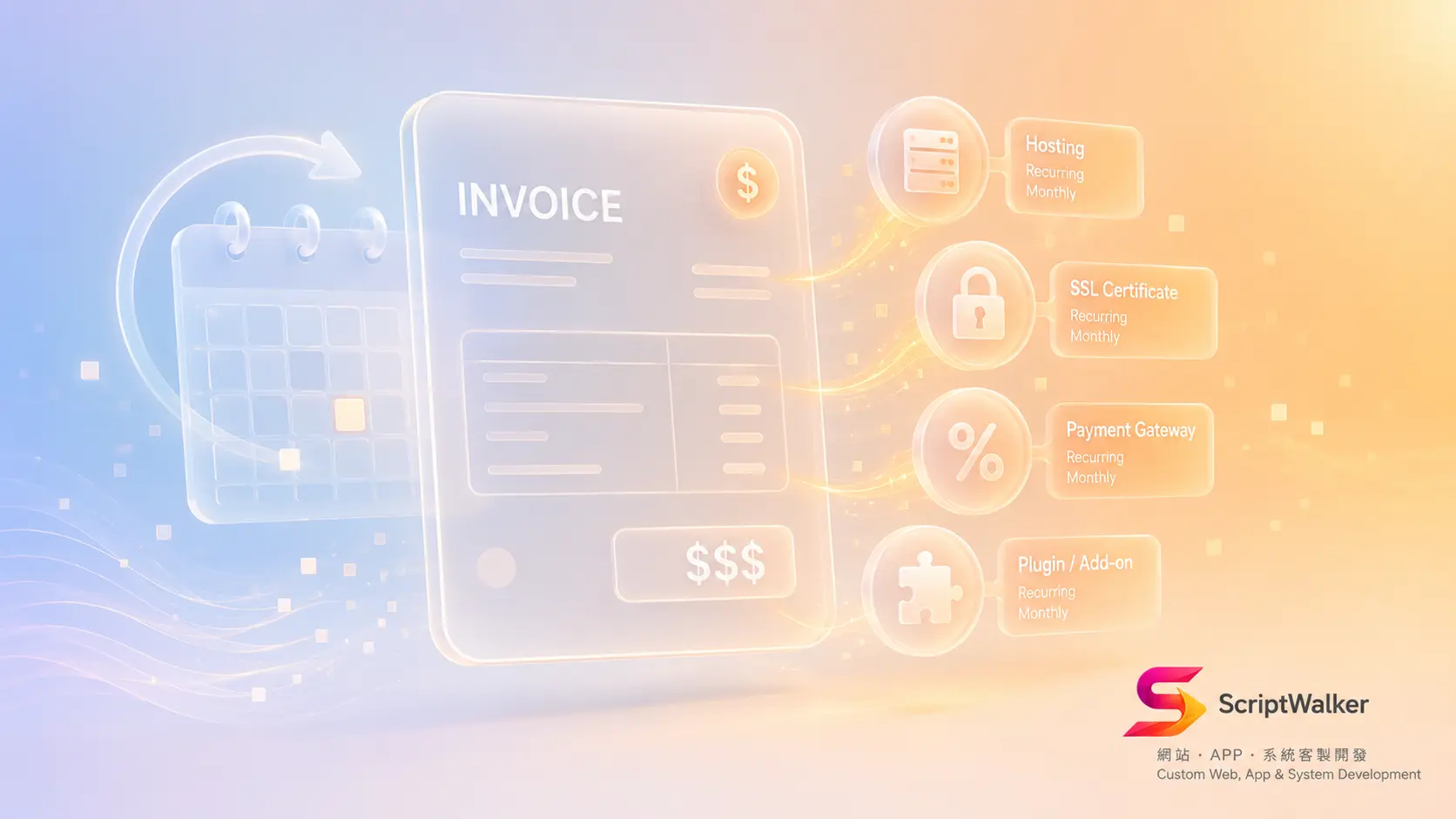
A real decision scene: two vendors quote the same e-commerce site — A at NT$450K, B at NT$380K. The owner picks the cheaper B. A year in, they discover B's solution quietly adds NT$18K/month in subscriptions, plugins, and hosting — over three years, more than NT$200K more expensive than A. Nobody lied. The problem: everyone compares the one-off "development fee" and nobody lays out the recurring costs.
Myths to break
- Myth 1: "The quote is the total cost." Truth: the build fee is often only 50–70% of three-year total cost of ownership (TCO); the rest hides in monthly subscriptions, payment fees, maintenance, and third-party services.
- Myth 2: "After launch there's little cost." Truth: launch is where recurring cost starts — hosting, SSL, monitoring, backups, plugin licenses, payment cuts never stop.
- Myth 3: "Free/open source means no monthly fees." Truth: open source saves license fees, but ops, updates, and security patching still cost labor — just from a different pocket.
Core framework: the three-year TCO formula
When comparing vendors, don't compare quotes — compare this:
Three-year TCO = one-off build fee + (monthly recurring cost × 36) + estimated change/maintenance fees
Fill each vendor's monthly recurring cost into the 9 items below, multiply by 36, and you'll see a ranking completely different from the quote sheet.
Three typical scenarios
- Personal brand / small shop (brochure site): recurring cost can be very low (NT$500–2,000/month) — shared hosting, per-transaction payment fees. TCO is mostly the build fee.
- Growing SMB (e-commerce/membership): recurring cost is decisive (NT$8,000–30,000/month) — payment cuts, hosting scaling, monitoring, maintenance make up 40–50% of three-year TCO.
- Company with integrations (site + app + backend): recurring cost is most complex (NT$20,000–80,000/month) — APIs, push, multi-env hosting, SLA maintenance; over half the TCO lands "after launch."
Full hidden-cost checklist (9 recurring costs)
- 1. Hosting/cloud: shared from NT$300/mo, VPS/cloud NT$1,500–20,000/mo, scaling with traffic.
- 2. Payment fees: ECPay ~2.8%, Stripe ~3.4% + fixed — bigger revenue, bigger bite.
- 3. SSL/domain: domain ~NT$400–800/yr; paid SSL extra (Let's Encrypt is free but needs auto-renewal).
- 4. Third-party APIs/SaaS seats: SMS, payment, maps, email (e.g., SendGrid), support tools — often over NT$10K/mo combined.
- 5. Plugin/module licenses: premium WordPress plugins, themes, page builders are mostly annual.
- 6. Monitoring/backup: Sentry, UptimeRobot, off-site backup — NT$0–5,000/mo.
- 7. Email/domain mailbox: Google Workspace from ~NT$200/user/mo.
- 8. CDN/bandwidth: Cloudflare free tier often suffices; advanced and heavy traffic extra.
- 9. Maintenance/SLA: security updates, dependency upgrades, small changes — retainer often NT$5,000–30,000/mo.
Vendor scorecard (quote transparency)
- ☐ Does the quote separately list "monthly recurring cost"?
- ☐ Does it mark which fees go to third parties vs. to the vendor?
- ☐ Are payment/SMS cuts and usage fees clearly rated?
- ☐ Are hosting specs and capacity stated, with overage terms?
- ☐ Are plugin/licenses listed as annual or perpetual?
- ☐ Is post-launch maintenance included, extra, or excluded?
- ☐ Are accounts/licenses under your name or the vendor's?
- ☐ Did they give you a three-year TCO estimate, not just a quote?
Miss 4+ of these and it's usually not cheaper — the cost is deferred somewhere you won't notice.
ScriptWalker's approach + who we're not for
Our quotes always include a "three-year TCO worksheet" itemizing the 9 recurring costs above, marking which go to third parties vs. us — you compare totals, not a single number. Maintenance is a transparent retainer (from NT$8,000/mo, including security updates and monitoring).
Where we're not a fit (honestly):
- Clients who only want the cheapest one-off quote and zero post-launch involvement — our model will look expensive to you.
- Extremely tight budgets needing only a one-page brochure — self-hosting Wix/WordPress is more economical.
- Clients who want all accounts under the vendor's name — we insist accounts belong to you, which is the opposite of that expectation.
90-day onboarding playbook (surface the hidden costs)
- Month 1: inventory all existing/planned recurring costs, build the TCO worksheet, transfer all accounts/licenses to your name.
- Months 2–3: review each line for savings (free CDN, consolidate SaaS seats, disable unused plugins).
- Day 90: reconcile actual monthly fees vs. estimate; recalibrate next year's budget.
Decision checklist
- ☐ Did I get a "quote" or a "three-year TCO"?
- ☐ Do I know the fixed monthly deduction after launch?
- ☐ Do I know which fees grow with revenue?
- ☐ Are my accounts/licenses under my own name?
- ☐ Did I budget for maintenance?
- ☐ Did I compare both quotes with the same ruler (TCO)?
FAQ
Why can a cheaper quote end up more expensive?
Because cheap usually comes from deferring cost — annual-fee plugins, higher-cut payment gateways, lower-spec hosting. These aren't on the quote but bill you monthly. A three-year TCO comparison exposes it.
How much of total cost is recurring?
Depends on type: a brochure site may be 10–20%, e-commerce/membership often 40–50%, and app + integration projects can exceed half after launch.
How do I get a vendor to spell out hidden costs?
Ask directly for a "three-year TCO worksheet" that marks each fee as third-party or vendor and flags which grow with usage. Vendors willing to share it usually aren't hiding costs elsewhere.
What's the risk of accounts under the vendor's name?
When you switch vendors or part ways, you may not recover control of the domain, hosting, or payment backend — effectively held hostage. Insist all accounts are under your own name from day one.
Call to action
Want to know your site/system's real three-year total cost? ScriptWalker offers a free TCO health check — we lay out the recurring fees you're paying and find what can be cut. Free 30-minute consult:
- Email: [email protected]
- Phone: 0916-224-047
- LINE: @ufv9089p