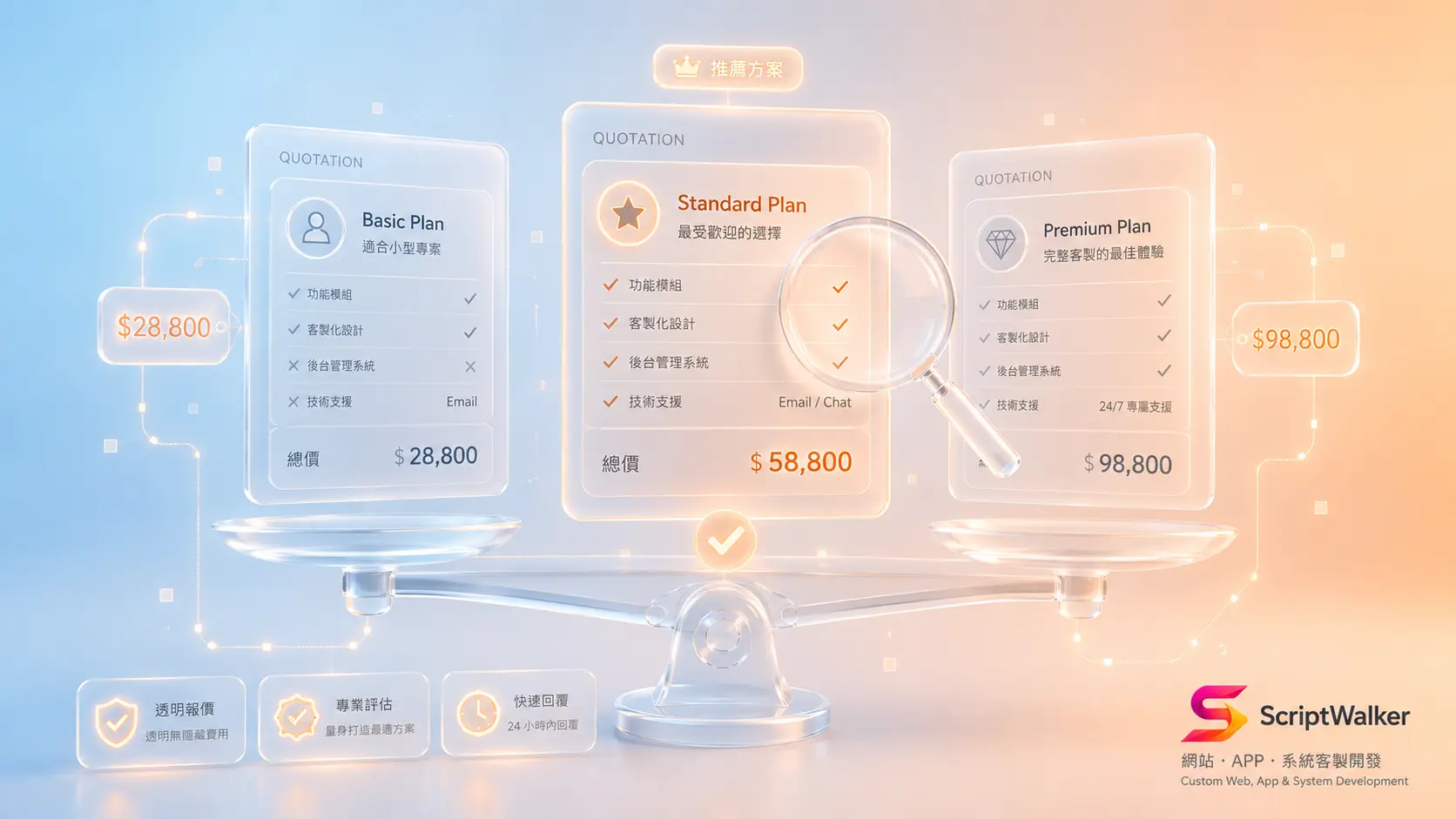
The general manager of an industrial parts company laid three quotes on the conference table: Vendor A at NT$380,000, Vendor B at NT$920,000, Vendor C at NT$1,450,000. All three said "internal order management system, lump sum," all said "approx. 3 months," all were two pages long. His first question: "Same job, how can it be 4x apart? Is someone ripping me off?"
Usually nobody is. The gap exists because the three quotes are not measuring the same work. Vendor A priced "move the Excel file online." Vendor C priced role-based permissions, audit trails, ERP integration and one year of maintenance. The real problem is not who is expensive, it is that nobody converted the three quotes into a common unit.
Industry myths: four things most owners get wrong about comparing bids
- Myth 1: More bidders means more savings. Reality: past three vendors, decision time stretches 3 to 5 extra weeks while your internal briefing hours scale linearly. From vendor four onward, the discount you negotiate is usually smaller than the time you burn.
- Myth 2: A lower quote means lower risk. Reality: a low quote usually defers risk into change orders. We take five or six rescue calls a year from companies that signed for NT$380K and were asked for another NT$220K before acceptance.
- Myth 3: Lump sum is industry convention, no need to unbundle. Reality: lump sum is a technique for hiding uncertainty. Without a module-level breakdown, you have no way to trade scope for budget mid-project.
- Myth 4: A quote should be precise from day one. Reality: before requirements interviews are done, any total precise to the nearest NT$10,000 is a guess. The responsible answer is a range plus the conditions under which it converges to a fixed price.
The core framework: quote normalization formula
Comparable TCO(24) = Development quote + Missing-scope top-up + Client-side internal hours + 24 months of running costs + Change reserve + Exit cost
- Missing-scope top-up: take the most complete quote as the feature checklist, then price back in whatever the other vendors omitted but you actually need.
- Client-side internal hours: interviews, test data preparation, acceptance testing. Estimate at person-days times NT$4,000, a fully loaded internal rate you can calibrate against the Ministry of Labor occupational wage survey.
- 24 months of running costs: hosting, domain, certificates, payments. Check hosting against Vercel official pricing and payment fees against the ECPay official rate page, not the vendor verbal estimate.
- Change reserve: 15% of the development quote. That is not pessimism, that is the norm.
- Exit cost: what it would cost to move source code, data and documentation to another vendor in twelve months. If source code is not a deliverable, this line equals the price of rewriting.
| Item | Vendor A | Vendor B | Vendor C |
|---|---|---|---|
| Development quote | NT$380,000 | NT$920,000 | NT$1,450,000 |
| Missing-scope top-up | +NT$450,000 | +NT$120,000 | NT$0 |
| Client internal hours | 60 pd / NT$240,000 | 35 pd / NT$140,000 | 25 pd / NT$100,000 |
| 24-month running costs | NT$36,000 | NT$72,000 | NT$120,000 |
| Change reserve (15%) | NT$57,000 | NT$138,000 | NT$218,000 |
| Exit cost | NT$300,000 | NT$80,000 | NT$0 |
| Normalized TCO(24) | NT$1,463,000 | NT$1,470,000 | NT$1,888,000 |
Three quotes that looked 4x apart end up with A and B nearly identical, and C 28% higher in exchange for auditability and zero exit cost. The decision shifts from picking the cheap one to picking the one you need.
Three company profiles, one table, three conclusions
- 15-person trading company, NT$80M revenue, no IT staff: choose A, but write the missing scope into a contract annex and require source code plus database export scripts as deliverables. That pushes the NT$300,000 exit cost under NT$50,000.
- 60-person manufacturer with an existing ERP and one IT staffer: choose B. Integration and data consistency are the battleground, and Vendor A lacking ERP integration experience would push your internal hours to 90 person-days.
- 200-person multi-site service business with internal audit and privacy obligations: choose C. Audit trails and permission tiers are not upsells, they are baseline costs under the Personal Data Protection Act, and retrofitting them typically costs 2 to 3 times the original build.
Hidden costs of running a bidding round
- Requirement briefings: 3 vendors times 2 sessions times 3 people times 2 hours = 36 hours, about NT$18,000.
- Documenting current processes and form samples: 5 person-days, about NT$20,000.
- De-identifying and preparing sample data: 2 person-days, about NT$8,000.
- Internal evaluation meetings and approval loops: 3 person-days, about NT$12,000.
- Delay opportunity cost: six extra weeks of deliberation on a system that saves 15 hours a month equals 90 hours forgone.
- Trade secret exposure: three vendors receive your process maps, report formats and customer tiering rules, but only one gets the contract. The other two keep the know-how.
- Total: roughly NT$58,000 plus six weeks. Getting one more quote is not free.
10-dimension quote credibility scorecard (0 to 3 each, 30 max)
| # | Dimension | What a 3 looks like |
|---|---|---|
| 1 | Requirement granularity | Broken to feature modules, person-days per module |
| 2 | Assumptions and exclusions | At least 8 explicit not-included items |
| 3 | Effort transparency | Roles (PM / backend / frontend / design) with person-days each |
| 4 | Milestones and payments | 3 or more stages, each tied to an acceptable deliverable |
| 5 | Change management | Documented change order process and pricing |
| 6 | Measurable acceptance criteria | States performance thresholds, for example LCP under 2.5 seconds |
| 7 | Third-party cost disclosure | Hosting, payments, SMS itemized with unit prices |
| 8 | Data and privacy handling | Data processing clauses, deletion and backup policy |
| 9 | Deliverables list | Source code, schema, deployment docs, account ownership |
| 10 | Warranty and maintenance | Warranty period, response times, maintenance priced separately |
Reading the score: 24 and above proceeds to contract negotiation; 18 to 23 means request clarifications and rescore; below 18 keep it out of the comparison table entirely, because that is an estimate, not a quote.
How ScriptWalker quotes, and what we turn down
Our four engagement models: fixed-price project (fixed only after requirements are frozen), monthly retainer (from NT$18,000), advisory review (we do not bid, we write your RFP and normalize the quotes you already have, NT$25,000 flat), and full outsourcing with a long-term roadmap. The third exists specifically for owners with three quotes on the table.
Projects we decline:
- Clients who want a single total but will not spend four hours on requirement interviews.
- Rounds already sent to five or more vendors that will be decided purely on total price.
- Requests for an unpaid proof of concept or a free written specification before any engagement.
- Budgets under NT$150,000 that require two-way ERP or POS integration.
- Engagements where the decision maker attends no meetings and everything is relayed by an intermediary.
A mistake we made: in 2024 we took a project involving eight years of legacy data migration and underestimated the cleaning effort by roughly 40%, absorbing about NT$180,000 in unbilled hours. Since then, any project with historical data migration starts with a NT$30,000 data health check before we issue a fixed price. We would rather charge you a small amount up front than negotiate an overrun mid-project.
A 30-day playbook after the quotes arrive
- Days 1 to 7: paste all three quotes into the normalization table, list what each vendor omitted, and send one identical clarification questionnaire to all three so the answers are comparable.
- Days 8 to 14: hold a 90-minute clarification call with each vendor and require the actual technical lead to attend, not only sales. Ask about change order pricing and deliverable ownership on the call.
- Days 15 to 24: complete the scorecard, shortlist one vendor for negotiation, and formally decline the other two with a written request to destroy the materials you supplied.
- Days 25 to 30: before signing, move the missing scope, acceptance criteria, change order process and deliverables list into contract annexes. At day 90, review whether actual change orders stayed within the 15% reserve, and if not, audit which part of the requirement interview missed it.
Decision checklist
- ☐ Are all three quotes broken down to feature module level?
- ☐ Do I know exactly what each vendor left out?
- ☐ Have I estimated my own team person-days?
- ☐ Have I verified 24 months of hosting and payment fees line by line?
- ☐ Does the contract state source code ownership?
- ☐ Is there a change order pricing formula?
- ☐ Can acceptance criteria be verified with numbers?
- ☐ Are payments tied to acceptable milestones?
- ☐ Are warranty and maintenance priced separately?
- ☐ Is the bidder count kept to three or fewer?
- ☐ Was a mutual NDA signed before briefings?
- ☐ Did vendors receive de-identified sample data only?
- ☐ Have I set aside a 15% change reserve?
- ☐ Can I calculate the exit cost if I switch vendors in a year?
Fewer than 10 boxes checked means do not sign yet.
FAQ
How many vendors should I actually invite?
Three. One gives you no baseline, and five or more burns your briefing hours and delays the decision past the value of any discount. A good mix: one vendor you already know, one slightly larger than your need, one specialized in your industry.
What if a vendor refuses to itemize the quote?
You do not need their hourly rate, that is commercially sensitive. But you can require a breakdown to feature modules plus person-days. A refusal at module level usually means they never estimated the effort themselves, and that is the biggest red flag on a quote.
Should I push the cheapest vendor even lower?
No. In practice the first budget cut always falls on testing and documentation, and that gap returns at double the cost three to six months after launch. Cut scope instead, building the core 60% first and deferring the rest to phase two, rather than cutting the unit price.
Do I need an NDA during the bidding round?
Yes. Process maps, report formats and customer tiering rules shared in a briefing are trade secrets. Sign a mutual NDA before the first meeting and supply only de-identified sample data, then release real data after signing under a data processing clause.
Can someone review the quotes for me?
Yes, that is an advisory engagement. ScriptWalker offers independent review: we do not bid, we write the RFP, unify the clarification questionnaire, and deliver a normalized comparison table plus scorecard results. NT$25,000 flat, roughly five working days.
One thing you can do now
Send us the three quotes on your desk. We offer a free 30-minute online consultation and will mark, live on the call, every item each quote omitted that you will definitely need. No pitch required, and you do not have to invite us to bid.
- Email: [email protected]
- Phone: 0916-224-047
- LINE: @ufv9089p