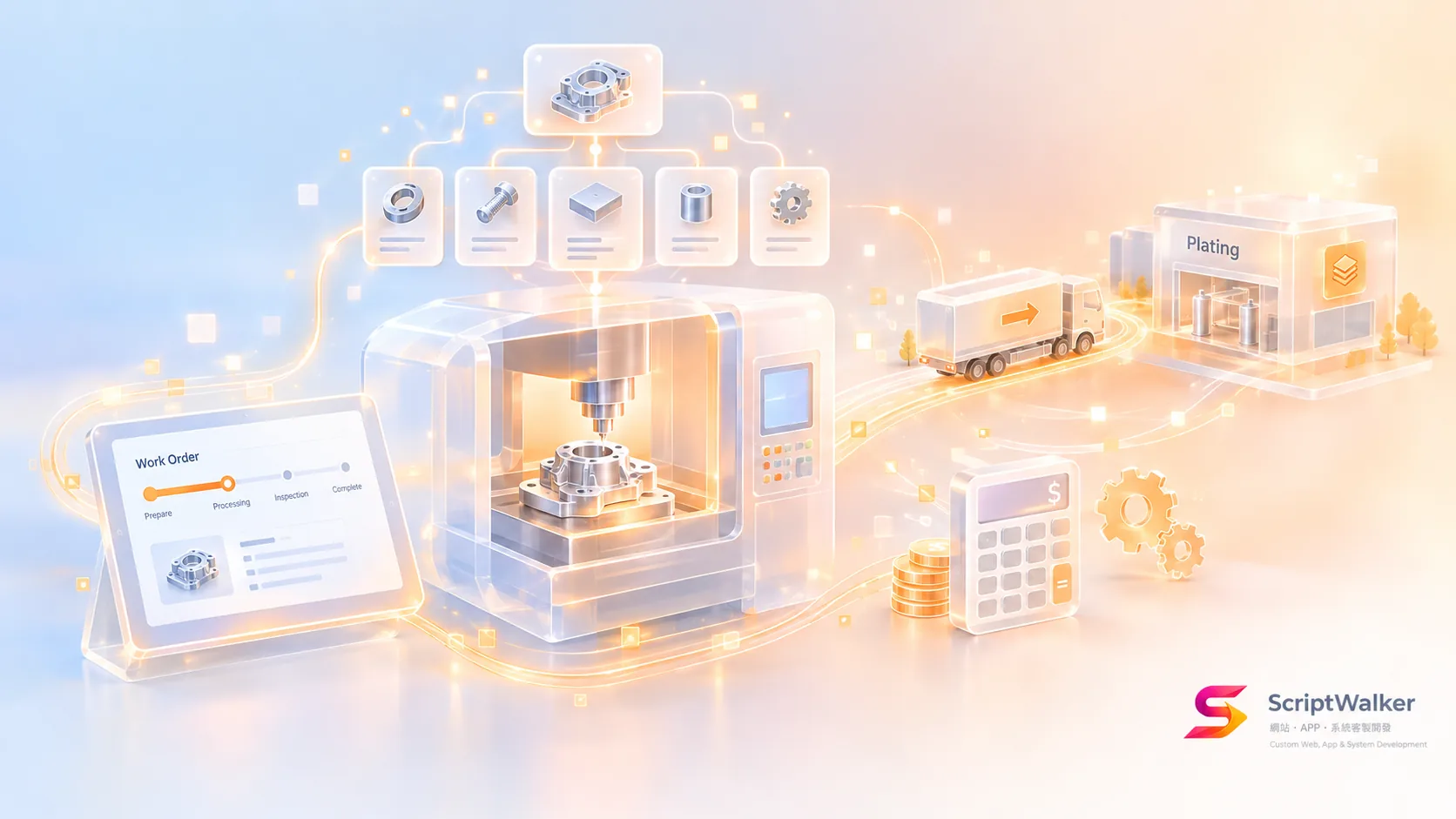
Short answer: For a 40-person high-mix precision machining shop, ERP works best in two phases: phase one covers BOM, work orders, outsourced processing and job costing in about 16–22 weeks for NT$600K–1.1M, with inventory and accounting integration in phase two. The biggest change after launch is cost-based quoting instead of the owner's gut feel.
Background and pain points: gut-feel quotes, whiteboard work orders, phone-chased outsourcing
The problem wasn't missing data but data scattered across the owner's head, a whiteboard and Excel. (Scenario compiled from common project needs; not a specific client.)
- Size: 40 people, 18 CNC lathes and mills, about 300 work orders a month, mostly equipment makers ordering 20–500 pieces.
- Quoting: the owner estimated hours from experience; quotes for similar parts varied 20%, and some part numbers lost money unnoticed.
- Work order status: on a shop whiteboard, so sales walked the floor to answer delivery questions; about 15% of deliveries were late.
- Outsourcing: plating, heat treatment and grinding at six subcontractors tracked by phone and paper, with parts "missing" every month.
Requirements: four phase-one modules fix quotes and delivery dates
Phase one only covers modules that directly affect quote and delivery accuracy.
| Module | Owner | Key functions | Phase |
|---|---|---|---|
| BOM and routing | Production control, engineering | Part numbers, materials, operations, standard hours | 1 |
| Work orders and reporting | Production control, shop floor | Dispatch, tablet start/finish, progress board | 1 |
| Outsourced processing | Production control, purchasing | Outsourcing orders, send/return, subcontractor dates | 1 |
| Job costing and quoting | Owner, sales | Actual labor and material cost, quote calculator | 1 |
| Inventory and purchasing | Warehouse, purchasing | Material stock, requisitions, receiving | 2 |
| Accounting and e-invoice integration | Accounting | AR/AP transfer, invoicing | 2 |
Why custom (hybrid) instead of packaged ERP
The shop chose custom production modules while keeping its accounting software, because the core problem was on the shop floor.
- Packaged ERP: strong finance, but work order and outsourcing flows must adapt to the software, tablet reporting often costs extra and licenses are per user.
- Open-source ERP (e.g. Odoo Community): broad features and no license fees, but Chinese manufacturing flows and local invoicing need heavy customization and ongoing maintenance.
- Custom: operations, outsourcing and costing follow the shop as it works today; accounting stays put with API transfers.
- When packaged is better: standardized products, inventory and finance as the focus, willingness to adapt processes, or upcoming listing-level internal controls.
Architecture and integrations: Laravel back office plus shop-floor tablets
The principle: the floor presses three buttons and the back office does the math.
- Laravel back office: BOM, work orders, outsourcing, costing and reports with department permissions.
- Flutter tablet app: a tablet at each machine; scan the work order QR code and tap start, pause or finish to log hours.
- LINE alerts: overdue outsourced parts and late work orders notify production control and sales.
- Accounting integration: phase two transfers shipments and receivables to existing accounting, with e-invoices following Taiwan's Ministry of Finance e-invoice platform rules.
Implementation timeline: 16–22 weeks in five stages
Cleaning up BOMs and standard hours takes longer than coding.
- Weeks 1–3 | Interviews: owner, production control, floor leads and sales; deliverables are process maps and a phase-one scope.
- Weeks 4–7 | Master data: BOMs, operations and standard hours for the 200 most-made parts; deliverable is an import sheet.
- Weeks 8–15 | Build: a test-site demo every two weeks, delivering work orders, reporting, outsourcing and costing in order.
- Weeks 16–19 | Pilot: run the lathe area first, with paper and system in parallel for two weeks.
- Weeks 20–22 | Full rollout: switch the mill area and outsourcing, and retire the whiteboard.
Cost breakdown: count tablets and master-data work too
Phase one totals about NT$600K–1.1M; ERP ranges from NT$150K to NT$1.5M by scope.
| Item | Cost | Notes |
|---|---|---|
| Phase-one development | NT$500K–900K | Four modules, back office and tablet app |
| Tablets and scanners | NT$60K–120K | About NT$5,000–8,000 each |
| Hosting | NT$2,000–5,000 a month | Cloud server and backups |
| Maintenance | From NT$2,000 a month | By response time and update frequency |
| Hidden costs | About 150–250 internal hours | Master data, training, double entry during parallel run |
Post-launch goals: 30, 60 and 90 days
The first 90 days check that data flows, then that costs are accurate.
- Day 30: 90% of work orders reported on tablets; whiteboard retired.
- Day 60: overdue outsourced parts tracked in real time; target late deliveries below 10% from 15%.
- Day 90: actual costs for main part numbers; target quote variance for similar parts within 5%, and loss-making parts identified.
Pitfalls and fixes: the five most common problems
Most issues come from data and habits, not the system.
- Building every BOM at once: start with the 200 most-made parts and add others as orders arrive.
- No one wants to set standard hours: derive them from a month of actual reports, then have leads confirm.
- Machinists avoid tablets: keep only start, pause and finish, and mount tablets at the machines.
- Subcontractors won't report: production control logs on their behalf, with QR codes on outsourcing slips scanned on return.
- Phase-one scope creep: log all new requests for phase two to protect the schedule.
Frequently Asked Questions
The questions readers ask most, each answered in the first sentence.
How much does ERP cost for a precision machining shop?
For about 40 people, phase one runs NT$600K–1.1M covering BOM, work orders, outsourcing and costing; inventory and accounting come later.
How long does ERP implementation take?
Phase one takes about 16–22 weeks. Cleaning BOMs and standard hours takes longer than development.
Can we keep our accounting software?
Yes. Customize production modules, keep accounting and connect them by data transfer, saving accounting module costs.
Will machinists actually use it?
Fewer buttons help. Tablets show only start, pause and finish, with a two-week paper parallel run before switching.
Next step: send us three typical work orders
ScriptWalker (a Taiwan Laravel/Flutter custom development studio) plans and builds custom ERP, with custom development from NT$80,000 and ERP typically NT$150K–1.5M over 16–24+ weeks depending on scope. Send three typical work orders and your current quoting method, and a free 30-minute call will tell you which modules belong in phase one:
- Email: [email protected]
- Phone: 0916-224-047
- LINE: @ufv9089p