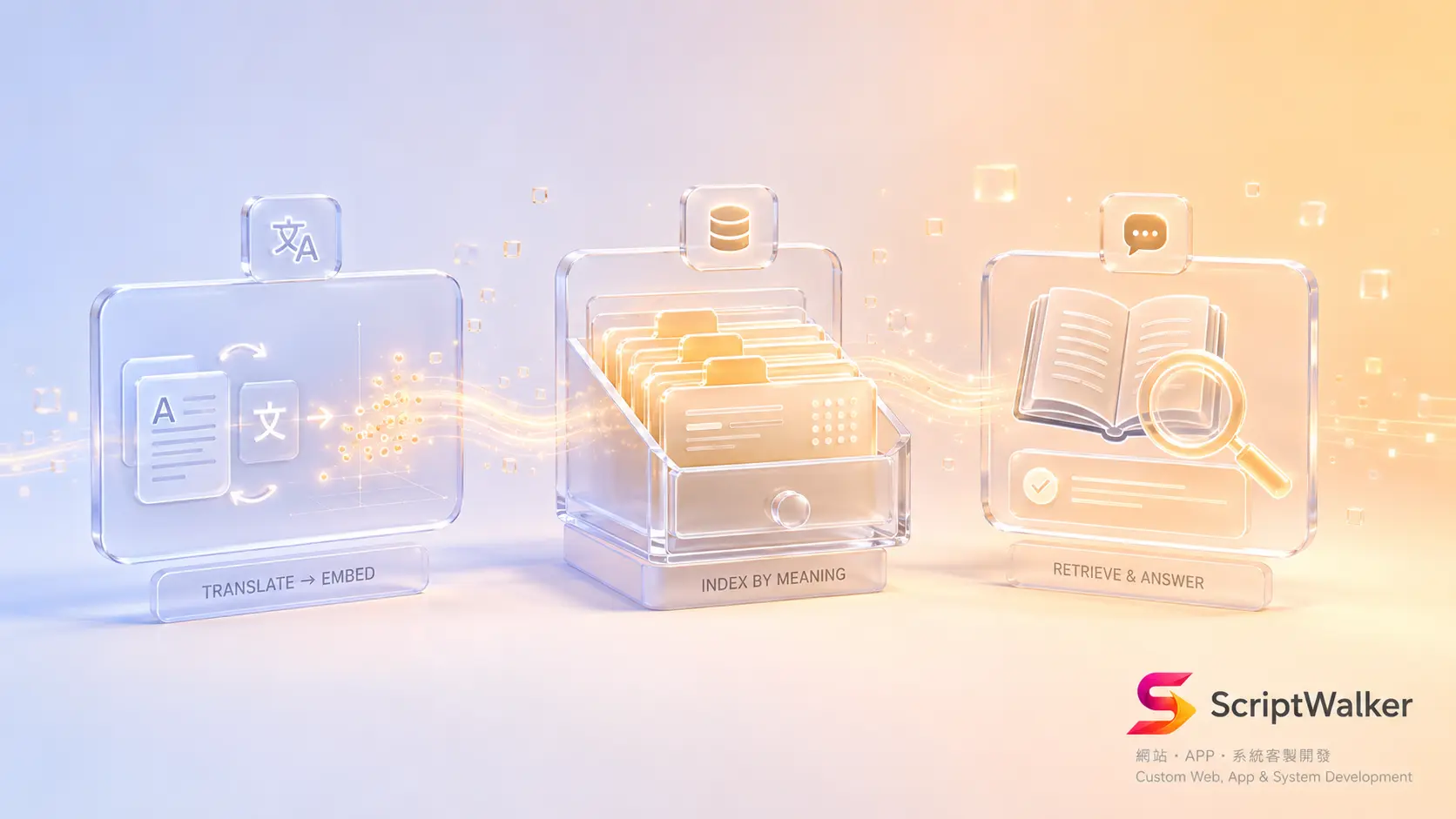
Scene: three acronyms leave an owner dizzy
An industrial-parts owner wanted an AI chatbot that could answer product-spec questions. The vendor deck read: "We use a RAG architecture, embed your documents and store them in a Vector DB." He nodded along, then couldn't recall what a single word meant — and didn't dare ask. These three terms are actually three links on one pipeline that decide whether your AI "really read your data" or "makes things up from vibes." Why cover them together? Because they're inseparable — drop any one and the chatbot falls back to the most embarrassing state: confidently wrong. Here's each with a everyday analogy.
Term 1: RAG (Retrieval-Augmented Generation) — turning AI from "answer from memory" into "open-book exam"
One line: first find the relevant passages in your data, then let AI answer based on them.
Analogy: picture an eloquent new hire who's never read your company docs. Instead of letting them wing it, you require: "always open the manual, find the right page, and answer from it." RAG is that "check the manual first" rule. Without it, AI is the new hire guessing from vibes.
Example: a customer asks "what's this bearing's temperature rating?" With RAG, AI finds the line in your uploaded spec sheet and answers "per spec sheet p.12, rated to 180°C." Without RAG, it guesses a number from generic web knowledge — confidently. That "confident but wrong" behavior is called a hallucination.
Term 2: Embedding — translating "meaning" into numbers a computer can compare
One line: convert a piece of text's meaning into a string of numbers so a computer can measure how close two texts are.
Analogy: imagine each text translated into coordinates, like latitude/longitude on a map. "Return" and "refund" differ as words but sit close together; "return" and "opening hours" sit far apart. Embedding is the machine that "translates meaning into coordinates," so the computer finds data by "how similar the meaning is," not "whether the words match exactly."
Example: a customer types "thing broke, want my money back," while your FAQ says "defective-item refund process." Keyword search finds nothing (no word matches), but their embeddings sit close, so AI retrieves the right entry. That's why semantic search understands human phrasing better than keyword search.
Term 3: Vector DB — the index-card cabinet that finds data by "meaning coordinates"
One line: a database that stores these "meaning coordinates" and finds the closest few among millions in milliseconds.
Analogy: a giant index-card cabinet sorted not alphabetically but by meaning — similar cards sit together. Bring a question and it instantly flips to the "nearby" cards. A normal database is like finding a book by title; a vector DB finds it by "topic scent." With only a few dozen pages you barely need it; with thousands of documents it's what lets AI "find the right passage instantly."
Example: you have 3,000 product docs and a customer asks about a fine spec. The Vector DB picks the 3-5 most semantically relevant passages from 3,000 in milliseconds to feed AI. Without it, you either dump everything into AI (too costly, over the length limit) or brute-force keywords (often wrong).
How the three connect (concept diagram)
Think of a four-panel comic: 1) your documents are translated by Embedding into meaning coordinates and stored in the Vector DB (prep work, done once). 2) a customer question is also embedded into coordinates. 3) the Vector DB uses those coordinates to instantly find the closest passages of your data (this is RAG's "Retrieval"). 4) "question + retrieved passages" go to AI to produce the answer (RAG's "Generation"). In one line: Embedding is the translator, Vector DB is the index-card cabinet, RAG is the whole "look it up before answering" rule. Chained, AI answers from your data instead of from vibes.
What this means for your decision
- Accuracy is 80% about data cleanup, not the model: same AI model, cleaner-data companies get far more accurate answers. Before adopting, ask: are my FAQ, specs and policies scattered across Excel, PDFs and employees' heads? That cleanup effort is the bulk of the project cost.
- Cost has two parts: one-time build (embedding data, building the Vector DB, wiring the front end) plus ongoing AI call fees (per query). Get clear on what's one-time vs monthly.
- Where data lives = your security level: post-embedding numbers still represent your content and are sensitive. Whether it's on your server or a third party, encrypted or not, and which model it's sent to directly sets your leak risk.
5 questions to ask the vendor
- Which vector database do you use, and is my data stored on my server or yours (or a third party)? Is it encrypted?
- Will my data be sent to train an AI model? How does the contract protect me?
- When AI can't find an answer, does it honestly say "I don't know" or make something up? (this tests hallucination protection)
- Who does the data cleanup, and is it in the quote? How long and how much to update a batch of documents?
- How is accuracy measured and accepted? When it's wrong, how do you trace the cause and fix it?
Common misconception
Most owners think "adopting an AI chatbot = buying a smarter ChatGPT." Reality: you're not buying a smarter model but a retrieval pipeline that makes AI answer only from your data. A powerful model fed the wrong passage still answers wrong; an ordinary model with clean data and accurate retrieval is genuinely useful. Success is decided by your data and this pipeline, not the model's name.
FAQ
Why do I need RAG — can't I just ask ChatGPT directly?
Because generic AI never read your price list, return policy or specs. Asked directly, it guesses from generic knowledge and can be confidently wrong (hallucination). RAG finds relevant passages in your data first, turning "answer from memory" into an open-book exam.
My company has little data — do I still need a vector database?
With small volumes (a few dozen FAQ pages) not necessarily; a normal database with simple search suffices. A vector DB pays off once your knowledge base has thousands of documents needing millisecond semantic retrieval. Rule: when keyword search often fails to find the right passage, go vector.
How much and how long for a RAG chatbot?
A RAG chatbot MVP over your own knowledge base is usually NT$150k-400k over 4-8 weeks, depending on data cleanup and integration scope. The biggest hidden cost isn't development but turning scattered, messy data into something AI can read; skimp there and accuracy suffers.
Could Embedding and the vector database leak my confidential data?
It depends on architecture. Embedding turns text into numbers that still represent your content, so treat them as sensitive. Ask the vendor: where is it stored, is it encrypted, which model is it sent to, and will it be used for training. Put those four in the contract rather than trusting "it's secure."
Call to action
Want to turn your FAQ, specs and policies into an AI chatbot that only speaks from your data and doesn't fabricate? We offer a free 30-minute technical consult to assess your data, estimate build and monthly costs, and demo a small RAG prototype. ScriptWalker builds long-lived AI applications with Laravel + Flutter.
- Email: [email protected]
- Phone: 0916-224-047
- LINE: @ufv9089p