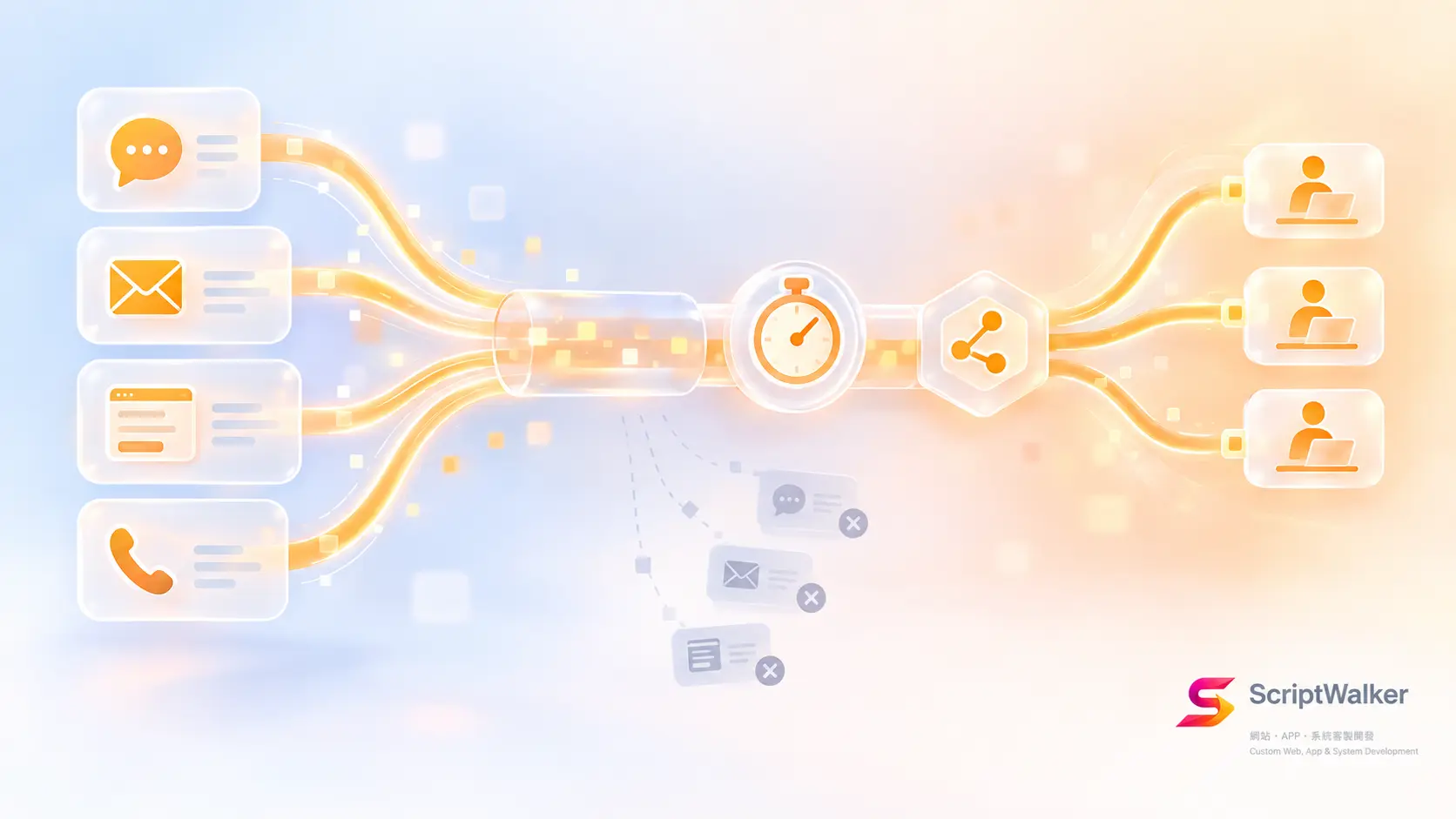
A 28-person custom cabinetry company in Taiwan gets about 200 inquiries a month: 90 through its LINE Official Account (LINE is Taiwan's dominant messaging app, and businesses run "OA" accounts on it), 60 through the website form, 30 by email and 20 by phone. Three salespeople each watch their own phone and inbox. When the operations manager audited September, the average time from a customer's message to the first human reply was 11 hours, and 61 inquiries (about 30%) never got a reply at all. The average order is around NT$150,000. The owner's question: pay an agency NT$100,000 to connect everything, or have an assistant learn n8n?
1. Four myths about answering inquiries
- "Missed leads are occasional slips." They are usually structural. An HBR audit of 2,241 US companies (2011) found only 37% responded to a web lead within an hour, and 23% never responded. With four entry points, nobody owns any single inquiry.
- "An auto-reply counts as a response." "We got your message" is a receipt. Your SLA should measure the first human reply.
- "A CRM will fix it." Inquiries sitting in LINE chats and personal inboxes never reach the CRM, so it cannot see them.
- "Let AI quote directly, it's fastest." One wrong dimension or site condition becomes a margin loss. AI is good at triage and drafting; a person should approve what goes out.
2. The framework: a missed-lead formula plus a three-layer pipeline
Monthly lost margin = monthly inquiries × miss rate × baseline close rate × average margin per deal
For the company above: 200 × 30% × 8% × NT$52,500 (35% margin) ≈ NT$250,000 of margin a month. That excludes the cost of replying slowly: the same HBR study found firms that contacted a lead within an hour were nearly seven times as likely to reach a meaningful conversation with a decision maker as those that waited even an hour longer.
- Layer 1, centralize data: all four channels write to one inquiry table with source, received timestamp and customer ID. The form posts to a webhook, LINE messages arrive through the Messaging API webhook, email goes to a dedicated forwarding address, and whoever answers the phone logs a short form within a minute.
- Layer 2, automate the flow: route by product line; if no human reply within 1 business hour, alert the manager; after 4 hours, reassign.
- Layer 3, smarter decisions: AI tags intent, budget and urgency and drafts a reply that sales edits before sending; review first-reply time and close rate per channel every week.
3. Three companies, three answers
| Scenario | Today | Recommendation |
|---|---|---|
| 8-person design studio | 40/month, two channels | Layer 1 plus LINE alerts; Make Free or Core is enough |
| 28-person cabinetry firm | 200/month, four channels | Layers 1–2, built by an agency |
| 120-person equipment supplier | 600/month, existing ERP | All three layers, linked to the ERP customer master |
4. Hidden costs: DIY vs. outsourcing
- Tools: n8n Cloud Starter from €20/month billed annually with 2,500 executions; Make Core from US$12/month; self-hosted n8n is free, but a server runs about NT$600–1,500 a month.
- DIY build time: an assistant learning on the job needs 60–100 hours, roughly NT$18,000–30,000, and their normal work slips 2–3 months.
- Maintenance: expired tokens and changed form fields take 4–8 hours a month.
- Silent failure: a flow broken for a week unnoticed scatters about 50 inquiries, around NT$50,000 of margin at risk by the formula.
- Outsourced: Layers 1–2 about NT$80,000–150,000 over 4–6 weeks; Layer 3 another NT$50,000–100,000; maintenance NT$5,000–15,000 a month.
5. Scorecard for an integration vendor (10 criteria, 0–2 points each)
- Measures your current reply time and miss rate before quoting
- Has a plan for all four channels, including phone
- Defines the SLA by first human reply
- Builds failure alerts
- Keeps data in your accounts
- Requires human approval of AI drafts
- Delivers a flow diagram and account inventory
- States tool fees and execution limits in writing
- Puts maintenance scope in a written SLA
- Runs a 30-day post-launch data review
Under 14 points: ask for fixes or look elsewhere.
6. How ScriptWalker fits, and when we don't
- Advisory: 4–8 hours to map channels and calculate lost margin, with a blueprint you can build yourself.
- Project: build Layers 1–2 on a Laravel back office or n8n.
- Retainer: maintain alerts, tune routing rules, monthly report.
- Full outsourcing: all three layers plus ERP/CRM integration.
We are not the right fit if:
- You get fewer than 30 inquiries a month; one person with a phone can handle it.
- Nobody is willing to own the SLA.
- You want AI to send quotes with no human review.
- Your CRM already has a shared inbox module; finish configuring it first.
7. 90-day launch playbook
- Month 1: log two weeks of inquiries with channel, received time and first-reply time to set a baseline; name an SLA owner.
- Months 2–3: launch the unified table and routing; start with a 4-hour SLA and tighten to 1 hour; pilot Layer 3.
- Day 90: compare reply time, miss rate and close rate, rerun the formula and decide whether to expand.
8. Decision checklist
- ☐ I know monthly inquiries per channel
- ☐ I have measured average first human reply time
- ☐ I know our miss rate
- ☐ I have calculated monthly lost margin
- ☐ Every inquiry lands in one table
- ☐ Phone inquiries get logged too
- ☐ Every inquiry has an owner
- ☐ Overdue inquiries alert a manager
- ☐ Broken flows trigger alerts
- ☐ A person approves AI drafts
- ☐ The data sits in company-owned accounts
- ☐ We review the reply-time report weekly
9. FAQ
How long should the SLA be?
Measure the baseline first, then tighten. Most small businesses start at 4 business hours and move to 1 hour once stable; after hours, an auto-reply states when you will respond the next day.
n8n or Make?
Low volume and no engineers: Make is quicker to learn. Self-hosting or high volume: n8n fits better. Either way, someone has to maintain it.
Can LINE OA messages flow into the inquiry table automatically?
Yes. Enable the Messaging API and set a webhook; user messages are sent to your server or automation tool, which writes them to the table.
What if AI triage is inaccurate?
Start with AI tagging only and let sales correct it. After 1–2 months of corrections, adjust the rules; do not rely on it for routing on day one.
10. Next step
Want to know how many inquiries you lose each month? Bring two weeks of inquiry records to a free 30-minute consultation; we will run the lost-margin formula together and decide whether to build it yourself or outsource.
- Email: [email protected]
- Phone: 0916-224-047
- LINE: @ufv9089p