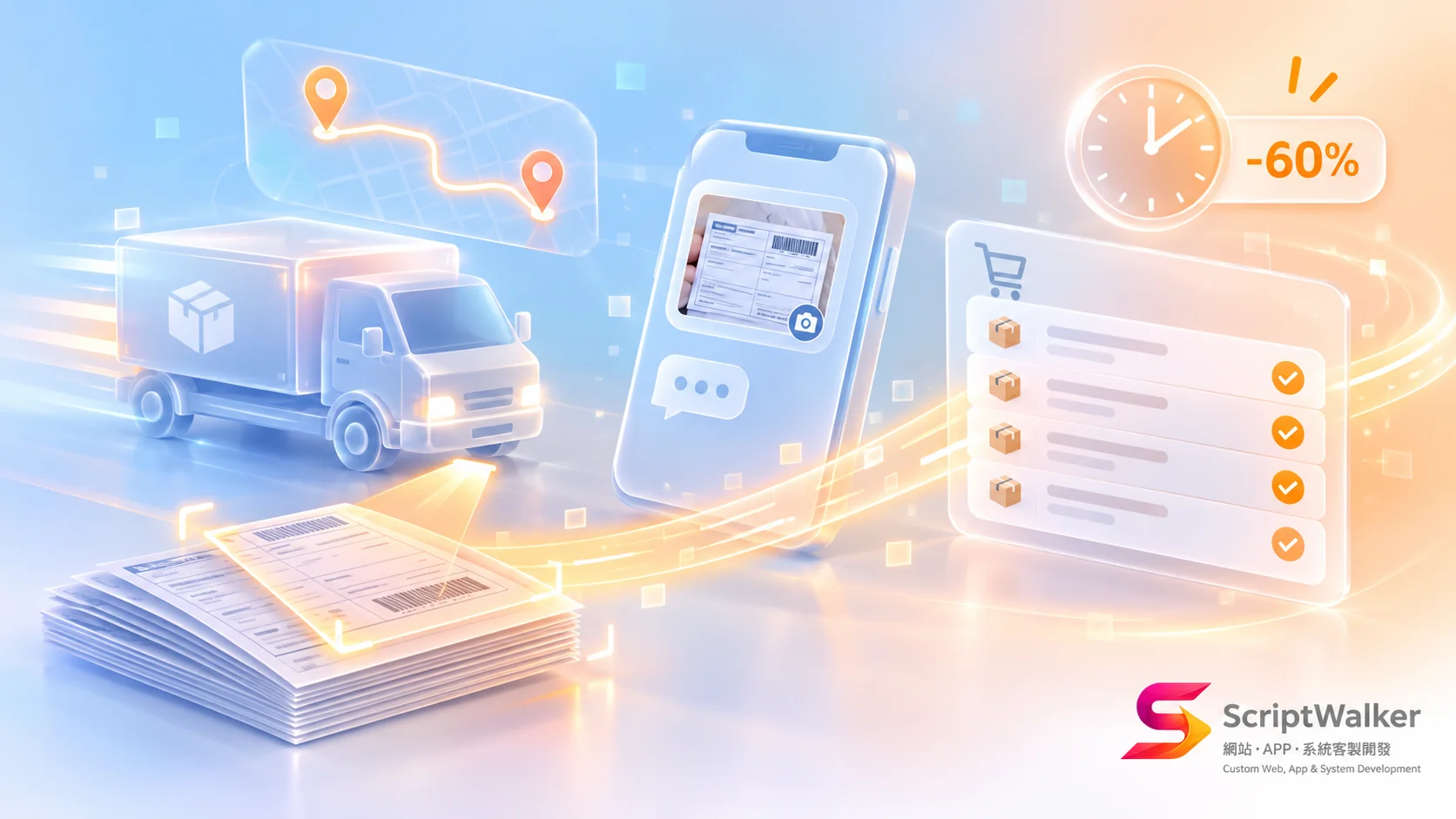
Direct answer: A small trucking company should start with waybill recognition and automatic order entry, with route planning second. A company handling about 300 handwritten or LINE-photo waybills a day can cut order-entry time by about 60%, for roughly NT$250K–400K and payback in about 7–12 months; once addresses and parcel counts are right, routing and tracking get accurate too.
Industry snapshot: the trucks are digital, the office still types
In trucking, most AI opportunity sits in order intake and customer service, not the driver's seat. According to Taiwan's Ministry of Transportation 2025 employment survey for transportation and warehousing, average monthly pay was NT$67,793, up 4%, with 169.3 working hours a month, above the all-industry average. Labor keeps getting pricier, yet many companies with 10–50 trucks have GPS in every vehicle while 2–4 office staff still key in faxes, LINE photos and handwritten forms one by one, at about 1.5–2 minutes each; a mistyped address means a re-delivery.
Four typical AI use cases
For small trucking firms, the fastest payback comes from cases that remove typing and phone calls.
- Waybill recognition and order entry: Read photos, faxes and PDFs, extract sender, recipient, address, parcel count, volume and cash-on-delivery, and create orders.
- "Where is my shipment" replies: Customers enter a tracking number on LINE and AI answers with the status, even at night.
- Exception sorting: Refusals, unclear addresses and damage reports are classified, routed to the right staff and the shipper is notified.
- Route planning suggestions: Draft routes by address, time window and vehicle type for dispatchers to adjust.
Real cases: how two trucking companies did it
Both cases show that keeping humans in the loop first, then letting go gradually, has the lowest failure rate.
- Company A in Taoyuan (25 trucks, less-than-truckload): About 300 waybills a day, 60% photographed by customers on LINE. A PoC on 200 historical waybills reached 96% field accuracy for printed forms and 88% for handwritten ones. In production, high-confidence fields create orders automatically and low-confidence ones are highlighted for staff; one of three agents moved to exception handling, and daily typing fell from about 9 hours to 3.5. Lesson learned: customers photographed several forms in one picture, so a LINE prompt now asks for one form per photo.
- Company B in Taichung (12 refrigerated trucks): Started with exception sorting and automatic notices. Of about 150 exceptions a month, once handled by phone, 70% now trigger an automatic LINE message, and complaint calls fell by about half. Lesson learned: early on the AI confused "delayed" with "refused" until 80 labeled examples were added.
Recommended tool stack
Off-the-shelf services are enough; no custom model training is needed.
| Purpose | Tool | Why |
|---|---|---|
| Text recognition | Google Document AI or Azure Document Intelligence | Handles Traditional Chinese and handwriting, priced per page, cheap at low volume |
| Field structuring | OpenAI GPT or Claude API (structured output) | Turns messy text into fixed fields with confidence scores |
| Intake channel | LINE Messaging API | Customers already send waybills on LINE |
| Workflow | n8n or Laravel queues | Connects OCR, model and the existing order system |
| Review screen | Laravel back office | Highlights low-confidence fields for one-click fixes |
ROI model: about NT$35,000 saved per month
Assuming 300 waybills a day and two staff dedicated to entry, payback is about 7–12 months.
- Investment: NT$250K–400K to build; OCR and model fees about NT$3,000–8,000 a month (depending on API pricing and volume).
- Time saved: 60% of about 10 hours of daily entry is 6 hours × 22 days = 132 hours, about NT$33,000 a month at NT$250/hour.
- Fewer errors: About 40 re-deliveries a month from wrong addresses at about NT$300 each; halving them saves about NT$6,000.
- Net benefit: About NT$34,000–36,000 a month; after fees, payback in about 7–12 months.
Rollout timeline: Phases 1–4 in about 11–16 weeks
Measuring accuracy before integrating is the key to avoiding wasted work.
- Phase 1 | Assessment (2 weeks): Collect 500 historical waybills; count formats, handwriting share and common errors.
- Phase 2 | PoC (3–4 weeks): Recognize 200 and measure accuracy per field; below 85%, adjust intake first.
- Phase 3 | Pilot (4–6 weeks): Connect LINE and the order system; every order is confirmed by staff before creation.
- Phase 4 | Production (2–4 weeks): High-confidence orders are created automatically, with monthly error reviews and new examples.
Common failure modes and fixes
Failures usually come from expectations and data, not weak models.
- Expecting 100% automation: Handwriting will always have unclear characters; design a "highlight for humans" flow.
- Messy customer codes and addresses: Clean frequent customer and address master data first so AI can match them.
- Poor photos: An automatic LINE prompt to shoot straight, one form per photo, improves quality immediately.
- Cash-on-delivery errors: Always have staff double-check amount fields.
- Unclear personal data handling: Waybills carry names, phones and addresses; confirm cloud services do not train on your data and set retention limits.
Where AI does not fit
In these cases, fix the process or add a form before adding AI.
- Fewer than 50 waybills a day, typed in under an hour.
- Major customers already upload via API or Excel batches.
- Dangerous or high-value goods that require item-by-item human checks.
- No order system yet; everything is still on paper.
ScriptWalker's offering
ScriptWalker (a Taiwan-based Laravel/Flutter custom development studio) offers AI order entry for trucking: a PoC accuracy assessment from NT$60,000 (2–4 weeks), and full waybill recognition with a review back office from NT$250,000, with optional LINE tracking replies and exception notices.
Frequently Asked Questions
How accurate is AI waybill recognition?
Printed forms often reach 95%+ field accuracy and handwritten ones about 85–92%, so keep human review for low-confidence fields.
How much does AI cost for a trucking company?
Waybill recognition and order entry costs about NT$250K–400K over 11–16 weeks, plus NT$3,000–8,000 a month for models and OCR.
Why not start with route planning?
Route planning needs clean order and address data; get order entry accurate first and routing results follow.
Do customers have to switch to a fixed form?
No, AI reads many formats, but offering big customers an online order form improves accuracy and speed further.
Decision checklist and next step
Six or more yes answers means a waybill AI PoC is worth doing first.
- ☐ More than 150 waybills a day
- ☐ 30%+ arrive as photos, faxes or handwriting
- ☐ Two or more staff mainly do data entry
- ☐ More than 20 re-deliveries a month from address errors
- ☐ An order or dispatch system exists to integrate with
- ☐ Customers mainly send waybills on LINE
- ☐ You can provide 500 historical waybills for testing
- ☐ You are willing to keep a human review step
- ☐ Someone owns the monthly error review
Send us 20 de-identified sample waybills for a free feasibility assessment:
- Email: [email protected]
- Phone: 0916-224-047
- LINE: @ufv9089p