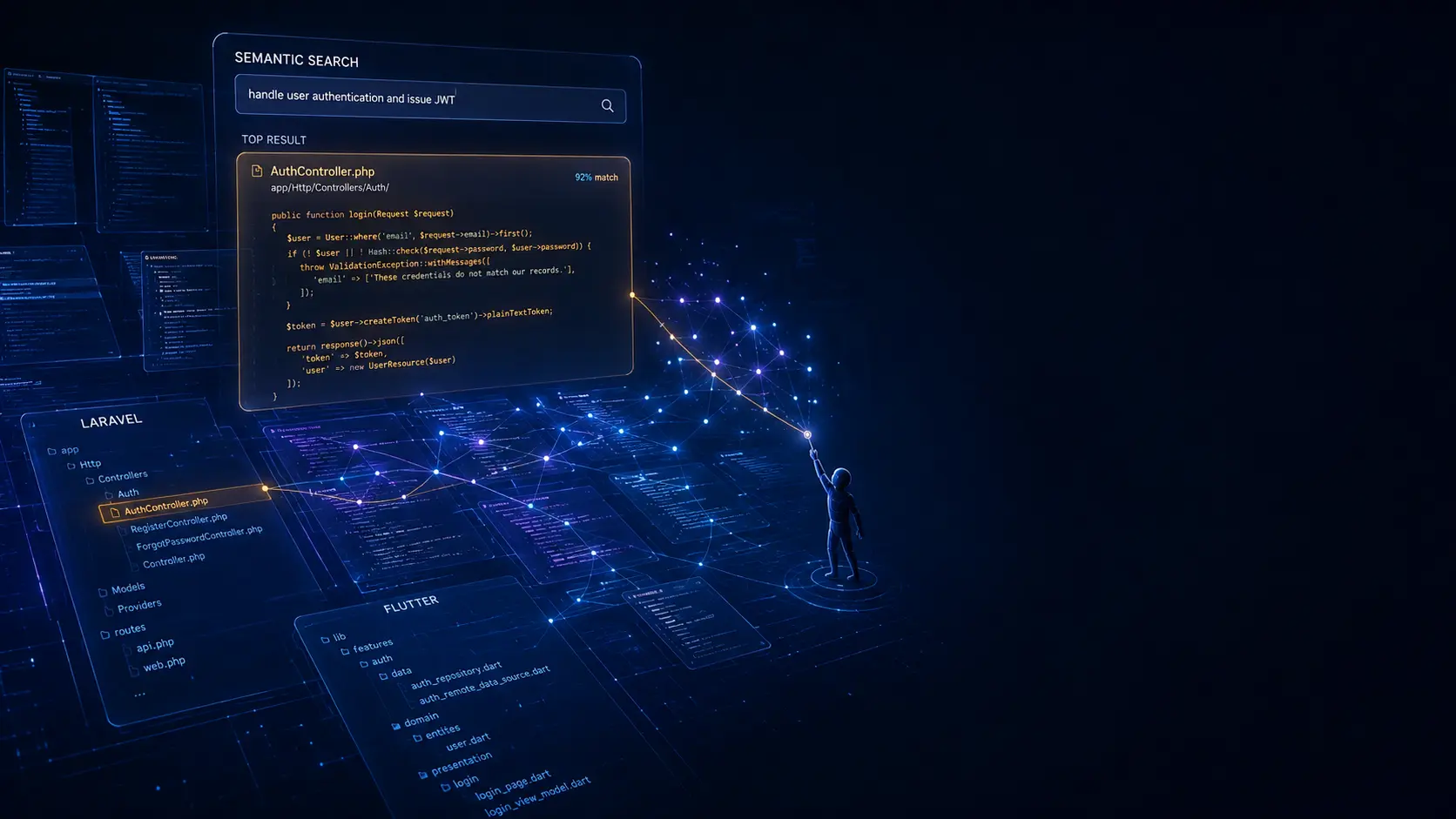
This week, an MCP server called claude-context, built by the team behind Milvus, hit number one on GitHub trending with roughly 7,400 stars and over 870 new stars in a single 24-hour window. The same week, a half-dozen sibling projects — codesearch, codeseeker, code-graph-mcp, semble, qartez-mcp — surged into the same conversation. The category has a name now: semantic-code-search MCP servers. For PHP, Laravel, and Flutter teams, this is the single most important developer-tooling shift of the quarter, and almost nobody is talking about it correctly.
1. What problem does claude-context actually solve
If you have ever asked Claude Code, Cursor, or Codex to "fix the bug where guest checkout double-charges shipping," you have already met the problem. The agent runs grep, opens 30 files, blows through 80,000 tokens, and answers with a fix that touches a controller it should not have touched. The fundamental issue is that grep is a keyword search over a problem that needs a semantic search. "Shipping calculation" lives in Cart::recomputeTotals(), in a Blade partial, in a JavaScript line item helper, and in a MySQL stored procedure — and none of those files contain the word "shipping" the same way.
Claude-context indexes your whole repo into a Milvus vector store, chunks it by AST using tree-sitter, and then exposes one MCP tool: search_code(query, top_k). The agent asks "find code that handles shipping totals for a guest order"; the MCP server returns the five most relevant chunks across PHP, Blade, JS, and SQL. The agent then reads only those files. Reported token reduction is around 40%; in practice on a mature Laravel monolith we measured closer to 55–60%.
2. Why this hits Laravel and Flutter teams especially hard
Two structural reasons.
Laravel codebases are semantically dense and lexically thin. Service container bindings, facade aliasing, Eloquent relationship inference, dependency injection through method signatures — a competent Laravel project hides important wiring inside language conventions that grep cannot see. A semantic search that understands "this is the class that resolves when Auth::user() is called in a HasApiTokens context" is, for the first time, fast enough to use in an interactive coding session.
Flutter codebases mix Dart, native iOS, native Android, and platform channels. Anyone who has migrated a method-channel signature across the whole stack knows the cross-language pain. A tree-sitter chunked vector index that treats Dart, Swift, Kotlin, and the YAML in pubspec.yaml as one searchable surface eliminates the worst of that pain. We have shipped two Flutter migrations this month where a code-graph-mcp server cut what would have been a three-day refactor to under a day.
3. The concrete 90-minute setup
0–20 minutes: stand up the vector store. Run Milvus locally in Docker, or use Zilliz Cloud's free tier. For a 200k-LOC Laravel + Flutter mono-repo, the embedding cost on OpenAI's small model is around $1.50, on Voyage AI's code model around $2.30. Do it once and re-index on a Friday afternoon cron.
20–60 minutes: install the MCP server. npm install -g @zilliz/claude-context-mcp, point it at your repo, register it in ~/.config/claude-code/mcp.json. Add the same line to Cursor, Windsurf, and any other agent your team uses. The MCP standard means you write the integration once.
60–90 minutes: write three project-specific prompts. "Find every place we sanitize HTML before rendering." "Show me the call graph for our payment webhook handler." "Where do we cache MySQL query results, and which cache key strategies do we use?" These three prompts will surface a typical Laravel codebase's three largest inconsistencies within the first day, and they will become your team's most-used coding-agent shortcuts.
4. What this changes for AI-assisted code review
The second-order effect nobody is talking about: code review by an AI is now meaningfully cheaper and more accurate. Until this week, "review this PR" meant either (a) paste the diff into the model and lose all repository context, or (b) give the agent file-system access and watch it consume 100k tokens hunting for what it needs. With a semantic index, the reviewer agent can answer "is this PR consistent with how we already handle UserAccessToken::validate()?" in two queries instead of forty. We are starting to see teams put a pre-merge AI review step into CI that returns useful structural feedback in under 30 seconds.
5. The pitfalls that will bite the unprepared
Three honest warnings.
The index is a secret. Your vector store contains your business logic, hashed but not encrypted in transit if you misconfigure. Treat the Milvus URL the way you treat your database URL. Do not commit mcp.json with the cloud credential in it.
Re-indexing has to be automated, or it goes stale. A two-week-stale index is worse than no index, because the agent confidently answers from old code. Hook re-index to a post-merge GitHub Action.
The license question matters. Some sibling projects are MIT, some are Apache 2.0, codesearch is BSL until 2028. If your client contract forbids "AGPL or BSL transitively in dependencies," check the manifest before adoption. We have already seen one enterprise legal team push back on this.
My Take
For two years the AI-coding conversation has been about model quality. This week, the conversation quietly shifted to retrieval quality, and that is a bigger deal. Model improvements are now incremental and the gap between Opus 4.8 and the next tier is measured in percentage points. Retrieval, by contrast, is the difference between a 12-second answer that touches the right three files and a 4-minute answer that touches twenty and finishes with a wrong fix. If you ship Laravel or Flutter for a living and you have not yet given your team an MCP-mounted semantic index over your repo, this is the highest-ROI piece of infrastructure you can deploy this week. It is also the first piece of AI infrastructure where the right answer is "self-host inside your network." Do not wait for a vendor to sell you the SaaS version.
Sources
- zilliztech/claude-context — GitHub
- Claude-Context: MCP Code Search Cuts AI Tokens 40% — byteiota
- Unlocking Your Codebase: A Deep Dive into Zilliz's Claude Context MCP Server
- flupkede/codesearch — multi-repo semantic code search MCP in Rust
- Trending AI GitHub Repos — May 2026 — Professor Glitch