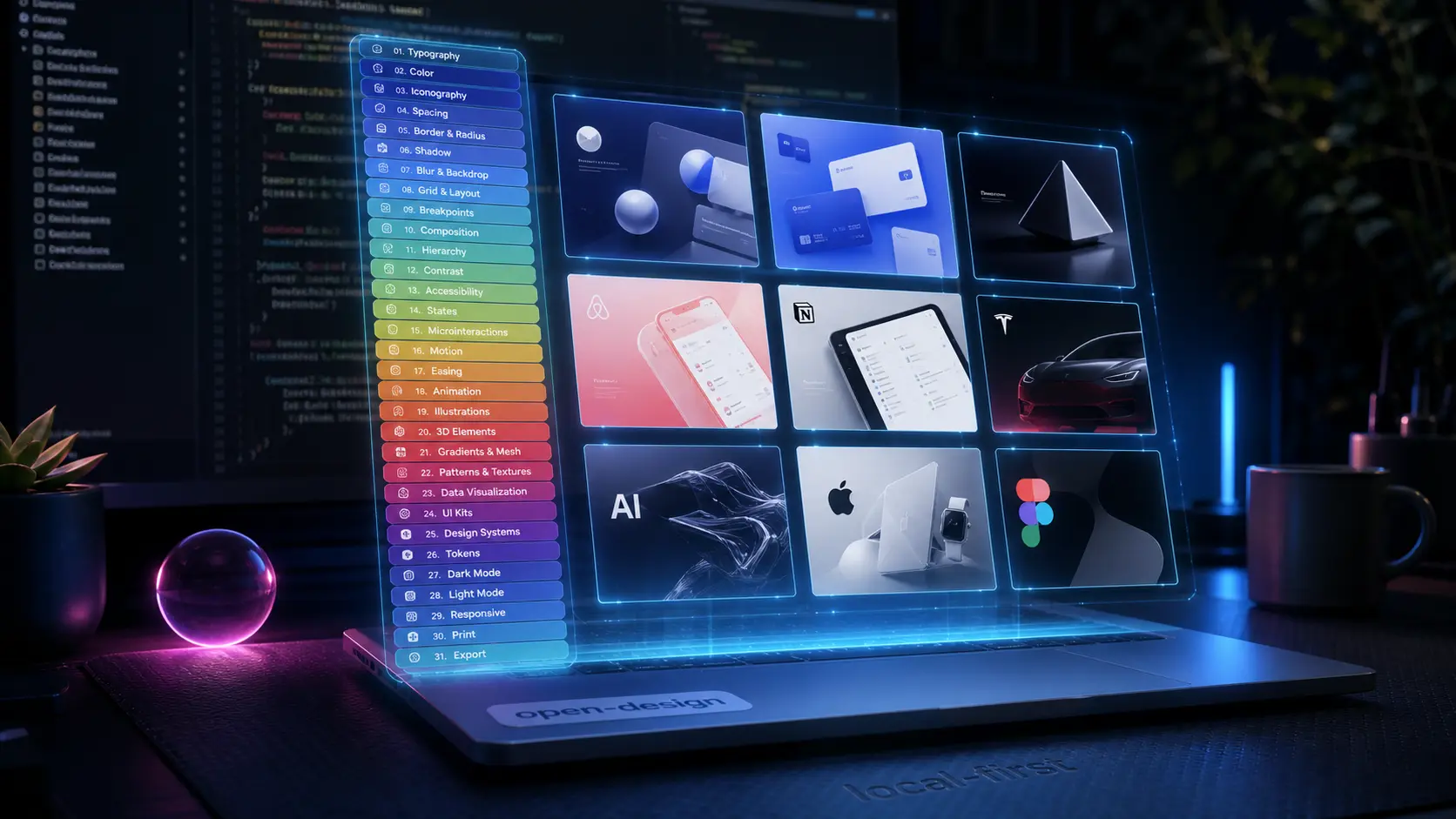
If you spent April reading about Anthropic's hosted "Claude Design" and quietly worrying that another walled garden was about to swallow the front-end design loop, May 2026's GitHub trending list answers back. nexu-io/open-design opened the month at almost no stars and is now sitting at roughly 8,500, the single fastest-growing web/design repo on GitHub right now. It bills itself plainly: "Local-first, open-source alternative to Anthropic's Claude Design."
What it actually ships is more interesting than the tagline. The repo bundles 31 composable design Skills (typography, layout, motion, icon, palette, etc.) and 72 brand-grade Design Systems — Linear, Stripe, Vercel, Airbnb, Tesla, Notion, Anthropic, Apple, Cursor, Supabase, Figma, Xiaohongshu, and dozens more — in plain Markdown that any modern coding agent can read. From a single CLI it auto-detects 13 coding-agent CLIs already on your PATH (Claude Code, Codex, Cursor Agent, Gemini CLI, OpenCode, Qwen, Copilot CLI, Hermes, Kimi, Pi, Kiro, Mistral Vibe, Devin for Terminal) and uses whichever one you have. The output isn't a screenshot — it is a sandboxed, runnable preview that exports to HTML, PDF, PPTX, or MP4.
For PHP and full-stack web developers, three things matter.
1. Prototyping Cost Just Collapsed
The classic agency loop — Figma file, design review, dev hand-off, Tailwind translation — is replaced by open-design "Build a Stripe-style billing dashboard for our Laravel app, dark mode, with the receipts list in shadcn cards". The skill files enforce a checklist culture (contrast, spacing scale, focus states, RTL, motion-reduce) so the output isn't another generic AI mush-design.
2. The Design System Is Now a Markdown File
A single design-systems/your-brand.md becomes the source of truth: any LLM in your stack can render to it, your CI can lint against it, and your designers can edit it without leaving VS Code. This is the AEO/GEO logic from last week applied to internal tooling — make your brand machine-readable and every agent on the team becomes brand-compliant by default.
3. BYOK at Every Layer
BYOK means it is finally usable inside enterprise PHP shops. You point it at your own Anthropic, OpenAI, Bedrock, or self-hosted Qwen endpoint. No data leaves your laptop. For agencies in regulated industries this is the difference between "interesting demo" and "we ship this on Monday."
The Honest Caveats
8,500 stars is not 80,000, the Skills library is community-curated and uneven in places (the Tesla and Xiaohongshu systems are stronger than the older starters), and the auto-detect logic for coding agents will fight you if you have non-standard CLI installs. Expect the next 30 days to be a feature-velocity blur — the repo's issue tracker is already shipping multiple PRs a day.
My Take
The pattern of the last 12 months has been: hosted SaaS launches a magic feature, the open-source community ships a local-first Markdown-and-skills-folder version 30–60 days later, and the open version wins inside engineering teams because it composes with the agents and editors people already pay for. Mago did this to PHPStan last week. Open Design just did it to Claude Design. If you run a web shop, archive your old "design tokens.json," write your brand into one Markdown file, and call it from the same agent that writes your PHP. The "designer / developer / prompt engineer" job description is collapsing into one Markdown editor with a CLI underneath.
Sources
- nexu-io/open-design — GitHub
- open-design README (English)
- open-design 中文 README
- open-design Skills directory
- open-design Design Systems directory