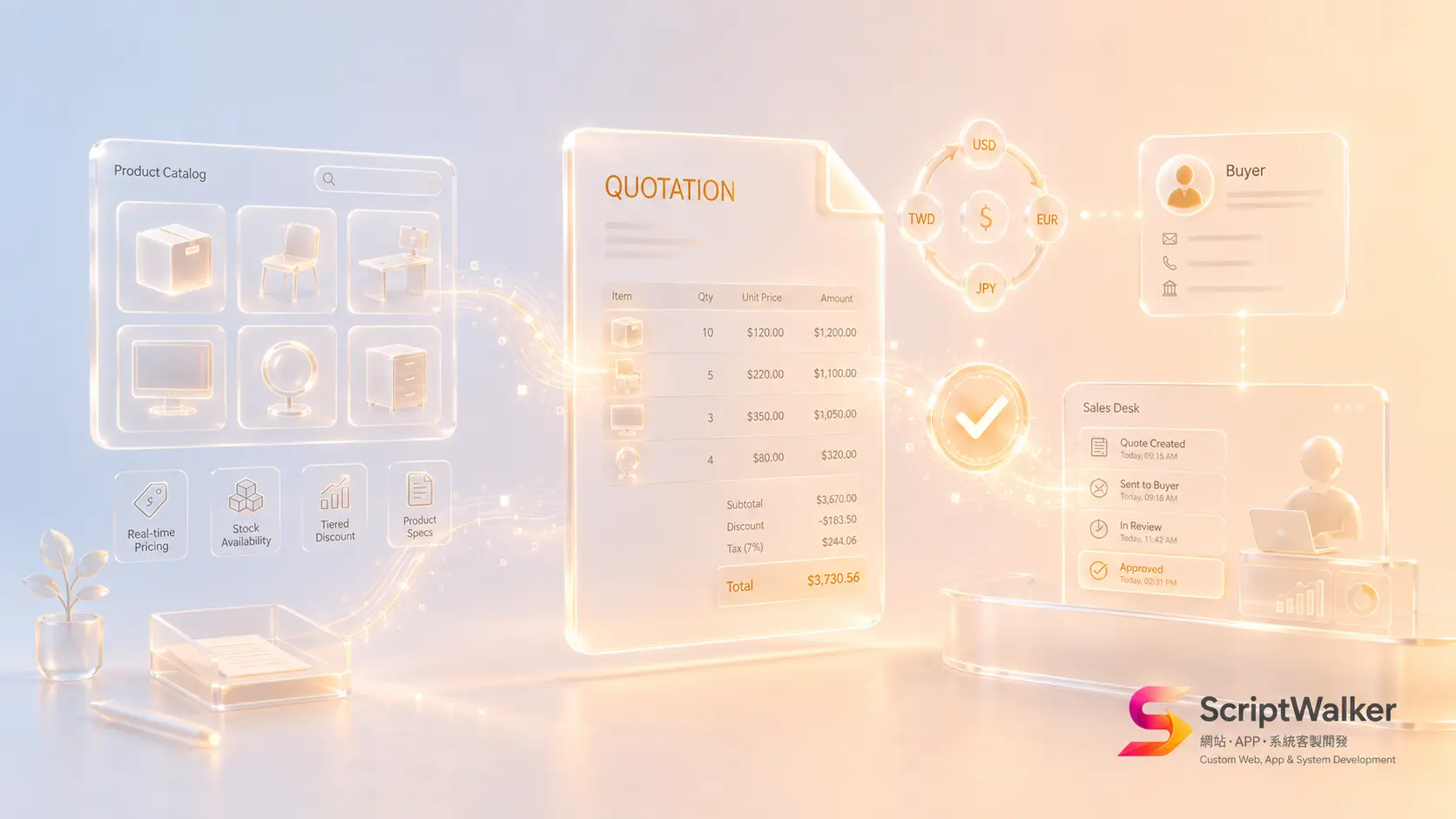
An industrial-parts trading company has 4,000 SKUs, 300 customers, and a different discount for every one of them. All day, sales reps open an Excel price list, copy-paste, calculate the exchange rate, save a PDF, and send it over chat — 40 minutes per quote, and if the customer changes a quantity, they start over. In peak season, "sending quotes" eats half the day, and when a customer says "tweak the one from last time," nobody can find the file. The owner asks: "Can we have a system where customers submit RFQs themselves and reps generate a quote in a few clicks?" This guide breaks down the B2B RFQ / quotation system — from product catalog, customer-specific pricing, and PDF quotes to multi-currency and approval flows — with real costs and a 90-day roadmap.
When It Fits vs When It Doesn't
- Fits: B2B trading and manufacturing with many SKUs, complex specs, and "one price per customer"; wholesalers who quote constantly, juggle quote versions, and need to track RFQ-to-order conversion; exporters needing multi-currency and FX conversion.
- Fits: Companies where quotes need manager approval (discounts beyond a rep's limit require sign-off), who want to mine RFQ history for customer insight, or who want returning customers to self-serve their own RFQs.
- Doesn't fit: Public, transparent pricing you can add-to-cart and check out (that's e-commerce, not RFQ); fewer than 50 SKUs and under 10 quotes/month (Excel plus a template is enough — don't over-invest); one-off project quotes with no repeat customers (a document template will do).
Alternatives Matrix
| Option | Cost band | Pros | Cons |
|---|---|---|---|
| Excel price list + PDF | Almost free | Zero learning curve, flexible | No version control, wrong FX, lost files, no self-serve RFQ, no data |
| Generic CRM quote module (Zoho/HubSpot) | ~US$20–75/user/mo | Fast launch, built-in pipeline | Weak catalog and tiered pricing, limited self-serve RFQ, low customization ceiling |
| ERP built-in quoting (SAP B1, etc.) | From hundreds of thousands NT$ + annual fee | Connected to inventory and finance | Heavy rollout, weak customer-facing portal, inflexible quoting and UI |
| Custom Laravel RFQ platform | From NT$180,000 | Full control of catalog, custom pricing, approvals and brand; ERP-ready | Higher cost and timeline, needs ongoing maintenance |
Full Process (Phases + Time + Deliverables + Tools)
- Phase 1 — Requirements & pricing rules (1–2 weeks): map catalog structure, customer tiers, tiered/custom-price rules, approval limits, quote templates. Deliverable: spec and pricing-logic sheet (Notion).
- Phase 2 — Information architecture & wireframes (1 week): customer RFQ portal, sales quoting console, PDF quote layout. Deliverable: wireframes and prototype (Figma).
- Phase 3 — Core build (4–8 weeks): product catalog, customer-specific pricing engine, RFQ cart, auto-generated PDF quotes, approval flow, multi-currency FX. Deliverable: test environment (Laravel + Vue, PDF via DomPDF, rates via ExchangeRate-API).
- Phase 4 — Integration & launch (2 weeks): connect ERP/accounting, import legacy catalog and customers, training, load testing. Deliverable: launch checklist and training docs. Verify performance against Core Web Vitals such as LCP.
Real Cost Breakdown
- Development: standard build (catalog + custom pricing + PDF quotes) from ~NT$180,000; with approval flow, multi-currency and ERP integration ~NT$300,000–500,000.
- FX API (hidden): free tiers refresh slowly; commercial real-time rates run ~US$10–50/mo. One wrong rate can wipe out a deal's margin.
- Payments (optional, hidden): to collect deposits, ECPay is ~2.8%, Stripe ~3.4% + NT$10/transaction.
- ERP integration (hidden): success hinges on whether their ERP exposes an API; custom connectors often add NT$50,000–150,000.
- Maintenance & hosting (hidden): cloud hosting, catalog updates, FX and tax-rule maintenance — roughly 15–20% of build cost per year.
Reality vs What Clients Imagine
- Imagined: just import the Excel. Reality: dirty data (same item written many ways, inconsistent units, missing SKUs) often eats half of Phase 4 — catalog governance is the invisible project.
- Imagined: pricing is just a discount. Reality: B2B stacks "customer tier x quantity break x promotion x currency"; designing the pricing engine is far harder than the UI.
- Imagined: customers will self-serve RFQs. Reality: long-time customers prefer phone and chat; migration needs reps to push it and give incentives (faster replies, visible custom prices).
Common Pitfalls & How to Avoid Them
- Pricing rules hard-coded: every discount change needs a developer. Build a configurable engine so sales maintains rules themselves.
- No quote versioning or expiry: customers haggle with old prices. Lock a version number, quote date and validity days; expire automatically.
- FX not snapshotted: pulling only live rates breaks reconciliation. Snapshot the rate at quote time and store it on the record.
- Approval flow blocks sales: requiring sign-off on every discount kills speed. Use limits — in-limit quotes go out instantly, only over-limit ones route to approval.
- Quote PDFs don't look official: bare PDFs lower trust. Use a template with configurable letterhead, terms, signature and tax rules.
- The trail ends after the RFQ: without an RFQ-to-quote-to-follow-up-to-order status flow, win rate can't be optimized. Manage every RFQ as a pipeline.
Success Metrics + Post-Launch 90-Day Roadmap
- Day 30: catalog and custom prices imported, all reps quoting; watch time-per-quote dropping from 40 min to under 5, and quote error rate.
- Day 60: open the customer self-serve RFQ portal, enable approval flow; watch share of self-serve RFQs and time-to-first-quote (TTFQ).
- Day 90: connect ERP, start reporting; watch RFQ-to-order conversion, quote volume, average deal cycle and customer activity.
Decision Checklist
- ☐ My catalog has 50+ SKUs with complex specs/units?
- ☐ I need "one price per customer" or quantity-break pricing?
- ☐ I issue 10+ quotes per month?
- ☐ I often redo quotes because of manual FX or quantity changes?
- ☐ I need multi-currency with FX snapshots?
- ☐ Discounts beyond a limit need manager approval?
- ☐ I want returning customers to self-serve RFQs?
- ☐ I want to track RFQ-to-quote-to-order conversion?
- ☐ I need professional PDF quotes with configurable terms?
- ☐ I plan to integrate ERP or accounting later?
- ☐ I understand hidden costs like FX API, payments and ERP connectors?
- ☐ I'm fine shipping an MVP first, then iterating approvals and integration?
FAQ
Isn't a generic CRM's quoting feature cheaper?
For validation, yes. But once you have multi-tier pricing, customer-specific prices, multi-currency and approval limits, or want customers to self-serve RFQs, a generic CRM's catalog and pricing flexibility hits a wall with a low customization ceiling. For SKU-heavy, rule-complex B2B, a custom platform saves more time and errors long term.
How much does a custom RFQ/quotation system cost and how long does it take?
A standard build (catalog + customer-specific pricing + PDF quotes) starts around NT$180,000 over ~6–8 weeks; with approval flow, multi-currency and ERP integration it's ~NT$300,000–500,000 over ~10–14 weeks, depending on pricing-rule complexity and whether the ERP offers an API.
Do I have to integrate an ERP?
Not necessarily. Most clients run the quoting system standalone first to fix speed and accuracy, then connect the ERP around day 90 to sync inventory and orders. The catch: the ERP must expose an API or import/export interface, or connector costs balloon.
What if customers won't self-serve RFQs?
Roll it out to the sales side first and prove internal efficiency; go gradual externally, giving long-time customers incentives (faster replies, visible custom prices, quote history) with reps guiding them. Migration usually takes one to two months.
Call to Action
Want to turn a quoting process scattered across Excel and chat into a system where customers self-serve RFQs and reps quote in a few clicks? ScriptWalker offers a "B2B RFQ & Quotation System Build" service (custom Laravel, from NT$180,000), planning pricing rules, PDF quotes, multi-currency and ERP integration end to end. Book a free 30-minute consult:
- Email: [email protected]
- Phone: 0916-224-047
- LINE: @ufv9089p