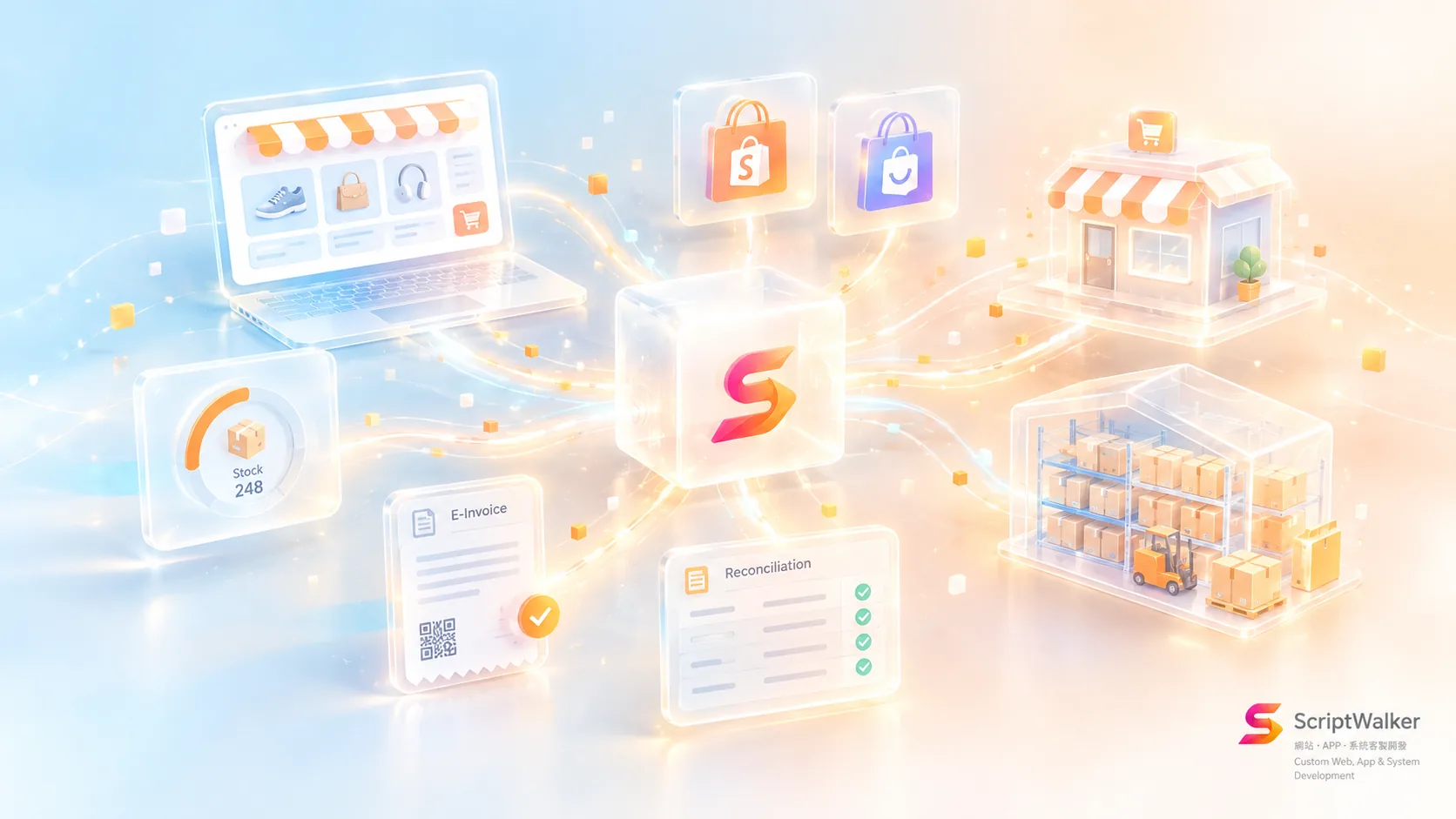
Short answer: For brands selling on a website, marketplaces and in stores, phase one of ERP should cover omnichannel orders, inventory sync, e-invoicing and reconciliation, in about 16–20 weeks for NT$600K–1M. The targets are to cut overselling from 30 orders a month to under 5 and month-end reconciliation from 3 days to half a day.
Background and pain: four versions of the stock number
The biggest problem for omnichannel brands is not order volume but each channel keeping its own books. The following is a scenario case (based on common project requirements, not a specific client): a 22-person homeware brand sells 1,500 SKUs through its website, two marketplaces and 2 stores, with about 4,500 orders a month.
- The warehouse lead updates stock on each platform by hand at noon; during campaigns about 30 orders a month are oversold, and cancellations hurt marketplace ratings.
- Bundles (a gift box equals 3 single items) are often deducted incorrectly.
- Website and stores issue e-invoices separately, marketplace orders follow other rules, and accounting spends 3 days at month end reconciling orders and payouts.
Requirements: 4 modules in phase one, purchasing and membership later
Phase one only covers processes that go wrong every day; everything else waits.
| Module | Owner | Phase | Problem solved |
|---|---|---|---|
| Omnichannel order hub | Service, warehouse | Phase 1 | Central processing and shipping for all channels |
| Inventory sync and bundles | Warehouse, stores | Phase 1 | One stock number, auto write-back, bundle deduction |
| E-invoicing | Accounting | Phase 1 | Unified issuing, voids and allowances |
| Marketplace payout reconciliation | Accounting | Phase 1 | Auto-match orders, fees and payouts |
| Purchasing and replenishment | Purchasing | Phase 2 | Reorder suggestions by sales velocity |
| Omnichannel membership | Marketing | Phase 2 | Merge website and store loyalty points |
Why a hybrid: custom core plus existing POS
This brand fits a custom ERP core while keeping its off-the-shelf POS, because the pain lies in rules between channels, not in store checkout. Packaged ERP covers orders and inventory well, but bundle deduction, marketplace payout formats and reconciliation rules usually need extra customization or manual work. Omnichannel SaaS launches fast and suits brands with under 500 SKUs and standard processes. This brand has 1,500 SKUs, 120 gift bundles and frequent co-branded campaigns with changing rules, so it builds its own core.
To be honest: if you only run a website plus one marketplace with no stores or bundles, the store platform's built-in inventory or an omnichannel SaaS at a few thousand NT dollars a month is enough. You do not need ERP.
Architecture and integrations: one central stock, five connected systems
The principle is that stock lives in one place; every channel reads from it and writes back.
- Core: a Laravel back office for orders, stock, bundles, invoices and reconciliation.
- Marketplaces: import orders and write back stock through open APIs such as the Shopee Open Platform, syncing every 5–10 minutes.
- Website: deducts stock at checkout and hides items below safety stock.
- Store POS: keeps the existing POS and sends sales every 15 minutes.
- E-invoicing: issued through a value-added service provider and uploaded to the Ministry of Finance e-invoice platform.
- Warehouse mobile work: a Flutter app for barcode picking and stock counts, replacing paper pick lists.
Process and timeline: 20 weeks in 5 stages
Master data is where timelines slip most; without unified SKUs, stock cannot sync.
- Weeks 1–3, process interviews: order-to-cash flow charts for each channel and a requirements document.
- Weeks 4–6, master data: unify SKUs, build the channel mapping table and rules for 120 bundles.
- Weeks 7–14, build and integrate: demos every 2 weeks; orders, stock, invoices, then reconciliation.
- Weeks 15–17, pilot: run old and new in parallel and compare stock and invoice counts daily.
- Weeks 18–20, full launch: retire the Excel stock sheet; deliver manuals and training.
Costs: NT$600K–1M to build, plus 4 ongoing items
First-year total cost is about 1.15–1.3x the build cost.
| Item | Cost | Notes |
|---|---|---|
| Phase one build | NT$600K–1M | 4 modules plus warehouse app |
| Hosting and backup | NT$3,000–8,000/month | Depends on order volume and sync frequency |
| E-invoice value-added service | Per invoice | Commonly a few thousand NT dollars a month |
| Marketplace API changes | NT$10K–30K each | Needed when platforms update |
| Maintenance | From NT$2,000/month | Depends on response time and scope |
Post-launch targets: 30/60/90 days
These are estimated targets; actual results depend on data quality and execution.
- Day 30: all channel orders flow into the hub; daily stock variance under 1%.
- Day 60: overselling under 5 orders a month; zero bundle deduction errors.
- Day 90: month-end reconciliation down from 3 days to half a day; the owner sees daily margin by channel.
Pitfalls and fixes
These 5 pitfalls are the most common in e-commerce ERP projects.
- Different product IDs on each platform → build the channel mapping table before syncing.
- Launching right before a campaign → avoid switching in the 4 weeks before major sales such as 11.11.
- Syncing stock but not cancellations → returns and cancellations must restore stock too.
- Safety stock set to zero → keep 3–5 units on best-sellers to absorb sync delays.
- Not asking accounting about invoice rules → settle allowances, voids and platform-issued invoices in month one.
FAQ
Does every e-commerce brand need ERP?
No. A single channel with under 300 SKUs can use the store platform's inventory; omnichannel plus stores needs a central ERP.
Can we start with an omnichannel SaaS?
Yes, if SKUs are few and processes standard. Consider custom when you need bundles, consignment or custom reconciliation rules.
Do we integrate e-invoicing ourselves?
Use a value-added service provider. It issues and uploads invoices; your system calls its API and keeps records.
Will shipping stop during launch?
No. Run old and new in parallel for 2 weeks, switch outside peak campaigns, and do a full stock count as the starting balance.
Next step: count your channels and bundles
ScriptWalker (a Taiwan-based Laravel/Flutter custom development studio) plans and builds ERP systems. Custom systems start at NT$80,000; ERP typically costs NT$150K–1.5M depending on scope and takes 16–24+ weeks; maintenance starts at NT$2,000 a month. Send us your channel list, SKU count and current reconciliation method, and a free 30-minute call will help you decide between SaaS, packaged ERP and custom:
- Email: [email protected]
- Phone: 0916-224-047
- LINE: @ufv9089p