Direct answer: For most SMB apps, Flutter is enough: iOS and Android share one codebase, development often costs 30–40% less than two native apps, and each change is made once. Only heavy Bluetooth hardware, AR, watch apps or extreme animation performance justify native development.
The pain: choose wrong and the same app costs twice as much
The most common Flutter-versus-native mistake is building two native apps because "native is better." A six-salon hair brand wanted a member booking app. The first vendor proposed Swift for iOS and Kotlin for Android, quoted NT$1.2M, and every change had to be made twice. The brand switched to Flutter: the same features were quoted at NT$750K, and after launch a coupon-rule change was made once and shipped on both platforms the same day.
The direct answer: three questions decide Flutter or native
Bottom line first: answer no to all three and choose Flutter; any yes means a deeper conversation with your vendor.
- Question 1: does the app's core depend on long-running Bluetooth connections (medical devices, industrial sensors)? Yes → lean native.
- Question 2: do you need platform-specific features such as AR, watch apps or in-car interfaces? Yes → lean native, or Flutter plus native modules.
- Question 3: will you only ever ship on iOS or only on Android? Yes → costs are similar, so follow the team's expertise.
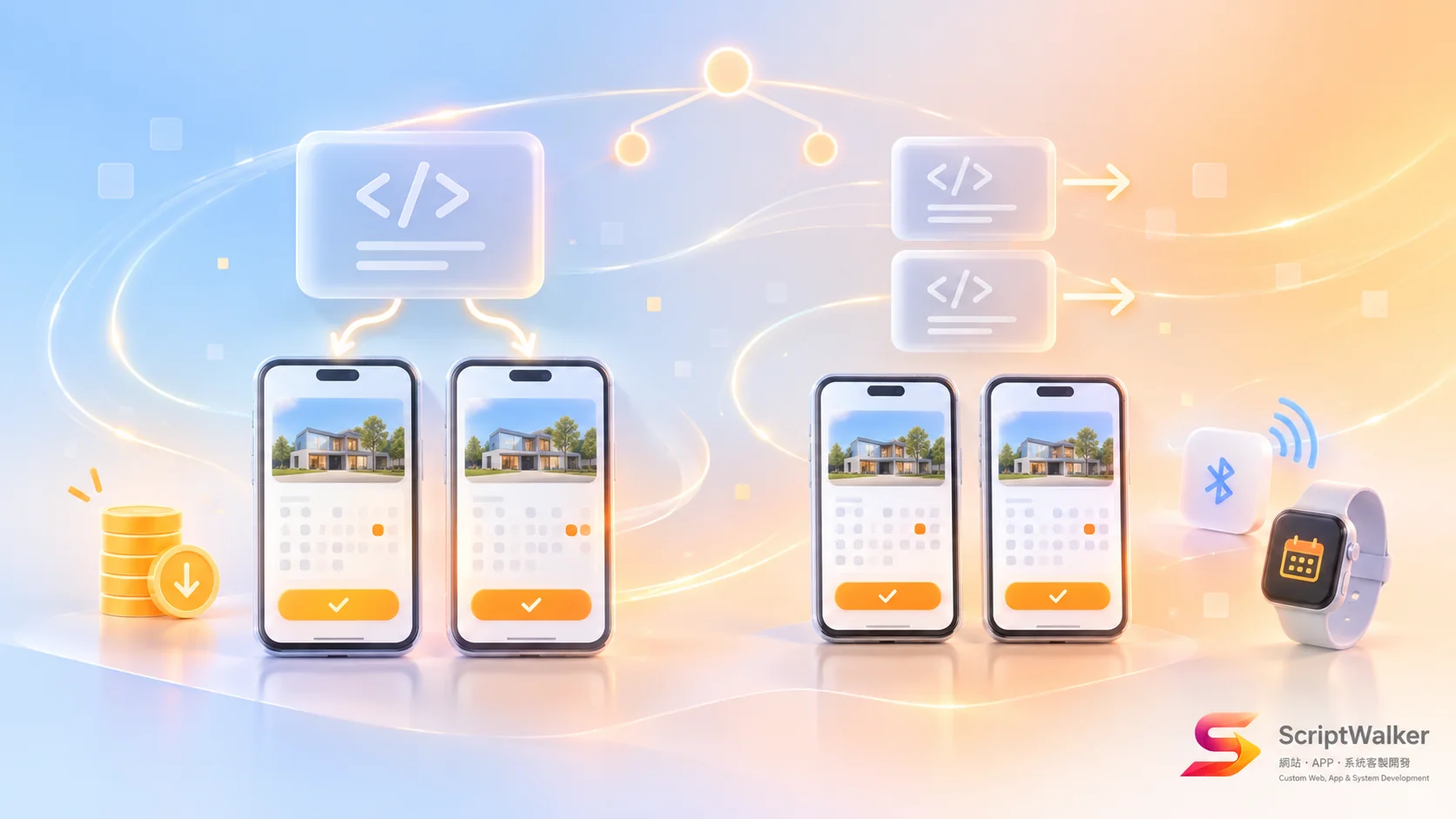
Decision tree: both platforms? → No: follow team expertise → Yes: heavy hardware or platform-specific features? → No: Flutter → Yes: native, or Flutter plus native modules.
Flutter vs native comparison: cost, maintenance and flexibility at a glance
For SMBs the key difference is building once versus building twice.
| Item | Flutter (cross-platform) | Native (Swift + Kotlin) |
|---|---|---|
| Development cost (two-platform member app) | Typically NT$400K–800K | Typically NT$650K–1.3M |
| Timeline | About 10–16 weeks | About 14–24 weeks |
| Changes and maintenance | Change once, both platforms in sync | Two codebases changed separately |
| Visual consistency | Nearly identical on both | Follows each platform's style |
| Hardware and platform features | Packages for most, native modules for a few | Most complete, earliest support for new features |
| Best for | Members, booking, orders, forms, internal tools | Heavy hardware, AR, watches, game-grade animation |
Store costs are the same either way: the Apple Developer Program is $99 a year and Google Play is a one-time $25. Google Play also raises its target API level requirement every year, so budget annual upgrade work for native or Flutter alike. Flutter is open source and maintained by Google; see the official Flutter site.
Three scenarios: the Flutter-or-native answer changes with size and needs
Every company "wants an app," but the answer depends on where the core functionality sits.
- Scenario A, store membership and booking (5–20 stores): choose Flutter. Points, booking, push notifications and coupons fit one codebase for both platforms at about NT$400K–800K.
- Scenario B, internal app for field staff (20–100 people): choose Flutter. Dispatch, photo reports, signatures and offline storage have mature packages, and the app can share a Laravel back office API.
- Scenario C, health product paired with your own Bluetooth device: lean native, or Flutter with a native Bluetooth module. Connection stability is the product, so spending 20–40% more is justified.
ScriptWalker (a Taiwan-based Laravel/Flutter custom development studio) builds most apps in Flutter, but for scenario C we first run a two-week technical proof to confirm Bluetooth is stable under Flutter before choosing the architecture.
Decision checklist: the more yes answers, the better Flutter fits
With seven or more yes answers, Flutter is almost certainly better value than native.
- ☐ You need both iOS and Android
- ☐ Budget is under NT$1M
- ☐ Features center on members, booking, orders and forms
- ☐ You want the same screens and features on both platforms
- ☐ You will update monthly or quarterly
- ☐ No long-running Bluetooth connections
- ☐ No AR or watch app
- ☐ You want to launch within four months
- ☐ You have no in-house iOS/Android engineers
- ☐ Your back office is or will be a web system
- ☐ Long-term maintenance cost matters more than peak performance
Frequently Asked Questions
These are the questions readers ask most; the first sentence of each answer is the answer.
Are Flutter apps slower than native apps?
For member, order and form apps users notice no difference; gaps appear only with game-grade animation or heavy computation.
Flutter or native: which costs less to maintain?
Usually Flutter, because one change updates both platforms, cutting maintenance hours by about 30–40%.
Could Flutter be abandoned?
The risk is low: Google maintains it as open source with a large community; still require source code handover in your contract.
Should an iOS-only app use Flutter?
Not necessarily; for one platform the costs are similar, but if Android may follow within 1–2 years, Flutter saves money.
Next step: a first consultation that tells you Flutter or native straight, with no upselling
Send us your feature list or a reference app. In a free consultation we will tell you whether Flutter or native fits and roughly what it costs; if you do not need an app at all, we will say so and suggest a website plus a LINE Official Account:
- Email: [email protected]
- Phone: 0916-224-047
- LINE: @ufv9089p