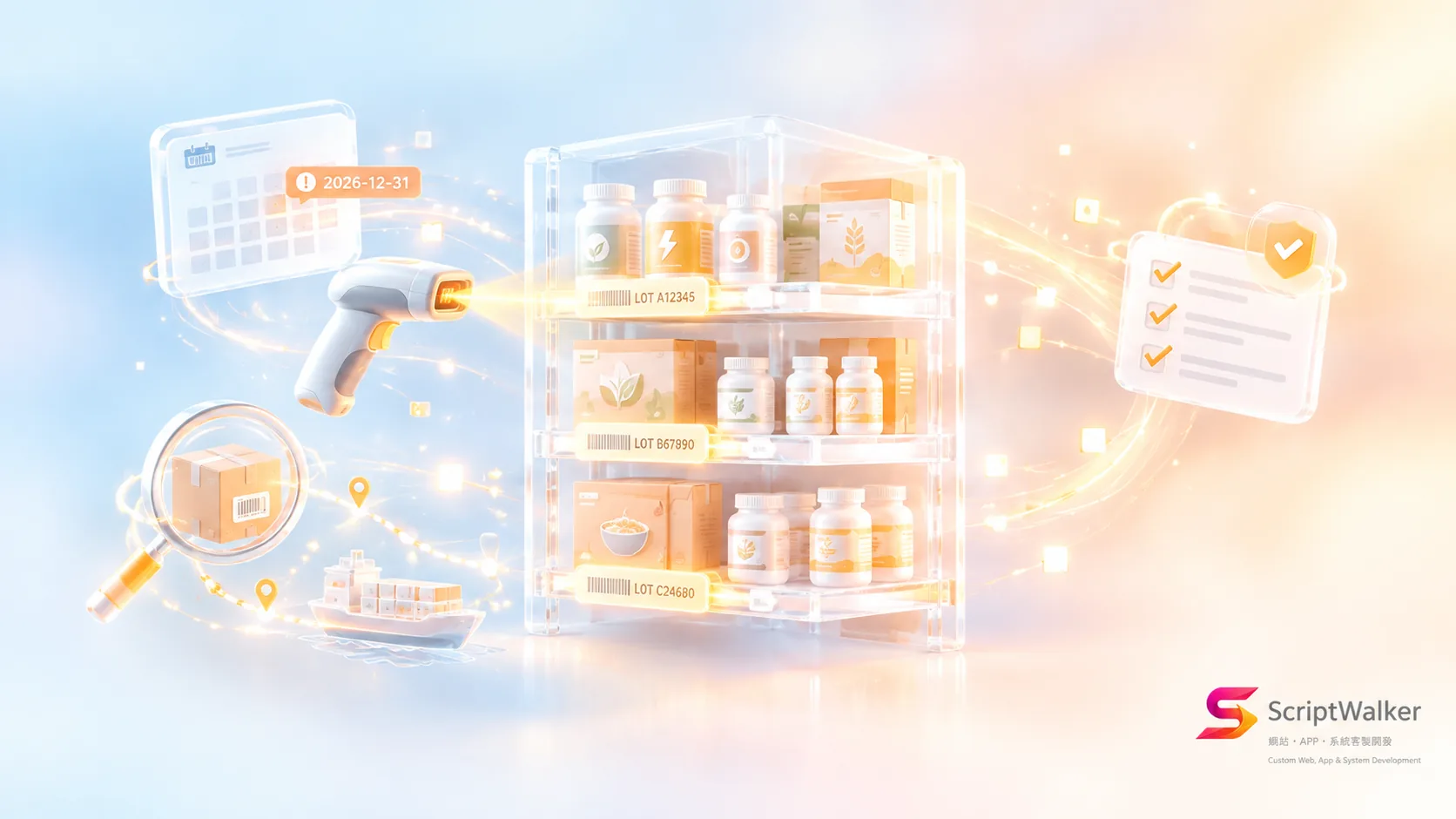
Short answer: For a food and supplement trading company, phase one of ERP should cover inventory and sales, lot and expiry tracking, first-expired-first-out (FEFO) picking and traceability lookup. For an 18-person importer with 800 SKUs, that is about 16–22 weeks and NT$500K–900K, aiming to cut a lot lookup from half a day to one minute and halve expired write-offs.
Company background and pain points: 800 SKUs, about NT$600K in expired stock a year
The biggest losses in this business come from not seeing expiry dates, not from not seeing revenue. Scenario case (a scenario based on common project requirements, not a specific client): an 18-person importer of health supplements and food ingredients represents 6 overseas brands, about 800 SKUs, supplying pharmacies, online stores and 120 retail outlets, with lot numbers written only on paper receiving slips.
- The warehouse picks from memory, older lots get buried, and expired write-offs reach about NT$600K a year.
- When a retailer reports an off smell in one batch, an assistant spends more than half a day digging through 3 months of delivery notes to find affected customers.
Requirements: 4 modules in phase one, accounting and receivables in phase two
Solve lots and expiry first; every other module builds on that data.
| Module | Owner | Phase | What it solves |
|---|---|---|---|
| Purchasing and receiving (lot and expiry entry) | Purchasing, warehouse | Phase 1 | Every case has a lot and expiry date on arrival |
| Inventory and FEFO picking | Warehouse | Phase 1 | The system assigns the earliest-expiring lot |
| Sales and shipping (lot-linked) | Sales, warehouse | Phase 1 | Each delivery note records which lot shipped |
| Traceability and near-expiry reports | QA, sales | Phase 1 | Trace a lot in one minute; see near-expiry stock 90 days ahead |
| Receivables and reconciliation | Finance | Phase 2 | Tracking retailer payments |
| Accounting export and e-invoicing | Finance | Phase 2 | Less double entry |
Why custom (hybrid) instead of packaged ERP
The company chose custom inventory plus its existing accounting software, because the core difference lies in lot workflows, not accounting.
- Packaged ERP: most handle lots, but picking rules, near-expiry alerts and trace reports often cost extra customization.
- Open-source ERP: feature-rich, but localization and maintenance need a long-term owner.
- Custom: only the 4 modules this company needs, with screens matching the warehouse's real flow; accounting stays on the current software, connected by data export.
To be honest, with fewer than 200 SKUs, no expiry management, or a plan to replace the whole finance process at once, packaged ERP is usually cheaper and faster.
System architecture and integrations
A Laravel back office sits at the core, and the warehouse works from phones or scanners without a separate app.
- Laravel back office: purchasing, inventory, shipping, traceability and reports, with 5 permission roles.
- Mobile web scanning: staff scan case and lot codes with phones or Bluetooth scanners, no app store release needed; a Flutter app can follow if offline work becomes necessary.
- Regulatory data: Taiwan's Act Governing Food Safety and Sanitation requires businesses to keep source documents for ingredients and products, and designated categories must build traceability systems and report electronically; the system includes export formats matching the food traceability management system.
- Phase two integrations: an e-invoice value-added provider and the existing accounting software, plus marketplace orders via API or file import.
Build process and timeline: 5 phases in 16–22 weeks
Master data cleanup takes the most time, not coding.
- Weeks 1–3 | Process interviews: interview purchasing, warehouse, sales and QA, and map lot flow from receiving to shipping. Deliverable: requirements and phase-one scope.
- Weeks 4–7 | Master data: SKU codes, unit conversions, shelf lives and a lot count of current stock for 800 items. Deliverable: importable master data.
- Weeks 8–15 | Development: test site demos every 2 weeks, building receiving, inventory, shipping and traceability in order.
- Weeks 16–19 | Pilot: one brand and about 120 SKUs first, with Excel in parallel for 2 weeks.
- Weeks 20–22 | Full launch: all SKUs switched, staff trained, Excel inventory retired.
Cost breakdown: NT$500K–900K for phase one, plus annual fixed costs
Budget differences come mainly from SKU count, lot rule complexity and marketplace integration.
- Phase one development: NT$500K–900K (4 modules, 5 roles, traceability and near-expiry reports).
- Hosting and backups: about NT$1,500–4,000 a month.
- Maintenance: from NT$2,000 a month, scaled by support hours.
- Phase two: receivables, accounting export and e-invoicing, about NT$250K–500K.
- Hidden costs: scanners and label printers about NT$20K–50K, 80–120 internal hours for master data, and a 1–2 day warehouse closure for the pre-launch full count.
At ScriptWalker (a Taiwan-based Laravel/Flutter custom development studio), custom system development starts at NT$80,000, and ERP runs about NT$150K–1.5M and 16–24+ weeks depending on scope.
Post-launch targets: 30/60/90 days
These are projected targets; actual gains depend on data completeness.
- 30 days: 100% of receipts logged with lot and expiry; 100% of delivery notes linked to lots.
- 60 days: trace lookups under one minute; weekly near-expiry reports to sales.
- 90 days: book-to-physical gap under 1%, target of halving expired write-offs, and monthly cycle counts without closing the warehouse.
Pitfalls and fixes
Most problems come from data and habits, not features.
- Old stock without lot numbers: Fix: run a full count before launch and assign placeholder lots by receiving month where lots are unreadable.
- Multiple pack units per SKU: mixing cases, boxes and bottles skews stock. Fix: define unit conversions in master data and count shipments in the smallest unit.
- Warehouse ignores assigned lots: Fix: scanning the wrong lot triggers a warning, and managers review an exceptions report weekly.
- Inconsistent expiry formats: Fix: convert to year-month-day on receipt, using the month's last day when only month and year are given.
FAQ
The questions readers ask most often. The first sentence of each answer is the answer.
How much does ERP cost for a food trading company?
About NT$500K–900K for phase one. That covers inventory, lots and expiry, FEFO picking and traceability, with accounting extra.
How long does implementation take?
About 16–22 weeks. Master data takes 4 weeks, and full launch follows a pilot with 2 weeks of parallel Excel.
Do we have to comply with food traceability rules?
Designated categories must keep traceability systems and report electronically. The system can export matching formats.
Can we keep our current accounting software?
Yes. Phase one leaves accounting alone, and phase two connects it by data export to reduce switching risk.
When is packaged ERP the better choice?
With fewer than 200 SKUs and no expiry management. Packaged features are enough and launch is faster.
Next step: prepare a list of SKUs and lots
If you trade food, supplements or ingredients, tell us your SKU count, monthly receiving and shipping volume and current inventory tools. We will reply with which modules belong in phase one, whether custom or packaged fits, and a rough timeline and budget.
- Email: [email protected]
- Phone: 0916-224-047
- LINE: @ufv9089p