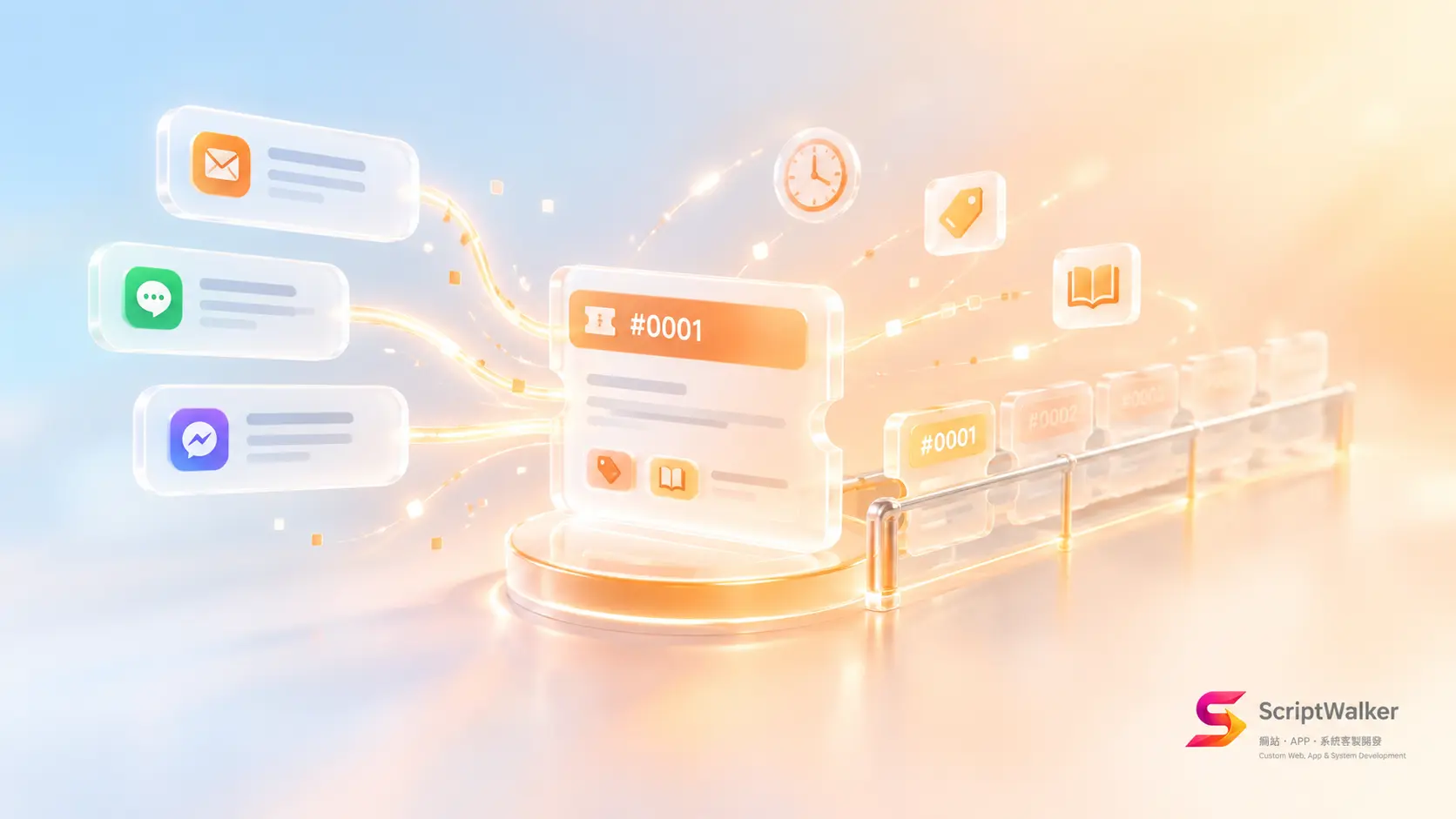
Three people take turns watching LINE — and the complaint still slipped through
An industrial parts company runs support with three people, one per channel: the website form, the LINE Official Account, info@. A long-standing customer asked for a quote on LINE, the colleague responsible was on leave, and the message sank down the thread; ten days later a one-star review appeared on the company's Google profile. Roughly 400 inquiries a month, and not one carries a ticket number, an owner or a due date. A helpdesk does one thing: it turns a message into a case.
When it fits, and when it does not
Good fit
- More than 150 messages a month, across two or more channels (LINE, email, web form, phone, Facebook/Instagram)
- Three or more agents, or shift coverage
- Response-time commitments (B2B contracts, dealers, warranty)
- The same questions repeat and can move to self-service
- Complaints need categorizing and counting
Poor fit
- Under 50 messages a month with one owner: a shared inbox is enough
- Sales conversations with back-and-forth negotiation: that is CRM
- Nobody will own "who handles what"
- The real need is live dispatch (rides, breakdowns), not a queue
Alternatives compared
| Option | Strengths | Weaknesses | Cost band (10 seats) |
|---|---|---|---|
| Shared inbox + labels (Gmail / Outlook) | Zero learning curve, usable today | No SLA, no reporting | Included in existing accounts |
| SaaS such as Zendesk / Freshdesk | Complete feature set, fast to launch | Per-seat pricing, LINE needs an add-on | US$25–115 per seat per month |
| Self-hosted open source (Zammad / FreeScout / Chatwoot) | No seat fees, you own the data | You run ops and upgrades | Build NT$120,000–250,000 + hosting NT$1,500–4,000/month |
| Custom build (Laravel + Filament) | Fits existing workflow and ERP | Longest build | NT$250,000–600,000 |
The decision rule: do tickets need to cross-reference internal data? If agents must see order status and warranty while replying, integration cost eats SaaS's price advantage.
The build, week by week
- Week 1 — Baseline: export three months of messages and categorize by hand; usually 60% concentrate in five question types. Tool: Google Sheets.
- Week 2 — Process design: define states (new / in progress / awaiting customer / awaiting internal / resolved / closed) and targets per priority. Tools: Figma or Miro.
- Weeks 3–5 — Build: connect the LINE Messaging API webhook, email intake (IMAP or forwarding) and the web form; merge contacts on email or mobile number.
- Week 6 — Knowledge base: turn high-frequency questions into 15–30 FAQ articles and reply templates; typically absorbs 20–30% of inbound.
- Week 7 — Pilot: route email fully through the system while other channels run in parallel for two weeks.
- Week 8 — Go live and dashboard: first response and resolution time, SLA attainment, volume by category, reopen rate.
Full cost breakdown
- Discovery and process design: 24–40 hours (NT$36,000–80,000)
- System build: NT$120,000–450,000 depending on integration depth
- LINE Official Account: the Messaging API is free, but message volume is billed by plan; agent replies are not billed, pushes are
- Email delivery: SendGrid or Amazon SES, NT$0–1,500/month
- Hosting and database: NT$1,500–4,000/month including backups
- SSL: NT$0 with Let's Encrypt; commercial EV certificates NT$3,000–15,000/year
- SMS notifications: NT$0.8–1.5 per message
- Maintenance and minor changes: 15–20% of build cost per year
- The line item everyone forgets: training and the parallel run. Two weeks of parallel running means handling everything twice — add 40–60 person-hours
What clients expect vs what actually happens
- Expected: service gets faster. Reality: it is slower for four weeks, until the team internalizes the taxonomy and templates.
- Expected: LINE works as before. Reality: after the Messaging API, agents reply from the back office; anyone answering from their phone splits the record.
- Expected: AI can categorize from day one. Reality: without three months of hand-labeled data, accuracy is not usable.
- Expected: the knowledge base is written once. Reality: with no named owner it serves stale answers within six months.
- Expected: stricter SLAs are better. Reality: an SLA nobody can hit just turns the report red.
Seven traps and how to avoid them
- Trap 1: every message becomes a ticket. "Thanks" opens one too. Fix: auto-close rules.
- Trap 2: forty categories. Too granular and agents pick "Other". Fix: cap version one at eight.
- Trap 3: no contact merging. One customer on two channels becomes two tickets. Fix: build a contact master.
- Trap 4: SLA clocks that never pause for the customer. Three silent days land on the agent. Fix: pause in "awaiting customer".
- Trap 5: no escalation path. Tickets sit with tier one for three days. Fix: auto-escalate on timeout.
- Trap 6: no retention policy. Threads hold names, phone numbers, national ID numbers. Fix: set retention periods first.
- Trap 7: only support sees the reports, so the same problems recur. Fix: take the top five issues to the monthly management meeting.
Success metrics and the first 90 days
- Day 30: dropped-message rate and median first response; target zero drops. Ignore satisfaction scores this early.
- Day 60: reopen rate and knowledge base hit rate. Above 15% repeats, write templates rather than hire.
- Day 90: FAQ pageviews divided by inbound volume, plus average labor cost per ticket.
Decision checklist
- ☐ More than 150 messages per month?
- ☐ Two or more channels?
- ☐ Three or more people rotating?
- ☐ Has a dropped message cost you a deal?
- ☐ Do you commit response times?
- ☐ Can you name last month's top three complaints?
- ☐ More than five recurring question types?
- ☐ Do agents check order records while replying?
- ☐ Will a manager own routing rules and SLAs?
- ☐ Can you accept four slower weeks?
- ☐ Will someone maintain the knowledge base?
- ☐ Do threads contain personal data?
- ☐ Is support headcount likely to grow?
Seven or more: move to process design. Four to six: run a shared inbox for three months first. Three or fewer: not yet.
FAQ
Isn't SaaS like Zendesk simply faster?
On launch speed, yes. First price the cost curve as seats grow, whether LINE needs an add-on, and whether agents need order data on the same screen.
What happens to LINE chat after connecting the Messaging API?
Messages route to your system and the back-office chat still works, but replying from both sides splits the record.
How many knowledge base articles are enough?
Cover the categories behind about 70% of inbound, usually 15–30 articles; hit rate is the metric.
Can we launch with AI auto-replies?
You can, but start with "AI drafts, human sends" — a wrong answer gets screenshotted, at a cost far above the labor saved.
How does ScriptWalker price a helpdesk build?
Basic (single channel, ticket workflow, reporting) from NT$180,000; standard with three channels and a knowledge base from NT$320,000; ERP sync scoped separately. Maintenance runs 15–20% of build cost per year.
Next step
To find out whether you should build one at all, we spend 30 minutes on your last three months of volume and staffing and calculate the break-even month. No fee.
- Email: [email protected]
- Phone: 0916-224-047
- LINE: @ufv9089p