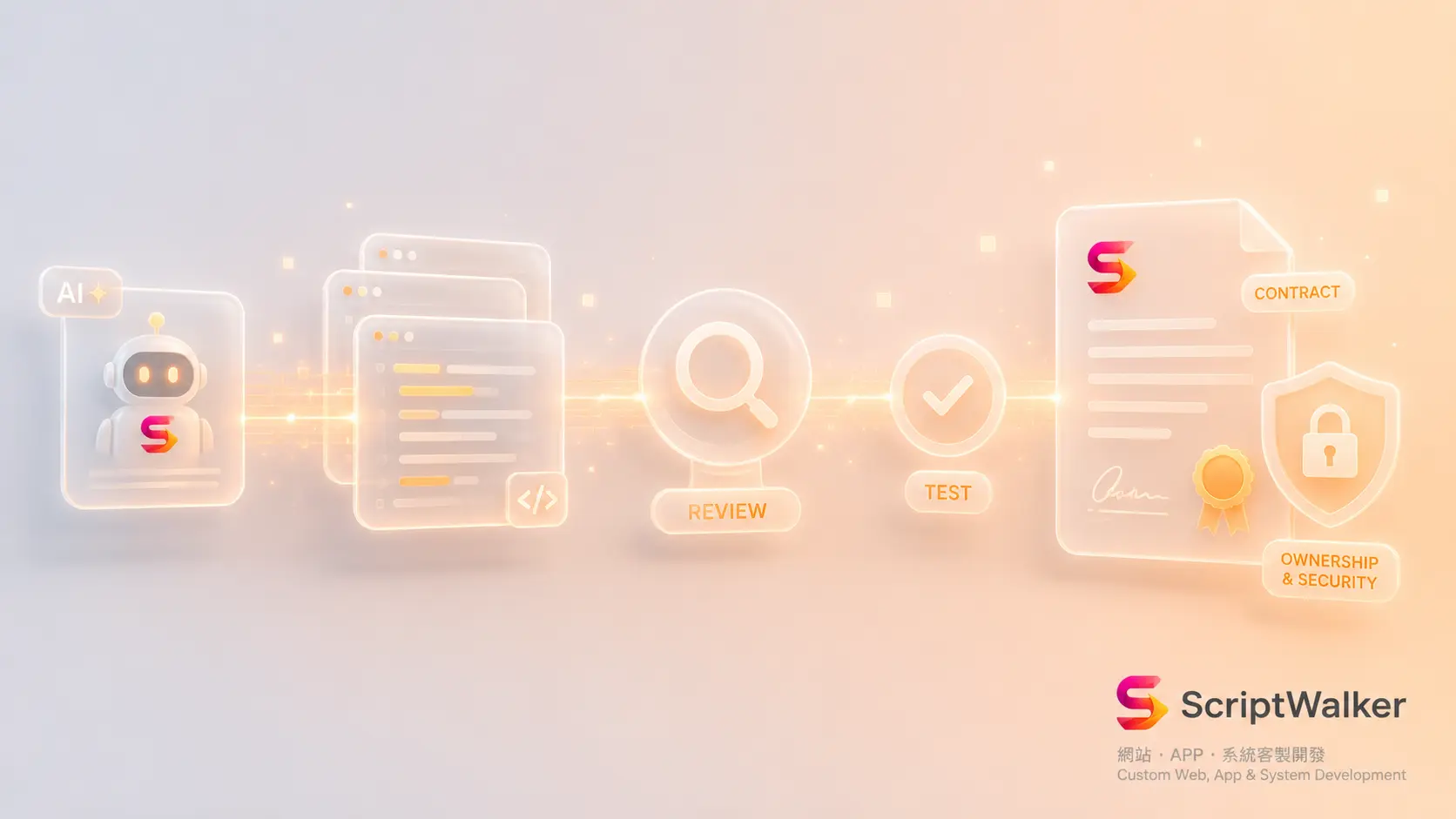
An SMB owner recently got a quote: the studio says we develop with AI assistance, so we deliver in three weeks and 30% cheaper than others. He is thrilled, and uneasy: is it cheaper from efficiency, or from cutting corners? Who owns the copyright of AI-written code? Who is responsible if it breaks? This is the question almost every buyer faces in 2026 yet few ask clearly. This piece is not about whether to use AI (nearly every studio does); it is how to ask, to keep the risk out before you sign.
Myths to Break
- Myth 1: AI-written code is lower quality. Truth: AI assistance itself does not decide quality; review and testing do. A senior engineer accelerating with AI then reviewing line by line often beats a junior writing by hand.
- Myth 2: AI means it should be much cheaper. Truth: AI accelerates typing, not thinking. Requirement clarification, architecture, testing, and debugging, the truly time-consuming parts, get limited help. Quotes slashed too hard usually skipped review and testing.
- Myth 3: AI-generated code copyright is automatically mine. Truth: it depends on the contract, the tool used, and its terms. Without contract language that all deliverables (including AI-assisted parts) copyright vests in the client, you may land in a gray zone.
- Myth 4: AI can write it, so maintenance is easy. Truth: if nobody actually understands the code, AI output is harder to maintain; when a bug hits, no one can explain why it is written that way.
Core Framework: The 6 AI-Dev Questions Before You Sign
Paste these 6 questions straight into your RFP; if the vendor cannot answer clearly, that is a red flag:
- IP: Will the contract state in writing that all deliverables (including AI-assisted code) copyright and usage rights vest fully in the client?
- Quality: Is AI-generated code human-reviewed (code review) and covered by automated tests? Roughly what coverage?
- Security: Will you paste my source, DB schema, or keys into third-party AI tools? Which kind (an enterprise version with training disabled)?
- Maintenance: After delivery, if a bug appears, can you explain every key piece of logic, not the AI made it, I am not sure?
- Documentation: Will you include docs and comments sufficient for another engineer to take over?
- Portability: Is the code locked to some AI platform proprietary service, making it hard to switch vendors later?
Three Typical Scenarios Compared
- Scenario A: single landing page (small, low risk). Heavy AI assistance and fast delivery are totally reasonable; focus on IP ownership and easy to modify later. The savings should show in the quote.
- Scenario B: e-commerce/system with payments and members (medium risk). AI can accelerate, but insist on human review + testing + source not leaked. If 30% cheaper comes from skipping tests, you are gambling with your operations.
- Scenario C: system handling PII/finance/healthcare (high risk). Strictest requirements: explicit no-data-leak clauses, full testing, auditable docs. Here AI acceleration should not be a discount excuse; it should free up time for more safeguards.
Hidden Cost Checklist
- IP dispute cost: unclear ownership blocks you when you later want to open-source, resell, or switch vendors; lawyer fees minimum.
- Security leak cost: source or keys pasted into third-party tools; one leak can mean a full rewrite.
- Black-box maintenance cost: code nobody understands means every small change requires re-reverse-engineering; labor doubles.
- Test debt cost: skipped tests become post-launch bugs, each detonating during operations.
- Platform lock-in cost: bound to some AI-proprietary service, switching vendors equals redoing it.
Vendor Evaluation KPI Scorecard
| Dimension | Good signal | Red flag |
|---|---|---|
| IP clause | Contract states deliverables all vest in client | Vague or refuses writing |
| Code review | Fixed human review process | AI-made, no need to check |
| Testing | Can state coverage and test strategy | Cannot say if there are tests |
| Security | Enterprise version with training off, signs DPA | Casually pastes into free tools |
| Explainability | Can explain key logic | AI wrote it, not sure |
| Documentation | Provides handoff docs and comments | No docs |
| Portability | Not tied to proprietary platform | Locked to some AI service |
| Communication | Proactively explains where AI is used | Avoids or denies use |
ScriptWalker''s Approach + When We''re Not a Fit
Our stance: AI-assisted development is an efficiency tool, not a quality discount. We accelerate with AI, but every delivered line is reviewed and tested by a senior engineer; the contract states all deliverables copyright vests in the client, and we do not feed client source into third-party tools that train on it.
We are not a fit for these clients:
- Those wanting only cheapest, fastest, quality-be-damned one-off projects
- Those refusing reasonable testing and documentation costs, wanting only good enough to run
- Those expecting you use AI so it should be free or near-free quotes
Transition / Kickoff Playbook
- Month 1: at signing, write all 6 AI-Dev Questions into contract clauses; establish source and key storage rules.
- Months 2–3: attach code-review records and test results to each milestone delivery; spot-check explainability of key logic at acceptance.
- Day 90: review whether docs suffice for a third party to take over, confirm no platform lock-in, and archive handoff materials.
Decision Checklist
- ☐ Does my contract state deliverables (incl. AI-generated) copyright vests in me?
- ☐ Can the vendor describe their code-review process?
- ☐ Does the vendor have a test strategy and rough coverage?
- ☐ Will my source/keys be pasted into third-party AI tools?
- ☐ Can the vendor explain every key piece of logic when a bug hits?
- ☐ Will delivery include docs sufficient to take over?
- ☐ Is the code locked to some AI platform?
- ☐ Is the cheap quote from efficiency, or from skipping tests?
- ☐ Will the vendor answer these 6 questions in writing?
- ☐ Is my project risk level (low/med/high) matched to the right rigor?
FAQ
My agency uses AI to build my project. Should I worry?
Not blanket worry, but ask. The key is not whether they use AI, but whether there is human review, testing, security safeguards, and IP ownership in the contract. A vendor who answers clearly makes AI a plus.
With AI, should the quote be much cheaper?
AI accelerates typing, not thinking. Requirements, architecture, testing, and debugging still need people. Reasonable efficiency gains can show in price, but cutting to skip tests turns savings into post-launch bugs.
Who owns the copyright of AI-generated code?
It depends on the contract and the tool terms. Always state in the contract that all deliverables including AI-assisted parts, copyright and usage rights vest fully in the client, to avoid future disputes.
Call to Action
Getting ready to hire and want to confirm a vendor AI development has safeguards? We offer a free 30-minute consult, or send us the 6 AI-Dev Questions above and see how we answer in writing. Contact us:
- Email: [email protected]
- Phone: 0916-224-047
- LINE: @ufv9089p