1. Industry snapshot
Taiwan's MOEA reports that electronic shopping revenue grew 3.4% in 2025, a fifteenth straight year of growth, and now accounts for roughly 10% of retail. The cost that arrives after the order is growing too: NRF and Happy Returns estimate about 19.3% of online orders were returned in 2025, 9% of them fraudulent. Most Taiwanese merchants still handle complaints and returns by reading emails and checking rules by hand. The headcount goes not into homepage recommendations, but into everything after checkout.
2. Typical AI use cases
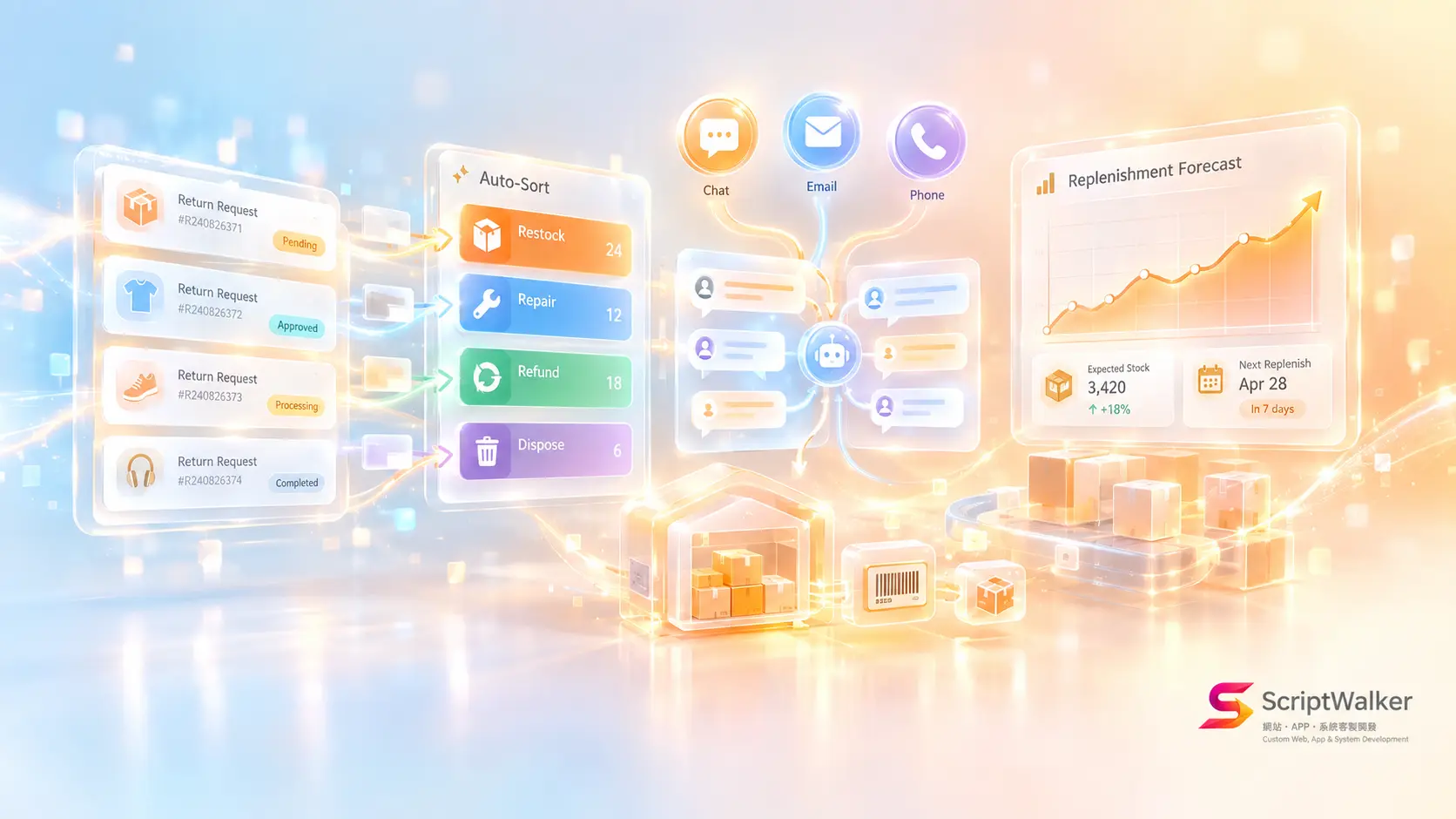
- Automatic ticket triage: label incoming messages as not delivered, defective, seven-day cooling-off return, wrong specification or suspected fraud, with a confidence score; low scores go to a human.
- Cross-channel support with human handover: LINE, website forms and Shopee in-platform mail merge into one ticket pool; AI answers status from order data and only drafts when a refund is involved.
- Structured return reasons: convert free text into fixed fields and push "runs small, not as described, damaged" to buyers weekly.
- Replenishment and demand forecasting: estimate safety stock from sales, campaign calendar, return rate and lead time; output a suggestion list for human confirmation.
3. Real cases
Case 1: EcLife (Taiwanese 3C retail chain). The retailer worked with Data-DI to turn product specifications, return SOPs and complaint records into a conversational knowledge base. According to a 2026 BusinessNext report (sponsored content by Data-DI), the goal is to cut three months of new-hire training to one. The trap was data ownership: specs, promotions and returns sit in three departments, and with no named owner AI just serves stale answers faster.
Case 2: Zalando (European fashion e-commerce). Training size models on body measurements from over a million customers, it avoided more than 8% of size-related returns. The decisive factor is not the model but that return reasons are structured fields, not a one-word "didn't fit".
4. Recommended tool stack
- OpenAI Structured Outputs or the Anthropic Claude API: triage needs stable JSON, and both bind output to a JSON Schema.
- LINE Messaging API: the main channel in Taiwan — webhooks to receive, push to update status, human handover.
- Laravel Queue: classification, summarisation and forecasting run as background jobs with retries, so the agent console never blocks.
- n8n: the glue between Shopee/momo export files and the ERP; flow changes need no redeploy.
- Meilisearch: search over past complaints and SOPs — adequate Chinese tokenisation, cheap to self-host.
5. ROI model
Take a merchant with 8,000 orders and 600 return or complaint tickets per month. Before AI, each ticket takes about 12 minutes — 120 hours per month. After, it drops to 5 minutes, saving 70 hours.
| Item | Amount (NT$ / month) |
|---|---|
| Development NT$320,000 (one-off, amortised over 24 months) | -13,300 |
| Monthly operations: hosting, monitoring, maintenance | -12,000 |
| LLM API usage (estimate) | -6,000 |
| Agent hours: 70 hours saved × NT$300 | +21,000 |
| Fewer misjudged returns and less rework (estimate) | +12,000 |
| Less stockout and dead stock (estimate) | +25,000 |
| Net benefit | +26,700 |
Excluding amortisation, monthly cash benefit is about NT$40,000, paying back in roughly 8 months; we also model a 1.5 point lift in 30-day repurchase among customers who returned an item.
6. Rollout timeline, Phase 1-4
Phase 1 (weeks 1-3), audit: export three months of complaint and return records, define 8-12 labels and the return-reason field set, and measure minutes per ticket and first response time as the baseline.
Phase 2 (weeks 4-7), ticket pool: connect the LINE Messaging API and website forms, backfill Shopee in-platform mail from export files, build the ticket pool and classification API; AI only classifies and drafts.
Phase 3 (weeks 8-11), rules engine: encode the seven-day cooling-off period, exempt product types, shipping-cost allocation and defect determination as testable conditions, plus the human handover threshold and an audit trail.
Phase 4 (weeks 12-16), forecasting: connect replenishment forecasting with weekly suggestion lists; compare against the baseline before allowing small automatic refunds.
7. Common failure modes and how to avoid them
- Return reasons are free text. "Didn't like it" can be neither trained on nor counted. Switch to a mandatory dropdown plus notes, and accumulate three months before discussing models.
- Wiring AI straight into a refund-capable API. Grant read and ticket-creation permissions only; keep refunds behind a human button, or cap per-transaction and daily totals.
- No human handover threshold. Force a transfer when confidence falls below 0.8, emotional or legal wording appears, or the amount exceeds the limit.
- Consumer protection rules not encoded. Article 19 of the Consumer Protection Act gives online buyers seven days after receipt to rescind without reason, but the Regulations on Reasonable Exceptions to the Right of Rescission in Distance Sales list exemptions: perishable goods, customised orders, opened audiovisual products or software, opened personal hygiene products, and digital content not on a tangible medium. Each must become a branch in the rules engine and a flag on the SKU (see also the Consumer Protection Committee explanation).
8. Where AI does not belong
- Cases already in formal dispute or mediation, requiring written notice of rescission.
- High-value custom orders, pre-orders and installation disputes, where liability needs human judgement.
- Food safety notifications and recalls — compliance risk far outweighs the efficiency gain.
- New brands with under three months of data, or a SKU range that turns over every quarter.
9. What ScriptWalker builds, and starting prices
We build the backend and rules engine in Laravel, connect LINE, your website and platform export files, and use Flutter for the mobile agent console. E-commerce support and returns AI integration from NT$280,000 (ticket pool, automatic triage, reply drafting, seven-day cooling-off rules engine); replenishment and demand forecasting module from NT$180,000; cross-channel ticket consolidation from NT$120,000. LLM API usage fees not included.
10. FAQ
Can AI issue refunds directly?
Technically yes, but do not enable it on day one. Let AI classify, look up orders and draft replies; after three stable months, allow small automatic refunds.
Can Shopee and momo in-platform mail be integrated?
Platform openness varies. Backfill the ticket pool from scheduled exports first, then switch to real-time integration when an API is available.
Is one year of complaint data enough?
Enough for classification — three months of well-labelled data is a workable start. For demand forecasting, aim for at least a year covering a full campaign cycle.
What if a wrong answer makes the complaint worse?
Set a confidence threshold and an audit trail, storing each reply's input, output and the SOP version it relied on.
11. Decision checklist and next step
- ☐ More than 200 return or complaint tickets per month
- ☐ Return reasons are already structured fields
- ☐ Support messages arrive from two or more channels
- ☐ Average handling time per ticket has been measured
- ☐ The returns SOP is written down and has an owner
- ☐ SKUs are flagged for seven-day cooling-off eligibility
- ☐ The order system exposes a query API
- ☐ Clear criteria exist for human handover
- ☐ Willing to run three months without automatic refunds
Six ticks means you are ready to build. To estimate hours and payback, contact us:
- Email:[email protected]
- Phone:0916-224-047
- LINE:@ufv9089p