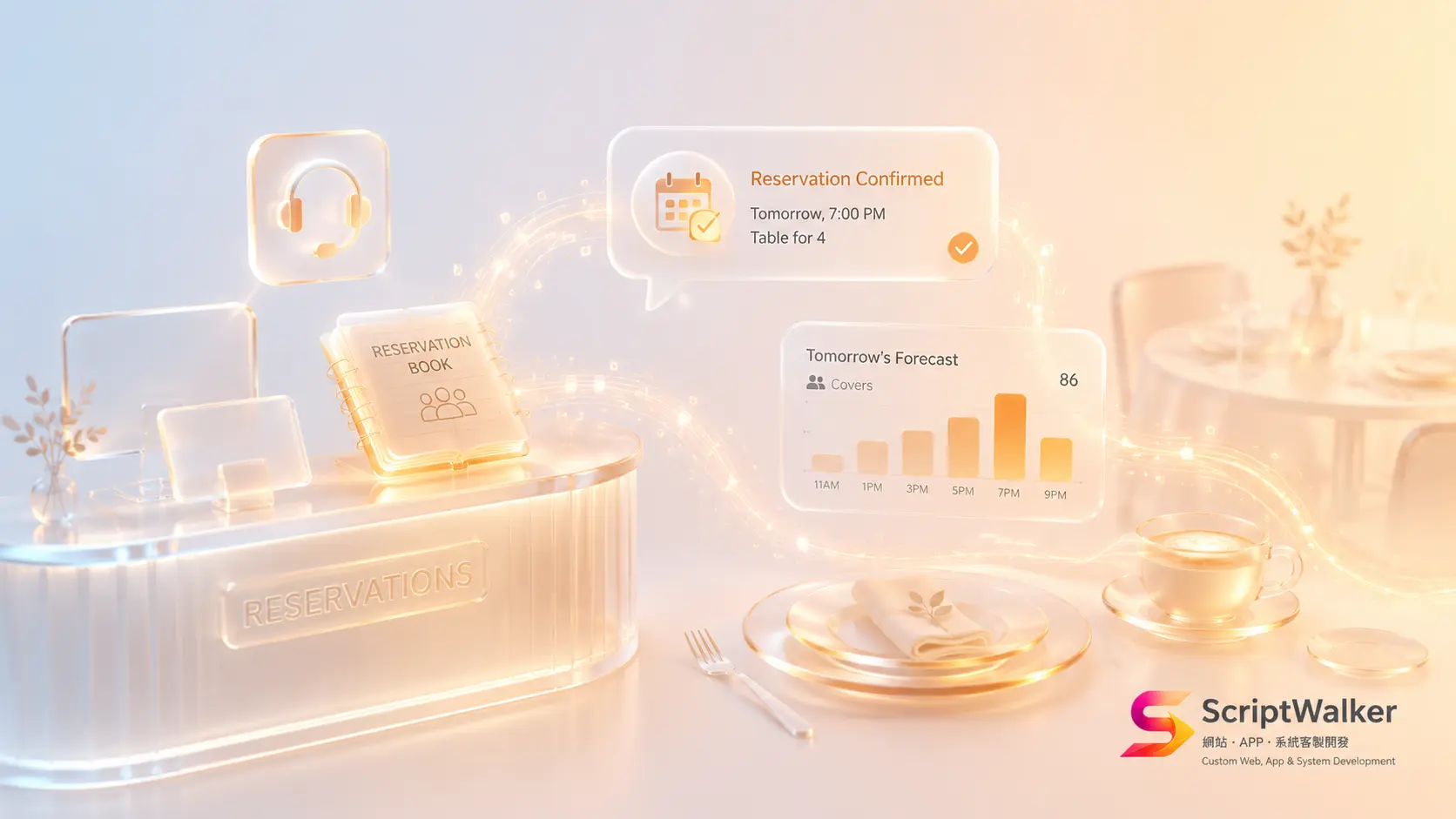
At the dinner rush the phone keeps ringing, but both front-of-house staff are running food, clearing tables, and cashing out. The customer trying to book a Friday table for four lets it ring six times, hangs up, and books the place next door. This is not an edge case: the industry estimates that roughly 60% of restaurant calls go unanswered during busy periods, with high-volume venues missing 20–50 calls a day. This piece focuses on the most practical entry point — using AI to automatically answer reservations, phone, and LINE chat — plus demand forecasting and review responses, with cost, real cases, and payback laid out.
1. Snapshot of AI Adoption in Restaurants
Restaurants are labor-intensive, thin-margin, and chronically short-staffed — yet also one of the fastest places to see AI pay off. Per the National Restaurant Association's 2026 State of the Restaurant Industry, 26% of operators already use AI-related tools in their venues; Toast's 2025 AI in Restaurants survey found 86% of operators comfortable with AI and 81% planning to use more. Adoption clusters around three areas — marketing copy, demand forecasting, and reservation/customer-service automation — because they map directly onto daily bleeding: missed calls, mis-forecast prep, and no time to answer reviews.
2. Five Typical AI Use Cases
- AI phone answering (Voice AI): Overflow calls are answered by AI covering hours, bookings, and takeout, escalating to a human only when it can't understand.
- LINE reservation/support auto-reply: When guests ask "any tables tonight?" or "vegetarian options?" on your official account, AI reads the menu and availability and books instantly.
- Demand forecasting and prep suggestions: Using sales history plus weather and holidays, forecast tomorrow's usage per item to cut both over-prep waste and stockouts.
- Google/delivery-platform review responses: AI drafts on-brand replies — negatives triaged and escalated, positives thanked automatically — with humans doing the final check.
- Menu and marketing copy generation: New-item descriptions, seasonal posts, and multilingual menus generated at once, turning marketing from "no time" into "done in ten minutes."
3. Real Cases (What They Did, Where They Tripped)
Case 1 | A US chain A (mirroring Popmenu/Max's public data): After deploying AI phone answering, the system handled over 329,000 calls and drove more than USD 1.5 million in online orders. Pitfall: early on the AI's menu knowledge wasn't wired to the POS and it quoted sold-out items; it stabilized only after real-time inventory was integrated.
Case 2 | A Taiwan reservation platform (mirroring public info from inline and Taiwan Mobile): Bookings were wired into LINE conversation and AI voice reservation, promising a "60-second booking" and claiming it helps operators cut labor cost by about 50%, with internal tests showing over 90% of users satisfied. Pitfall: natural language is messy; pure rule-based replies misfired at first, and things only flowed after switching to an LLM plus a clear human fallback.
Case 3 | A single-unit venue B (mirroring the Slang AI restaurant results range): After adopting AI answering, phone reservations rose about 50% and roughly 200 staff-hours a month of call handling were saved. The key was no longer dropping peak-hour calls — recovering bookings that would otherwise have leaked away.
4. Recommended Tool Stack (What and Why)
- ChatGPT API / Claude API: Understand guest questions and generate replies. Claude is steady on long text and brand tone; ChatGPT has a broad tooling ecosystem — pick one or mix by cost and tone.
- LINE Messaging API: Taiwanese guests already live on LINE; the official account is the shortest path for bookings and support, with no new app to install.
- n8n or Make: Wire LINE, the reservation system, POS, and Google reviews into automated flows — no backend from scratch, and fast to change.
- RAG / vector retrieval (e.g. LangChain + pgvector): Put the menu, FAQs, and booking rules into a knowledge base so the AI answers only from your real data, reducing hallucination.
- Voice layer (e.g. Whisper or a telecom Voice AI): Only needed if you answer phone calls — transcribe speech, then reuse the same reply logic.
5. ROI Model (Concrete Numbers)
Take a mid-size restaurant with ~NT$1.5M monthly revenue, missing 25 peak calls a day, average potential ticket NT$1,200, 30% conversion:
- Investment: LINE + AI reservation/support build ~NT$80,000–180,000 (one-off); monthly operations (API usage + hosting + maintenance) ~NT$3,000–8,000.
- Recovered missed bookings: 25 × 30 days × 30% × NT$1,200 ≈ NT$270,000 in potential monthly revenue recovered (conservatively counting one-third, ~NT$90,000).
- Labor saved: ~150–200 hours a month of call/message handling, worth NT$30,000–40,000.
- Demand forecasting: Research shows AI forecasting can cut food cost by ~2–4 percentage points, about NT$30,000–60,000 a month at this scale.
Combined, payback is roughly 8–12 months for a single unit; multi-unit rollouts are typically 4–6 months because fixed build cost is spread thinner.
6. Rollout Timeline, Phase 1–4
- Phase 1 Audit and data prep (1–2 weeks): Organize menu, booking rules, FAQs, and integration points (LINE, reservation system, POS).
- Phase 2 Build and knowledge base (2–3 weeks): Connect LINE Messaging API, build the RAG knowledge base, wire n8n flows and human fallback.
- Phase 3 Testing and tuning (2 weeks): Test on real conversations, patch gaps, tune tone, set escalation rules, and stress-test at peak.
- Phase 4 Launch and optimize (ongoing): Go live, watch missed-call rate, conversion, and error rate weekly, then add demand forecasting and review responses.
7. Common Failure Modes and How to Avoid Them
- Knowledge base not wired to live inventory/availability: AI says a table is free when it isn't, and guests arrive to nothing. Fix: integrate POS/reservation in real time, don't rely on manual updates.
- Expecting full automation with no human fallback: Forcing AI to handle complex complaints angers guests. Fix: set a clear fallback, escalate on confusion or emotional language.
- Dirty data, messy menu versions: Expired items and inconsistent prices make the AI misspeak. Fix: build a single source of truth for menu and rules before launch.
- Robotic tone: Canned replies hurt the brand. Fix: tune the prompt with brand-voice examples, keeping warmth and local phrasing.
- Launch and forget, no monitoring: No data, no optimization. Fix: weekly reporting on missed-call rate, error rate, escalation ratio, and booking conversion.
8. Where AI Is a Poor Fit (Honestly)
- High-end fine-dining reservation dialogue: Custom menus, allergies, and buyouts need a human; AI is only good for initial triage.
- Major complaints and food-safety incidents: Emotional handling and compensation calls need people; a bad AI reply escalates the crisis.
- Small shops with only a few calls a day: Volume is too low, staff can handle it, and the cost won't return.
- Extremely messy data, no POS/reservation system: Without basic digitization, digitize bookings and menu first before talking AI.
9. The ScriptWalker Offer
We provide restaurant AI service integration: LINE reservation/support auto-reply (ChatGPT/Claude API + LINE Messaging API + n8n + RAG knowledge base) from NT$80,000; an add-on demand forecasting dashboard (wired to POS sales history) from NT$180,000; monthly operations NT$3,000–8,000. From data audit, integration, and testing to launch support, done in one pass — and we'll honestly assess whether your call volume justifies it.
FAQ
How long until AI reservation support goes live?
Basic LINE reservation/support auto-reply takes about 5–7 weeks: 1–2 weeks audit and data prep, 2–3 weeks build and knowledge base, ~2 weeks testing and tuning. Adding phone voice or demand forecasting extends it by several weeks.
Will it give wrong answers and drive guests away?
Two things matter: make the menu, availability, and booking rules the AI's only source of truth so it can't invent, and set a solid fallback — escalate to a human on confusion or emotional language. Get these right and most venues push error rates very low.
My shop's call volume is low — is it worth it?
If you get only a few calls a day that staff can handle, usually no — we'll tell you not to do it. It's worth it for venues consistently missing 20+ calls at peak, or already drowning in LINE official-account messages.
Do I have to replace my current reservation system?
Usually not. The AI support layer sits on top of your existing POS or reservation system, reading and writing availability and orders via API or n8n, keeping the current system as the single source of truth.
Decision Checklist + Call to Action
- ☐ I consistently miss 15+ calls/messages a day at peak?
- ☐ I can estimate the potential ticket and conversion of a missed booking?
- ☐ I have a LINE official account or plan to open one?
- ☐ My menu, prices, and booking rules can form a single source of truth?
- ☐ I have a POS or reservation system to integrate availability/inventory?
- ☐ I accept starting with LINE support, adding phone voice later?
- ☐ I'm willing to set a fallback and escalate complex cases to a human?
- ☐ I have someone to review data weekly and optimize?
- ☐ I know which cases (fine dining, major complaints) shouldn't be fully AI?
- ☐ I'm ready, budget and mindset, for an 8–12 month payback?
Want to recover the peak-hour bookings you're dropping and make prep more accurate? Spend 30 minutes letting us quantify your missed-call losses and payback — do it only if it's worth it:
- Email: [email protected]
- Phone: 0916-224-047
- LINE: @ufv9089p