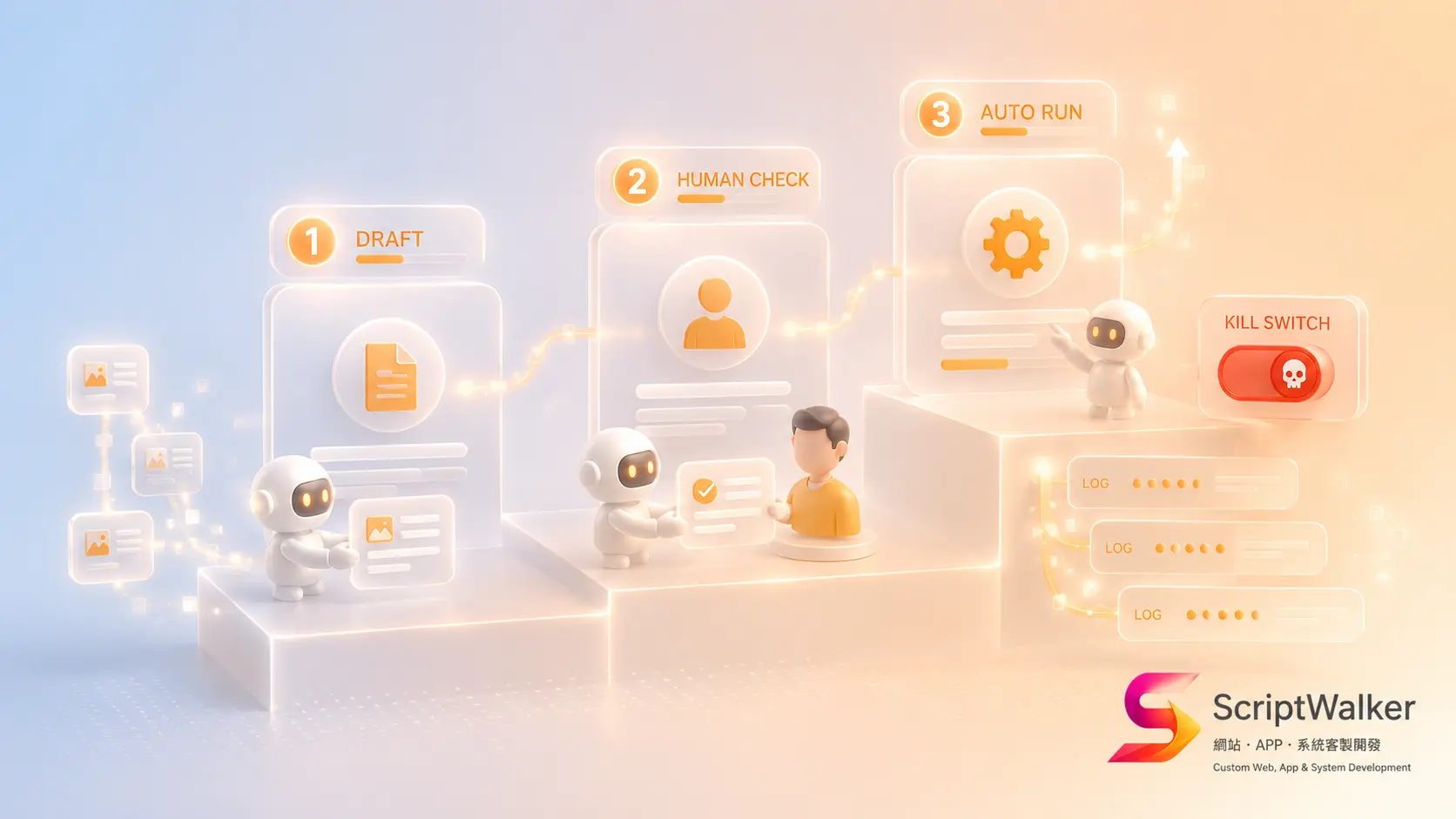
"Everyone in my industry says to adopt AI Agents. I run a 40-person company — where do I even start? Will I spend NT$500k and end up with a bot that constantly makes things up?" That's a traditional-industry owner's exact words. The anxiety is real: this week even automation and AI-agent governance startups raised big rounds, and Gartner projects a Fortune 500 company could run more than 150,000 AI Agents by 2028. But for an SMB, the question was never "adopt or not" — it's "in what order, so you don't burn money in the wrong place." Here's a repeatable three-phase framework, from an agency's perspective.
Myths to Break
- Myth 1: adopting AI Agents means handing the whole process to AI. Truth: the right adoption is "AI does volume, humans do judgment." Going fully automatic on day one bets your reputation on an unvalidated black box.
- Myth 2: buy a powerful Agent platform and you're set. Truth: tools aren't the bottleneck — data and process are. If your process isn't written down and data is scattered across LINE and Excel, no Agent can get traction.
- Myth 3: an AI Agent replaces a whole role at once. Truth: it replaces tasks, not people. The pragmatic move is letting Agents take 60–80% of repetitive tasks so humans focus on exceptions and judgment.
- Myth 4: adoption is a one-off project. Truth: Agents need continuous monitoring, correction and extension; without maintenance, accuracy quietly degrades within three months.
Core Framework: Three-Phase AI Agent Adoption
Don't leap to the end; split the risk into three phases:
- Phase 1 · Data readiness and observation (human-in-the-loop): write the target process into an SOP, centralize scattered data, and let the AI "watch" without acting. Goal: build a usable knowledge base and judgment samples.
- Phase 2 · Semi-automatic (AI drafts, humans review): the Agent produces drafts (replies, quotes, classifications) that humans approve or edit with one click. Goal: calibrate accuracy in real conditions and accumulate "when to escalate to a human" rules.
- Phase 3 · Agent on duty (auto-execute + exception escalation): hand validated, low-risk tasks to the Agent to run automatically, with clear "always route to human" red lines and an emergency kill switch. Goal: scale labor savings while keeping a human last line of defense.
The rule for advancing a phase: only promote a task type once the AI draft needs "almost no human edits" for 4 consecutive weeks and the exception rules are written down.
Three Typical Scenarios
- 10-person design studio (low maturity, light process): don't touch complex Agents. Chain a few tools with Zapier or n8n (form → notify → create card) for 80% of the benefit; stop at Phase 1–2.
- 40-person traditional industry (scattered data, heavy process): the biggest pain is data centralization. Invest in Phase 1 first (centralize inquiry, quote and support data), then semi-automatic support and quoting — fastest payback.
- 150-person service business (has IT, high volume): can reach Phase 3, but needs governance — identity/permission control, Agent behavior logs, kill switch. The bigger the scale, the less you can skimp on governance.
Full Hidden-Cost List
- Data-prep hours (biggest hidden cost): centralizing data from LINE/Excel/Email often takes 30–40% of project hours and is the most underestimated.
- Prompt and rule tuning: not a one-time write; the first 8 weeks usually need repeated iteration — clarify whether it's hourly or included.
- Model API fees: usage-based; at scale, potentially thousands to tens of thousands NT$/month — estimate peak usage first.
- Human-review cost (Phase 2): semi-automatic still needs human approval — a necessary transition investment, not waste.
- Governance and security: permission control, logging, auditing — pricier at scale, but not optional.
- Accuracy-degradation maintenance: data and context shift; budget a monthly retainer for ongoing monitoring.
Vendor KPI Scorecard
When hiring someone to help you adopt AI Agents, score these 10 dimensions (1–5 each):
- Do they first ask "where's your data, what's your process," rather than selling a tool
- Are they willing to start with a small pilot, not full automation
- Can they clearly state "which situations always go to a human"
- Do they provide Agent behavior logs and auditability
- Do they clearly estimate API usage and monthly fees
- Is there an emergency kill switch
- Do they write data ownership and portability into the contract
- Do they provide an accuracy-measurement method, not just a demo
- Do they honestly list "parts unsuitable for automation"
- Is there a post-launch maintenance and iteration mechanism
Below 35 of 50: talk to someone else.
ScriptWalker's Approach + When It Doesn't Fit
We offer an "AI Agent Adoption" service under the Retainer (managed monthly) model among the four engagement types: start with Phase 1 data readiness and process mapping, adopt in phases, and keep monitoring accuracy. But we'll tell you honestly when now isn't the time:
- Process still changes daily with no stable SOP: if humans can't even describe it, an Agent can't learn it — stabilize the process first.
- Too little data, too varied tasks: a few dozen all-different tasks a month makes automation ROI-negative; humans are faster.
- High-risk, zero-tolerance decisions: final calls with big money or legal liability stay with humans; the Agent only assists.
Kickoff Playbook
- Month 1: pick one high-frequency, low-risk process to pilot; complete SOP writing and data centralization (Phase 1).
- Months 2–3: launch semi-automatic (Phase 2), human-review every item, accumulate accuracy and exception rules.
- Day-90 review: check whether accuracy hit target for 4 straight weeks, decide whether to promote to Phase 3, and plan the next process.
Decision Checklist
- ☐ I have at least one high-frequency, repetitive process to automate
- ☐ That process already has a relatively stable SOP
- ☐ My data can be centralized and cleaned
- ☐ I accept semi-automatic with human review for a while
- ☐ I know which situations must go to a human
- ☐ I'm willing to budget ongoing API and maintenance costs
- ☐ I need Agent behavior logs and auditing
- ☐ I care about data ownership and portability
- ☐ I understand adoption is phased, not one-off
- ☐ I have an internal point person to help calibrate
Seven or more checks: ready to start. Four or fewer: sort out process and data first.
Roughly how much does AI Agent adoption cost and how fast is payback?
Depending on process complexity, SMB pilots often land in the low hundreds of thousands NT$ with 3–6 month payback. Start with one high-frequency process and calculate ROI from labor hours saved, not a company-wide rollout.
What if the AI Agent makes things up or errors?
It will — that's why you phase it. Phase 2 has humans review every item and build exception rules; Phase 3 keeps red lines and a kill switch. Accuracy is calibrated, not bought.
Can I adopt without an IT team?
Yes, but you should use an agency's retainer model so they own governance and maintenance. No internal maintenance plus forcing full automation is the easiest way to crash.
Call to Action
Want to know which process to start your AI Agent adoption with? We offer a free 30-minute "AI Automation Audit" to pick your highest-ROI first pilot and give you a phased roadmap.
- Email: [email protected]
- Phone: 0916-224-047
- LINE: @ufv9089p