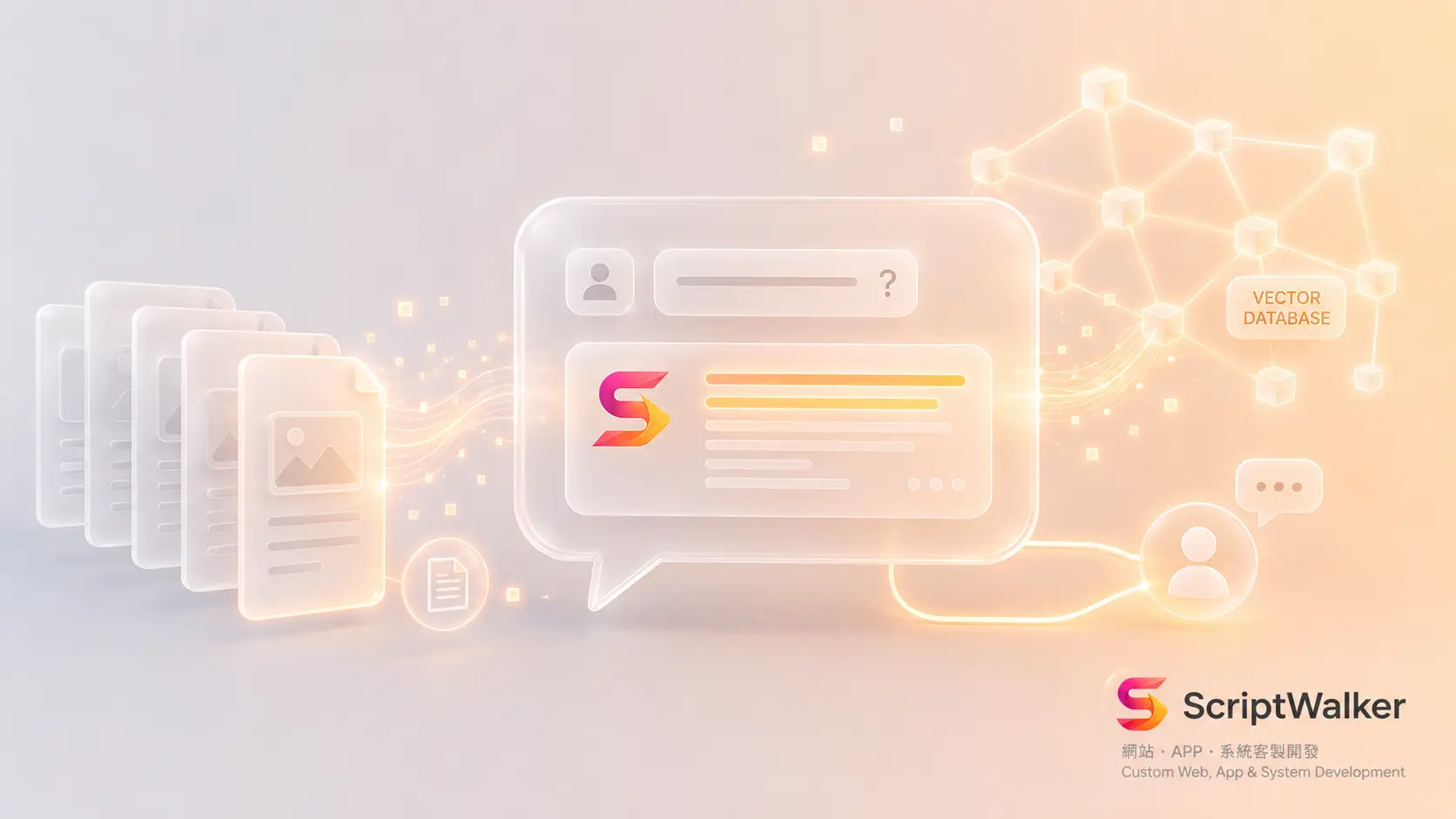
At 11 p.m., a customer asks on your site whether you are open weekends and can they return this. Nobody replies, and by morning they have bought elsewhere. A mid-size e-commerce store gets 1,000+ support emails a month, 60% of them repeats: shipping cost, delivery time, how to return. That is the pain an AI chatbot solves: auto-answer the repeats, save humans for conversations that truly need a human. But just plug in ChatGPT is the most expensive mistake; without your own data, it will confidently make things up.
When It Fits vs When It Doesn''t
Good fit for an AI chatbot:
- Large volumes of repetitive Q&A (shipping, hours, specs, returns)
- Stretched support staff; no coverage after hours or on weekends
- Complex product/service info customers struggle to find
- You already have documents, FAQs, product data to feed it
Not a fit (or hold off):
- Highly personalized questions needing complex judgment (medical diagnosis, legal advice, complaint negotiation)
- Very low message volume (fewer than 5 a day; just use a human)
- No existing documentation at all (organize your knowledge first)
- Industries where a wrong answer is catastrophic (finance, healthcare) needing strict human review
Alternatives Matrix
| Option | Pros | Cons | Cost band |
|---|---|---|---|
| Custom RAG AI support | Answers your own data, human handoff, controllable | Must build/maintain a KB | Build NT$80,000–300,000 + monthly |
| Rule-based chatbot | Cheap, controlled answers | Only preset questions, no nuance | NT$1,000–5,000/mo |
| Plug in ChatGPT / generic LLM | Fast, natural conversation | Does not know your data, hallucinates, security risk | API usage-based |
| SaaS support platform with AI (Intercom Fin, Zendesk AI) | Full features, ticket integration | High monthly fee, data on their platform | US$50–hundreds/mo |
Full Process Breakdown (with tools and deliverables)
- Week 1 | Knowledge inventory: consolidate FAQ, product data, return policy, chat logs. Tools: Notion / Google Docs. Deliverable: a structured knowledge-source list.
- Weeks 2–3 | Build the RAG KB: chunk documents, embed, store in a vector DB (pgvector, Pinecone). Deliverable: a searchable knowledge base.
- Weeks 4–5 | Conversation design: design the bot-answers-then-hand-off funnel plus brand voice. Tools: Figma. Deliverable: conversation flow + voice guide.
- Weeks 6–7 | Human handoff + admin: connect LINE OA / site widget; build one-click-to-human and a chat-log backend. Tools: Laravel + LINE Messaging API. Deliverable: a launchable support system.
- Week 8 | Test + tune: stress-test with real historical questions, fix wrong answers, fill gaps. Deliverable: an acceptance report.
Real Cost Breakdown
- Development: mid-size RAG build about NT$80,000–300,000 depending on KB size and integration complexity.
- LLM API usage: per-token; typical SMB monthly usage about US$20–200.
- Vector DB: self-hosted pgvector nearly free; SaaS like Pinecone from US$0–70/mo.
- Maintenance (hidden but essential): KB must be kept current, wrong answers fixed; budget NT$5,000–20,000/mo.
- Human agent hours: the bot will not catch everything; do not assume you can cut to zero.
Reality vs Client Imagination
- Client thinks plug in AI and it answers everything correctly. Reality: without your data it hallucinates; RAG KB quality decides everything.
- Client thinks set it and forget it. Reality: the KB needs ongoing maintenance; update it whenever a product or policy changes.
- Client thinks fully replace human support. Reality: catching 50–70% of repeats is already a great result; the rest needs humans, and the handoff experience must be good.
Common Traps vs How to Avoid
- Trap: the bot makes up answers (hallucination). Use RAG bound to your own data and design if-not-found say so and hand off; do not let it bluff.
- Trap: stale KB. Build an update-the-KB-whenever-product-or-policy-changes process with a named owner.
- Trap: no human exit. Every conversation needs a one-click human button so customers are not trapped in a bot loop.
- Trap: data leakage. Do not feed customer PII into third-party training; choose an API that lets you disable training and sign a DPA.
- Trap: robotic tone. Write a brand voice guide for the model so replies feel human.
Success Metrics + 90-Day Roadmap
- 30 days: watch auto-resolution rate (share ending without human handoff), aim for 40%+ first, and track the wrong-answer list.
- 60 days: fill knowledge gaps, push auto-resolution to 50–60%; analyze which question types get handed off.
- 90 days: add auto-update flows for new common questions; measure labor saved and CSAT.
Decision Checklist
- ☐ Do I have large volumes of repetitive support questions daily?
- ☐ Do I have existing FAQ/product data to feed the bot?
- ☐ Can I assign someone to maintain the KB?
- ☐ Do I accept the bot solving 50–70%, rest to humans?
- ☐ Do I have an after-hours/weekend no-reply pain?
- ☐ Can my industry tolerate occasional wrong answers (with human oversight)?
- ☐ Am I ready to budget monthly API + maintenance?
- ☐ Do I want chat logs kept in my own backend?
- ☐ Do I need LINE OA / site widget integration?
- ☐ Am I willing to start small (one product line)?
FAQ
Will the AI say something wrong and get me in trouble?
It can, if you plug in a generic model without binding your data. The right approach uses RAG to constrain answers to your knowledge base and designs an if-not-found hand off, minimizing hallucination risk.
How much and how long to build one?
A mid-size build runs about NT$80,000 to 300,000 over 6 to 8 weeks, then about NT$5,000 to 20,000 per month for API plus maintenance, depending on knowledge-base size and number of channels.
Can it fully replace human support?
Not advisable. In practice, offloading 50 to 70% of repeats is a strong result; complex, emotional conversations still need humans, and handoff smoothness directly shapes customer perception.
Call to Action
Want to know whether your support workload suits AI and what it costs? We offer a free support automation health check that calculates your automatable share and real cost. Contact us:
- Email: [email protected]
- Phone: 0916-224-047
- LINE: @ufv9089p